Hon. Dianne T. Renwick, Presiding Justice
Susanna Molina Rojas, Clerk of the Court
1920 - 1929
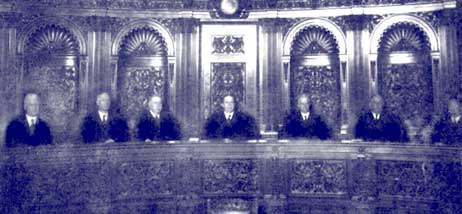
Associate Justices James O'Malley, John V. McAvoy, Edgar S. K. Merrell,
Presiding Justice Victor J. Dowling, Associate Justices Edward R. Finch,
Francis Martin, Joseph M. Proskauer.
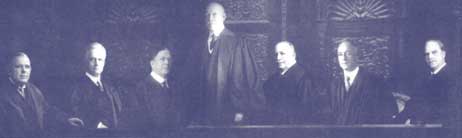
Associate Justices Francis Martin, Edward R. Finch, Victor J. Dowling,
Presiding Justice John Proctor Clarke, Associate Justices Edgar S. K. Merrell,
John V. McAvoy, William P. Burr.
The early 1920's saw the Court dealing with the aftermath of World War I.
Presiding Justice
1910-1910
Those post-war years led to dramatic changes in all aspects of American life, but presented new uncertainties for those having business with European concerns. One leading case involved a suit by a French company against a transatlantic cargo shipper who had refused to fulfill a contract during wartime because of the hazardous conditions at sea crated by those hostile Germany navy. The Appellate Division held that the shipping company had the right to discontinue activities in view of the wartime peril.
In another case concerning the validity of pre-war sale of German war bonds, the Court held that the sale was not voided, only suspended, during the war. And in a case brought by the Russian Socialist Federated Soviet Republic in 1921, the Court ruled that the plaintiff Republic had no right to sue because it was not recognized in this country as a sovereign state.
The 1920's were a vibrant period in the cultural life of New York City, and the times are reflected in the cases of the Appellate Division. By that time, in the entertainment world, vaudeville had begun its decline. Sundry cases involving everything from contract disputes to lost costume trunks passed through the Court. The Jazz Age was well under way, and “Tin Pan Alley,” as 28th street came to be called, resonated with new and exciting music just blocks from where the Appellate Division Justices heard learned argument.
Presiding Justice
1916-1926
Early in the century, the City had established itself as a center for the new film-making industry; the “Keystone Kops” and other favorites were a product of New York studios. In the 1920's, film-makers were still active in the City, and film stars such as Mary Pickford and Douglas Fairbanks saw their business disputes resolved in the Appellate Division.
The world of legitimate theater was also beginning to thrive. In 1915, the Appellate Division affirmed a decision which allowed the Schubert theaters to bar drama critic Alexander Woolcott from all their theaters. The Schuberts were angered because Woolcott, known for his biting wit, had written a series of extremely critical reviews for The New York Times.
By the 1920's, the “Blue Laws” that mandated the Sunday closing of theaters were gone, and the Appellate Division had put an end to the informal censorship powers of the City’s Commissioner of Licenses who had in the past revoked the licenses of plays he considered “offensive.” The decade saw New York nightlife at its height, despite the Prohibition laws that resulted in the appearance of hundreds of so-called “speakeasies,” illegal bars that sold bootlegged liquor. Meanwhile, the courts were left to deal with the fate of business contracts drawn up in good faith before the sale of liquor was made illegal.
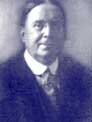
Presiding Justice
1927-1931
Nineteen twenty-nine saw the great Wall Street Crash, and the beginnings of the Depression. The following year, 1930, also brought a new seriousness to the reform movement in City life. In that year Samuel Seabury, a former judge, was appointed by the Appellate Division to lead a series of investigations into suspected corruption in the New York Magistrate’s Courts and in other aspects of municipal government. These investigations ultimately resulted in decisions by the Appellate Division, which dismissed those judges who had been involved in the corruption.
