
Court Services
Legal Help | Legal Advice | Limited-Scope Advice | Help Center | Interpreters | Mediation | Court Navigators
Finding Legal Help
Lawsuits should be taken seriously. If you have, or may have, a case in our court we strongly suggest that you consult an attorney to fully determine your legal rights and the best way of handling your legal problem. The court provides some services to help you represent yourself, but court staff cannot give you legal advice.

Finding a Lawyer and Getting Legal Advice
• Law Help
To find information on free legal services programs visit LawHelp and type in your zip code or the county you live in. Then select the type of legal problem you are dealing with. Next read about the eligibility requirements for each of the legal services organizations listed to see if you qualify and where to go for help.
• Legal Referral Services at the New York State Bar Association and the New York City Bar Association
The New York State Bar Association and the New York City Bar Association can help you find a lawyer in your area. Your initial conversation with a lawyer from these programs will be up to 30 minutes and will be either free or at a reduced rate of $35.
During your visit with the lawyer, you and the lawyer will discuss your legal problem and the lawyer will give you legal advice. You do not have to hire the lawyer. The lawyer does not have to take your case. If the lawyer agrees to take your case, the lawyer will charge you at his or her regular rates.
• City Bar Justice Center Legal Hotline
The City Bar Justice Center’s free Legal Hotline offers legal information, advice, referrals, and in some instances, brief services, to low-income New Yorkers. The Legal Hotline phone number is: 212-626-7383.
The Legal Hotline is staffed by attorneys who assist low-income callers on a range of civil legal issues, including housing law and debt collection. The staff includes bilingual attorneys who speak English and Spanish, and they can accept calls in any language through interpreting services.
• Monday Night Law Clinic
The New York City Bar Association, located at 42 W. 44th Street in Manhattan, runs a Monday Night Law Clinic. At the clinic, trained lawyers will meet with you for a free half-hour consultation. You must schedule an appointment for the Monday Night Clinic by calling 212-626-7373. Visit the Bar Association’s website for more information on Monday Night Law.
• Free Lawyers for Tenants (Universal Access to Legal Services)
Some tenants can get a free lawyer in their cases under the Universal Access to Legal Services Law. New York City is the first city in the country to provide universal access to lawyers for tenants in housing cases.
Visit Free Lawyers for Tenants to see if you qualify.
• Tenant Legal Service Organizations
The Tenant Legal Service Organizations document contains a list of all not-for-profit legal service providers actively handling housing matters in New York City. You can search for an organization that handles matters in your county. Visit the website of or call each organization to learn more about the services they provide and if you qualify.
• Lease Assistance Partnership
The New York Forward Small Business Lease Assistance Partnership (LAP) is a public-private partnership between Empire State Development, the nonprofit Start Small Think Big, and the New York State Bar Association, to help avoid business evictions. The initiative provides commercial tenants and small business landlords with free legal services and the information needed to reach a mutually agreeable lease renegotiation.
Limited-Scope Legal Advice and Representation
| Due to the COVID-19 pandemic, all in-person court-based volunteer lawyer programs are temporarily suspended. Some programs are providing services virtually. Please check back for updates. |
There are court-based programs that offer free consultations with a lawyer or free representation for the day regardless of your income.
• Volunteer Lawyer Program
The Civil Court Volunteer Lawyers Program (VLP) in partnership with the City Bar Justice Center, provides free legal information and legal advice to self-represented litigants. VLP operates through the Civil Court’s Help Centers. Volunteer lawyers help with legal issues involved in housing, consumer debt, name changes, small claims, and civil court procedure. Volunteer lawyers can review your court papers, discuss your case, help you fill out forms, help you plan what to do with your case, and tell you where to find a lawyer to represent you in your case.
Volunteer lawyers cannot represent you in court or file legal papers for you. If you seek help from VLP, you are still responsible for all court dates and filing deadlines.
Meet with a volunteer lawyer at the Help Center located in your county’s Civil or Housing Court, see Directory to find out where. No appointment is necessary. Be sure to bring all court papers and any letters, bills, or other documents related to your case.
Due to the COVID-19 pandemic, we are currently operating a virtual help center. Please contact 646-386-5556 to discuss general civil and small claims matters. Lease a message and a court attorney will call you back to answer questions, provide legal and procedural information, or refer you to a virtual volunteer program.
• Volunteer Lawyer of the Day Program (VLFD)
The Volunteer Lawyer of the Day (VLFD) Program is an unbundled legal services program, meaning the lawyer’s representation begins and ends the same day.
The Consumer Debt VLFD Program assists unrepresented consumer debtors with cases in Civil Court. The Consumer Debt VLFD Program is now operating virtually on a limited basis in some counties. The volunteer attorney examines the strengths and weaknesses of your case; provides legal advice about your defenses and options for settlement; and represents you on your court date.
You can seek assistance with connecting with VLFD from the Help Center, a clerk, or the judge.
The following is contact information for Consumer Debt VLFD programs in each county. Please note that representation can only be provided on a case-by-case basis due to limited capacity.
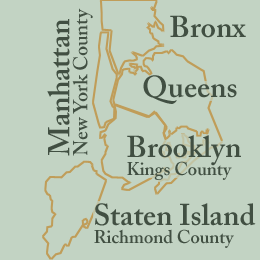
| County | Organization | Phone Number |
| Bronx | New York Legal Assistance Hotline | 929-356-9582 |
| Brooklyn (Kings) | Brooklyn Bar Association Volunteer Lawyers Program | 718-624-3894 |
| Manhattan (New York) | New York County Lawyers Association | 212-267-6646 |
| Queens | New York Legal Assistance Hotline | 929-356-9582 |
| Staten Island (Richmond) | New York Legal Assistance Hotline | 929-356-9582 |
Help Center
| Due to the COVID-19 pandemic, the New York City Civil Court Help Centers are providing virtual help. To find the telephone number that is right for you, please visit the virtual help center page. |
Overview
New York City Civil Court Help Centers are in every Civil and Housing Court building. The Help Centers provide free services to people without an attorney who are starting or answering a case.
Each Help Center has court attorneys and volunteer attorneys trained to give legal and procedural information on Housing, General Civil, and Small Claims procedures. There are also free pamphlets on legal topics; free internet for legal help; and information about legal, rental, and social services help. The Help Centers also have computer stations that can be used to access the Do It Yourself (DIY) programs to create forms needed for court.
The Help Centers do not schedule appointments and all visitors are helped on a “walk-in” basis, you may need to wait for assistance. Please bring any relevant documents including court papers, notices, written agreements you have signed, or court orders you have received.
Help Center Attorneys
Help Center Attorneys work for the Civil Court and provide information about the law and court procedures to people without an attorney. They are available to help all parties to a case and cannot give legal advice or tell you the best way to handle your case.
What Can Help Center Attorneys Do?
Help Center Attorneys can provide information on:
• Landlord-tenant, general civil, or small claims cases
• How to start cases
• How to answer cases
• Filling out housing and civil court forms
• Court procedure
• How to get or make repairs
• Referrals to appropriate agencies
Help Center Volunteer Attorneys
| Due to the COVID-19 pandemic, in person volunteer attorney programs are temporarily suspended. Please check back for updates on these programs. |
Volunteer attorneys provide free information about the law and court procedures to people without an attorney. Volunteer attorneys are unable to represent you in court or file your papers.
Please check with the Help Center to find out if there are volunteer attorneys scheduled on the date you plan to visit the Help Center. If you have a pending case and need help, you should still consider contacting the Help Center to discuss your concerns with one of our experienced and knowledgeable Help Center court attorneys.
Internet Access
Help Centers provide free access to the internet for litigants to research community resources, and legal topics while at the courthouse. You can also use the computer to fill out court forms, including DIY (Do-It-Yourself) forms, and access court resources including videos, publications, and community seminars. You can use the computer for up to 30 minutes to visit a number of websites. However, you cannot read or send email.
Help Center Hours, Locations, and Phone Numbers
For information on Help Center hours and locations please visit our Civil Court Directory or the Court Help Directory.
Visit the Virtual Help Center page for up-to-date contact information
Interpreters
The Civil Court provides free interpreters in more than 100 languages and in American Sign Language for all general civil, housing, and small claims cases. We are committed to providing equal access to our court for people who do not feel comfortable communicating in English. If you or someone you know has a case in Civil Court and want an interpreter, tell a clerk, court attorney, or judge.
For more information visit the Language Access and Court Interpreters page.
Mediation
What is Mediation?
Mediation is a free, voluntary, and confidential process that allows parties to create their own solutions to the problems that brought them to the court. Instead of asking a judge to decide the case, the parties meet with a professionally trained mediator who listens to each side, learns about the parties’ interests and needs, and explores mutually acceptable solutions. Parties do not need to have lawyers or witnesses present for mediation, but lawyers are welcome to participate and to assist in mediation. Parties should bring all relevant documents with them to mediation that might be helpful in resolving the dispute.
If the parties reach an agreement, the written and signed result, often called a stipulation, is reviewed by a judge. After the judge approves the stipulation, it becomes a binding contract that the court can enforce. If the parties are not able to reach an agreement, they can still ask a judge to hear their case and make a decision in court.
What are the Benefits of Mediation?
• Mediation is free. There are no filing or session fees.
• Mediation is confidential. Mediators do not share information about the case with the judge or anyone else.
• Mediation is fast. Sessions are scheduled early in the case. A settlement can often be reached in a 1- or 2-hour session.
• Mediation is voluntary. Any settlement reached must be agreeable to all parties. If a settlement cannot be reached with mediation, the parties can pursue their case in court.
• Mediation works. Parties create their own solutions and determine their own futures. Parties who settle through mediation are more likely to comply or follow through with the settlement.
Who are Mediators?
Mediators are neutral, experienced volunteers who have undergone specialized training in civil court dispute resolution. Many mediators are lawyers or law students, but they do not give legal advice.
What Types of Cases Can Be Mediated?
Mediation is available to parties in many cases in the Civil Court of the City of New York. This includes small claims, civil claims, and landlord-tenant disputes. Both sides must agree to mediation.
Mediation is available in all Small Claims cases. In the Housing Part, if both the landlord and the tenant come to court without a lawyer, their case may be sent to mediation. More mediation programs will be introduced in the Civil Court.
You may read more about mediation in the publication "Resolving Your Case Through Mediation"
Court Navigators
Court Navigators are specially trained and supervised non-lawyers who help court users have a productive court experience by offering non-legal support.
Who Can Use Court Navigators?
People who do not have a lawyer during their appearance in housing and consumer debt cases.
What do Court Navigators do?
Court Navigators:
• Provide one-on-one assistance and moral support while you are in court.
• Help you access and complete forms, including helping you use courthouse computers to fill out Do-It-Yourself (DIY) forms.
• Help you find a lawyer on LawHelp.
• Help you collect and organize documents you will need for your case.
• Assist in accessing interpreters and other services.
• Explain what to expect and the roles of people in the courtroom.
• Sometimes are permitted to accompany you into the courtroom and respond to factual questions from the judge.
Court Navigators are not able to give legal advice or get involved in negotiations or settlement conferences.
You may also read the Administrative Order of the Chief Administrative Judge establishing the Court Navigator program.