
|
|
|
|
OFFICIAL EDITION
NEW YORK
LAW REPORTS
  STYLE MANUAL

For more than 50 years, the New York Law Reports Style Manual has been issued by the Law Reporting Bureau with the approval of the Court of Appeals as a guide for New York judges and their staffs in the preparation of opinions for publication in the Official Reports. It also prescribes the style applied by the Law Reporting Bureau in editing the opinions for publication in the Reports. Although not binding on them, many lawyers find the Manual useful in preparing papers for submission to New York courts. The Style Manual provides a guide for opinion writers and editors in five primary areas: citation, abbreviation, capitalization, quotation, and word style and usage. Additionally, it specifies for editors the format and typographical standards for the Reports. General References This Manual supplements general citation and style authorities, providing more detail on New York materials and a more specific focus on judicial opinions. General authorities should be consulted on matters not covered by this Manual. These authorities include: The Bluebook: A Uniform System of Citation (19th ed 2010) Association of Legal Writing Directors & Darby Dickerson, ALWD Citation Manual (4th ed 2010) Bryan A. Garner, The Redbook: A Manual on Legal Style (2d ed 2006) The Chicago Manual of Style (16th ed 2010) Webster's Third New International Dictionary (2002) Black's Law Dictionary (9th ed 2009) Gerald Lebovits, Advanced Judicial Opinion Writing (7.4 ed 2004) Richard C. Wydick, Plain English for Lawyers (5th ed 2005) Important Changes The 2012 Edition leaves largely intact the content of the 2007 Edition and 2009 Supplement. Users' input inspired several rule clarifications and additions. Sample citations have been updated and expanded and residual style inconsistencies have been resolved. Other revisions reflect a continuing commitment to conform to modern style practices and reduce unnecessary variations from standard sources. The most noteworthy of the changes found in this Manual are: 1. Citation Style:
2. Abbreviation:
3. Quotations: The Style Manual's section on omitting or altering language in quoted material has been reordered for clarity and revised to allow for more precise use of ellipses, to clarify the style where language is both altered and omitted and to provide guidance where emphasis is omitted.
4. Word Style and Usage:
Other Notes: The rules on capitalization are essentially unchanged and reflect the modern practice to avoid excessive capitalization. The rules on formulation of case summaries (appeal statements) have been updated and examples have been added (Appendix 8). Guidance is now included for formatting data tables incorporated in decisions (13.3) and using supra and infra to cross-reference footnotes and sections of an opinion (12.6). The use of small capitals in the text of opinions and footnotes has been eliminated (13.5). The model citational footnote opinion has been updated (Appendix 7). Exceptions and Changes Deviations from the rules stated in this Manual are permitted where application of a rule would adversely affect the clarity or readability of an opinion. The Law Reporting Bureau welcomes suggestions for improvement of the Style Manual. Send them to: reporter@courts.state.ny.us. Internet Version of this Manual Changes to this Manual will be posted to the Bureau's Internet site at http://www.nycourts.gov/reporter/styman_menu.htm. Use of the Internet version is strongly recommended not only for updates, but also to gain the advantages of word searching, hypertext linking and coordinating use of the Manual with the Official Case Name and Citation Locator.
1.0 CITATION STYLE IN GENERAL
1.1 ELEMENTS OF A CITATION
1.1 (a) Case Citation Elements
1.1 (b) Statutory Citation Elements
1.2 PLACEMENT OF CITATIONS
1.2 (a) Where to Place
1.2 (c) Citations within Parentheses
(1) How to Reference
(2) Punctuation
1.2 (d) Citations in Footnotes
1.2 (e) Citational Footnote Style
1.2 (f) Footnote Numbers in Relation to Punctuation
1.3 REFERENCE TO PREVIOUSLY CITED AUTHORITY
1.3 (a) Options for Referencing Previously Cited Authority
1.3 (b) Short-Form References
(1) Shortened Case Names and Popular Names
(2) Shortened Citations
1.3 (c) Subsequent Reference to Immediately Preceding Authority
1.3 (d) Subsequent Reference to Parallel Citations
1.4 INTRODUCTORY SIGNALS
1.4 (a) Citations Introduced by Signals
1.4 (b) Signal Word Serving as a Verb
1.5 ELECTRONIC SOURCES IN GENERAL
1.5 (a) Electronic Services
1.5 (b) Internet Material
1.5 (c) CD-ROM Material
1.5 (d) New York Slip Opinions
1.5 (e) Unreported and Unofficially Reported New York Opinions Published Online
1.5 (f) Unreported New York Appellate Motion Decisions Published Online
1.5 (g) E-Books
2.0 CASES
2.1 CASE NAMES
2.1 (a) New York Cases
(1) Cases Officially Reported
(2) Cases Not Officially Reported
2.1 (b) Supreme Court of the United States Cases
2.1 (c) Other Cases
2.2 NEW YORK COURT DECISIONS
2.2 (a) Decisions Officially Reported
2.2 (b) Unofficially Reported or Unreported Decisions
2.3 FEDERAL AND OUT-OF-STATE DECISIONS
2.3 (a) Supreme Court of the United States
2.3 (b) Other Federal Courts
2.3 (c) Out-of-State and Unofficial Case Citations
2.4 OTHER SOURCES OF DECISIONS
2.4 (a) Electronic Case Citations
(1) Online Services
(2) Citing Tabular Cases
(3) Internet Material
2.4 (b) Commission, Agency and Ethics Opinions
(1) Commission and Agency Documents and Materials
(2) Ethics Opinions
3.0 STATUTES AND LEGISLATIVE MATERIALS
3.1 NEW YORK STATUTES AND LEGISLATIVE MATERIALS
3.1 (a) Statutory Abbreviation Style in General
3.1 (b) Statutory Citation Style
(1) Basic Citation Form
(2) Citation Strings and Multiple Statutory Citations
(3) Statutory Amendments, Additions and Renumbering
(4) Former Statutes
3.1 (c) Statutory Compilations
3.1 (d) Session Laws and Unconsolidated Laws
3.1 (e) Model Codes, Proposed Codes and Uniform Laws
3.1 (f) Legislative and Other Materials
3.2 FEDERAL STATUTES AND LEGISLATIVE MATERIALS
3.2 (a) Federal Statutory Abbreviations
3.2 (b) Federal Statutory Citation Style
3.2 (c) Federal Legislative Materials
3.3 OUT-OF-STATE STATUTES
4.0 REGULATIONS, COURT RULES, JURY INSTRUCTIONS AND COLLOQUIES
4.1 NEW YORK RULES, REGULATIONS, INSTRUCTIONS AND COLLOQUIES
4.1 (a) Basic Citation Form
4.1 (b) Particular Rules and Regulations
(1) Rules of the City of New York
(2) Rules of the Court of Appeals
(3) Rules of the Appellate Division
(4) Uniform Rules for the New York State Trial Courts
(5) Rules of the Chief Administrator of the Courts
(6) Rules of Professional Conduct, Code of Professional Responsibility, Rules Governing Judicial Conduct and Code of Judicial Conduct
(7) Rent Statutes and Regulations
(8) New York State Building Code
(9) New York City Building Code
(10) New York State Agency Regulations
4.1 (c) Pattern Jury and Criminal Jury Instructions
(1) Pattern Jury Instructions
(2) Criminal Jury Instructions
4.1 (d) Model Colloquies
4.2 FEDERAL RULES AND REGULATIONS
4.2 (a) Basic Citation Form
4.2 (b) Particular Rules and Regulations
(1) Federal Rules of Civil Procedure
(2) Federal Rules of Criminal Procedure
(3) Federal Rules of Evidence
(4) Federal Rules of Bankruptcy Procedure
(5) Federal Rules of Appellate Procedure
5.0 CONSTITUTIONS
5.1 GENERAL RULE
5.2 EXAMPLES
5.3 HISTORICAL CONSTITUTIONAL MATERIAL
6.0 TREATIES AND INTERNATIONAL AGREEMENTS
6.1 GENERAL RULE
6.2 EXAMPLES
7.0 LEGAL PERIODICALS, TREATISES AND OTHER WORKS AND DOCUMENTS
7.1 GENERAL RULES
7.1 (a) Page References
7.1 (b) Names of Authors
7.1 (c) Titles
7.1 (d) Internet Material
7.2 PERIODICALS, NEWSPAPERS AND BOOKS
7.2 (a) General Style
7.2 (b) Student-Authored Works
7.3 TREATISES
7.3 (a) General Style
7.3 (b) Omitted Title Material
7.3 (c) CD-ROM Material
7.4 DICTIONARIES AND ENCYCLOPEDIAS
7.5 AMERICAN LAW REPORTS (ALR) ANNOTATIONS
7.5 (a) General Style
7.5 (b) Author's Name
7.6 RESTATEMENTS
7.7 LEGAL DOCUMENTS
7.8 MANUALS, HANDBOOKS, GUIDELINES AND REPORTS
7.9 E-BOOKS
8.0 TITLES OF ACTIONS AND PROCEEDINGS
8.1 GENERAL RULES OF TITLE FORMULATION
8.1 (a) Parties at Trial Level
8.1 (b) Parties at Appellate Level
8.1 (c) Parties with Same Status
8.1 (d) Full Names and Initials
8.1 (e) Representative or Official Capacity
8.1 (f) Terms Omitted
8.1 (g) Parties in Transferred Proceedings, etc.
8.1 (h) Nonappealing Parties
8.2 COMMON TITLE STYLES
8.2 (a) Action with Party Suing in a Representative Capacity
8.2 (b) Proceedings against an Unnamed Public Official
8.2 (c) Criminal Action against Multiple Defendants
8.2 (d) Appellate Action with Some Parties Not Participating in Appeal
8.2 (e) Appellate Proceedings with Cross-Appealing Parties
8.3 TITLES IN VARIOUS ACTIONS AND PROCEEDINGS
8.4 PERSONAL IDENTIFYING INFORMATION
9.0 APPEARANCES OF COUNSEL
9.1 GENERAL STYLE
9.2 AMICUS CURIAE
9.3 APPEARANCES ON OWN BEHALF
9.3 (a) Non-Attorney Appearing on Own Behalf
9.3 (b) Non-Attorney Appearing on Own Behalf and by Attorney
9.3 (c) Attorney Appearing on Own Behalf
9.3 (d) Attorney Appearing on Own Behalf and for Client
9.3 (e) Attorney Appearing on Own Behalf and by Attorney
9.3 (f) Attorney Appearing on Own Behalf and by Attorney, and for Client
9.3 (g) Law Firm Appearing on Own Behalf
9.4 APPEARING SPECIALLY
9.5 NAME AND TITLE OF PUBLIC OFFICIALS
9.6 ATTORNEY GENERAL APPEARING IN CASES INVOLVING
CONSTITUTIONALITY OF STATUTE
9.7 OUT-OF-STATE ATTORNEY
10.0 CAPITALIZATION, NUMERALS AND NUMBERS, DATES AND TIME, AND NAMES
10.1 CAPITALIZATION
10.1 (a) Generally
10.1 (b) Government Bodies and Officials
10.1 (c) States and Political Subdivisions
10.1 (d) Branches of Government
10.1 (e) Government
10.1 (f) "Federal"
10.1 (g) "Capital" and "Capitol"
10.1 (h) Courts
10.1 (i) Judicial Officers
10.1 (j) Acts, Bills, Codes, Constitutions, etc.
10.1 (k) Crimes
10.1 (l) Parties
10.1 (m) Legal Documents
10.1 (n) Regional Names
10.1 (o) Animal Breeds
10.1 (p) Numbered Items
10.2 NUMERALS, NUMBERS AND SYMBOLS
10.2 (a) Numerals and Numbers
(1) Spelling Out
(2) Dollar Amounts
(3) Fractions
(4) Roman Numerals
(5) Criminal Sentences
(6) Firearms
(7) Sex Offender Risk Levels, Prisoner Disciplinary Hearings, Attorney Disciplinary Charges and State Retirement Tiers
(8) Ages
(9) Numbered Lists
10.2 (b) Symbols
(1) General Rule
(2) Distances and Measurements
(3) Percentage
10.3 DATES AND TIME
10.3 (a) Month, Day and Year
10.3 (b) Month and Year
10.3 (c) Day and Year
10.3 (d) Year Only
10.3 (e) Decades
10.3 (f) Centuries
10.3 (g) Abbreviation of Months
10.3 (h) Time
10.3 (i) Seasons
10.4 NAMES
10.4 (a) Names of Judges
10.4 (b) Personal Names
10.4 (c) Corporate Names
11.0 QUOTATIONS AND QUOTATION MARKS
11.1 QUOTATIONS
11.1 (a) General Rule
11.1 (b) Punctuation of Quotations
11.1 (c) Ellipsis; Omitted Material
11.1 (d) Brackets
11.1 (e) Using "[sic]"
11.1 (f) Material Emphasized
11.1 (g) Statutory and Regulatory Material
11.2 QUOTATION MARKS
11.2 (a) Single-Paragraph Quotations
11.2 (b) Multiple-Paragraph Quotations
11.2 (c) Multiple Quotation Marks
11.2 (d) Using Quotation Marks for Short-Form References
12.0 WORD STYLE IN GENERAL
12.1 GENDER NEUTRAL WRITING
12.1 (a) Using Inclusive Terms
12.1 (b) Using "He" or "She" as Generic Pronoun
12.1 (c) Additional Background
12.2 HYPHENATED WORDS AND PHRASES
12.2 (a) Compound Words
12.2 (b) Hyphenated Adjectival Phrase
12.2 (c) Hyphenated Prefix
12.3 AVOIDANCE OF LATINISMS AND LEGALISMS
12.3 (a) Using English Language Words and Phrases
12.3 (b) Exceptions to General Rule
12.3 (c) Typography
12.4 PERSONAL IDENTIFYING INFORMATION
12.4 (a) Personal Names
12.4 (b) Numerical Identifiers
12.4 (c) Other Identifying Information
12.5 DESCRIBING PERSONS WITH DISABILITIES
12.6 USING SUPRA AND INFRA
13.0 TYPOGRAPHY
13.1 TITLES OF DECISIONS
13.2 PARAGRAPH AND SECTION HEADINGS
13.3 TABLES
13.4 JUDGE NAME IN OPINION OPENING AND VOTE LINE
13.5 SMALL CAPITALS
13.6 ADDED EMPHASIS
13.7 FOREIGN WORDS AND PHRASES
13.8 NAMES OF NEWSPAPERS, MAGAZINES, BOOKS, ETC.
14.0 SPACING
14.1 ABBREVIATION SPACING
14.2 STATUTORY SPACING
APPENDIX 1 — COMMON CASE NAME ABBREVIATIONS
1.0 CITATION STYLE IN GENERAL
1.1 ELEMENTS OF A CITATION
1.1 (a) Case Citation Elements
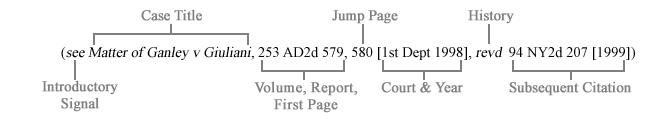 Include the court, omitting any information made redundant by the citation itself, pertinent jurisdictional information and year of decision for all full case references, including references to appellate history.
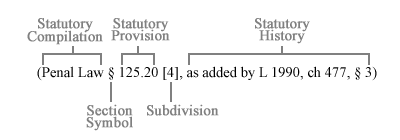
1.1 (b) Statutory Citation Elements
 1.2 PLACEMENT OF CITATIONS
1.2 (a) Where to Place
Citations in the traditional format of the Official Reports are embedded in the text of the opinion using citations in running text (§ 1.2 [b]) or within parentheses (§ 1.2 [c]). In this format, citations in footnotes, if any, are styled as provided in section 1.2 (d).
As an alternative to the traditional format, citations may be placed exclusively in footnotes using the citational footnote style (§ 1.2 [e]).
Unless otherwise indicated, the examples in this Manual are shown as citations within parentheses.
1.2 (b) Citations in Running Text
The term "citation in running text" indicates an authority referred to in the text of a sentence, as in the examples below:
The situation in Rogers v Rogers (63 NY2d 582 [1984], revg 98 AD2d 999 [2d Dept 1983]) mirrors the situation in this decision.
The clear and convincing evidence standard discussed in Solomon v State of New York (146 AD2d 439, 440 [1st Dept 1989], quoting Addington v Texas, 441 US 418, 427 [1979]) was not met here.
Plaintiff did not sustain a serious injury within the meaning of Insurance Law § 5102 (d).
1.2 (c) Citations within Parentheses
The term "citation within parentheses" refers to any citation that appears entirely within parentheses.
(1) How to Reference
Citations within parentheses may be referenced as in the examples below:
The clear and convincing evidence standard was not met here (see Solomon v State of New York, 146 AD2d 439, 440 [1st Dept 1989], quoting Addington v Texas, 441 US 418, 427 [1979]).
The facts in this decision are not unusual (see George C. Miller Brick Co., Inc. v Stark Ceramics, Inc., 9 Misc 3d 151 [Sup Ct, Monroe County 2005, Fisher, J.]).
Plaintiff did not sustain a serious injury (Insurance Law § 5102 [d]).
(2) Punctuation
Place the final period in a sentence ending with a parenthetical as follows:
Such is the law (People v Moran, 2 AD3d 216 [1st Dept 2003]).
or
Such is the law. (People v Moran, 2 AD3d 216 [1st Dept 2003].)
not
Such is the law (People v Moran, 2 AD3d 216 [1st Dept 2003].)
Place the parenthetical within the sentence (as in first example above) if it relates to the sentence alone. Place it outside the sentence (as in second example above) if it relates to more than one preceding sentence.
1.2 (d) Citations in Footnotes
In a footnote containing text, citations in running text or within parentheses may be used. Some examples are:
* The holding in Solomon v State of New York (146 AD2d 439, 440 [1st Dept 1989]) remains good law. [Note: running text]
* The issue was last visited in 1989. (Solomon v State of New York, 146 AD2d 439, 440 [1st Dept 1989].) [Note: parenthetical]
In a footnote containing only a citation, use the parenthetical citation style, but omit the opening and closing parentheses and change the internal brackets to parentheses. Some examples are:
* Solomon v State of New York, 146 AD2d 439, 440 (1st Dept 1989).
* See e.g. Penal Law § 125.25 (1) (a).
1.2 (e) Citational Footnote Style
The citational footnote style is an alternative to the traditional placement of citations, using footnotes only for the citational content that would otherwise appear in the body of an opinion if either the running text citation style (§ 1.2 [b]) or the citations within parentheses style (§ 1.2 [c]) were used. If used, the citational footnote style should be used for all citations in the opinion. See Appendix 7 for a model opinion formatted in the citational footnote style. Apply the following rules based upon the location where citational content would be placed in the traditional format.
(1) Running Text Style
Place the case name in running text and the volume—report—page or other bibliographic information in the footnote and eliminate the parentheses enclosing the citation. The footnote number should be placed at the point in the text where the citation would appear if the citation were placed in the text.
Example:
The situation in Rogers v Rogers1 mirrors the situation in this decision.
1. 63 NY2d 582 (1984), revg 98 AD2d 999 (2d Dept 1983).
(2) Citations within Parentheses Style
Place the footnote number at the point where the parenthetical citation would appear if the parenthetical citation were placed in the body of the opinion. Place the citation in the footnote and eliminate the parentheses enclosing the citation.
Example:
The facts in this decision are not unusual.1
1. See George C. Miller Brick Co., Inc. v Stark Ceramics, Inc., 9 Misc 3d 151 (Sup Ct, Monroe County 2005, Fisher, J.).
(3) Textual Footnotes
When using the citational footnote style, citations that appear within textual footnotes should not be placed within parentheses.
Example:
2. The effect of the deregulation on the structure and organization of the natural gas industry is detailed in General Motors Corp. v Tracy, 519 US 278, 283-297 (1997).
1.2 (f) Footnote Numbers in Relation to Punctuation
Footnote numbers appearing in decisions follow punctuation marks.
Example:
County Court denied defendant's motion;16 the Appellate Division reversed, vacated the judgment, restored the indictment to the preplea stage and reinstated the prosecution's notice of intent to seek the death penalty.17
1.3 REFERENCE TO PREVIOUSLY CITED AUTHORITY
1.3 (a) Options for Referencing Previously Cited Authority
To reference previously cited authority use a short-form reference or "id." where appropriate. A full citation may be repeated if a short form or id. is unsuitable. The subsequent citation should omit any reference to optional information (§ 2.2 [a] [7]) and history. A short-form reference should provide sufficient information to avoid confusion with distinct previous citations.
1.3 (b) Short-Form References
(1) Shortened Case Names and Popular Names
Subsequent references to a case in running text or within parentheses may use a shortened case name. The shortened form of the case name is usually the name of the first nongovernmental party (for example, "Krom" for "People v Krom" and "Albouyeh" for "Albouyeh v County of Suffolk"). Popular names for cases (for example, "the Central Park Jogger case") may be used when desired.
(2) Shortened Citations
Subsequent references to cases and statutes may be shortened as follows:
(Matter of Murphy, 6 NY3d at 43)
(Murphy, 6 NY3d 36) [Note: shortened case name with citation to initial page of decision]
(Murphy, 6 NY3d at 43)
(Murphy at 43)
(6 NY3d at 43)
(§ 205.05)
Subsequent references to periodicals, treatises and similar works may be shortened by omitting the author's name or the title, in whole or in part, as follows:
(Harper Lee, To Kill a Mockingbird 49-50 [1982]) [Initial]
(Harper Lee [or Lee] at 53) [Subsequent]
(David H. Kaye et al., The New Wigmore: Expert Evidence § 4.5 at 148 [2004]) [Initial]
(Expert Evidence § 4.7) [Subsequent]
1.3 (c) Subsequent Reference to Immediately Preceding Authority
When a subsequent reference is made to an immediately preceding authority, "id." may be used:
(id.) [Note: identical reference to an immediately preceding authority]
(id. at 495) [Note: reference to an immediately preceding authority at a different page]
(id. § 468-a) [Note: reference to an immediately preceding authority at a different section]
Capitalize "Id." when it is the first term in a separate citational sentence (§ 1.2 [c] [2]).
1.3 (d) Subsequent Reference to Parallel Citations
Where parallel citations are provided in the first reference, subsequent references that include a pinpoint page should supply the pinpoint page for each parallel citation. Thus, (Newbold v Arvidson, 105 Idaho 663, 672 P2d 231 [1983]) becomes (Newbold, 105 Idaho at 667, 672 P2d at 235).
1.4 INTRODUCTORY SIGNALS
1.4 (a) Citations Introduced by Signals
Citations may be introduced by signals that indicate the purpose for which the citations are made and their degree of support or contradiction concerning a proposition. Do not place a comma between the signal and citation. Consult standard citation authorities for information regarding the use of signals, their order when using two or more and the order of authorities after each signal.
The following examples illustrate the use of introductory signals:
(e.g. Dalton v Pataki, 5 NY3d 243 [2005])
(see Dalton v Pataki, 5 NY3d 243 [2005])
(but see Dalton v Pataki, 5 NY3d 243 [2005])
(cf. Matter of Oglesby v McKinney, 28 AD3d 153 [4th Dept 2006])
(but cf. Matter of Oglesby v McKinney, 28 AD3d 153 [4th Dept 2006])
(accord Matter of Oglesby v McKinney, 28 AD3d 153 [4th Dept 2006])
(see also Penal Law § 20.00)
(compare Penal Law § 210.40 with CPL 320.10)
(see e.g. CPL 40.50)
(but see e.g. People v McConnell, 11 Misc 3d 57 [App Term, 2d Dept, 9th & 10th Jud Dists 2006])
(see generally People v McConnell, 11 Misc 3d 57 [App Term, 2d Dept, 9th & 10th Jud Dists 2006])
(compare Klein v Eubank, 87 NY2d 459 [1996], with Shapiro v McNeill, 92 NY2d 91 [1998])
(compare Klein v Eubank, 87 NY2d 459 [1996], and D'Amico v Crosson, 93 NY2d 29 [1999], with Shapiro v McNeill, 92 NY2d 91 [1998])
(contra Koehler v Koehler, 182 Misc 2d 436 [Sup Ct, Suffolk County 1999])
1.4 (b) Signal Word Serving as a Verb
Do not italicize a signal word that serves as a verb of a sentence:
For a discussion of Executive Law § 63 (2), see Matter of Johnson v Pataki (91 NY2d 214 [1997]).
1.5 ELECTRONIC SOURCES IN GENERAL
Cite an electronic source if it is the sole source of material referenced or if the print version is not readily available. A citation to an electronic source requires information identifying the particular material referenced, and is likely also to require information about the location where the source of that material may be accessed (e.g. a website or an online service). Where the location or content of an electronic source is subject to change, a "last updated" or "last accessed" date should be included. If the format of an electronic source prevents precise citation to particular material referenced, add the necessary navigation instructions to the citation. Pinpoint citation is not possible if the electronic source is in a format (e.g. HTML) that does not contain fixed reference points, but may be included if the source is in a format (e.g. PDF) that contains fixed pagination, paragraph numbering or location numbers. Electronic government sources designated "official" or authenticated by some method involving encryption should be cited when available. The rules for citing specific types of electronic sources appear in the sections listed below.
1.5 (a) Electronic Services
Electronic services (e.g. Westlaw, Lexis) are cited as indicated in section 2.4 (a) (1) and (2).
1.5 (b) Internet Material
Internet material is cited as indicated in section 2.4 (a) (3) and section 7.1 (d).
1.5 (c) CD-ROM Material
CD-ROM material is cited as indicated in section 7.3 (c).
1.5 (d) New York Slip Opinions
Slip opinions scheduled for publication in the print Official Reports are cited as indicated in section 2.2 (a) (8).
1.5 (e) Unreported and Unofficially Reported New York Opinions Published Online
Trial court and Appellate Term opinions published online only with or without abstracts published in the print Official Reports are cited as indicated in section 2.2 (b) (2). Opinions published in the online version of the New York Law Journal are cited as indicated in section 2.2 (b) (3).
1.5 (f) Unreported New York Appellate Motion Decisions Published Online
Appellate motion decisions published online but not in the print Official Reports are cited as indicated in section 2.2 (b) (2).
1.5 (g) E-Books
E-books are cited as indicated in section 7.9.
2.0 CASES
2.1 CASE NAMES
2.1 (a) New York Cases
(1) Cases Officially Reported
First, Second and Third Series Cases
Case names for New York decisions reported in the first, second and third series of the New York Official Reports can be found in the Official Case Name and Citation Locator at http://www.nycourts.gov/reporter/Citator_Menu.htm. The case name for a decision is also provided in the "Cite Title As" field in the online Official Reports. Case names found in the Table of Cases in the printed Official Reports should not be used when they differ from the electronic version. To cite a companion case whose title is different than the official case name, formulate a case name as described in section 2.1 (a) (2).
(2) Cases Not Officially Reported
If a case has not been officially reported, formulate a case name using the citation naming conventions found in standard citation manuals and apply the abbreviations listed in Appendix 1. Also see examples of case names in Appendix 6.
2.1 (b) Supreme Court of the United States Cases
Case names for the Supreme Court of the United States cases are found on the Supreme Court website at http://www.supremecourt.gov/opinions/casefinder.aspx. Retain the abbreviations provided. If the case does not appear in the Supreme Court's listing, formulate a case name using the citation naming conventions found in standard citation manuals and apply the abbreviations listed in Appendix 1.
2.1 (c) Other Cases
For any other case, use the case name found in standard citation services or formulate a name by applying citation naming conventions found in standard citation manuals. In either event, use the abbreviations listed in Appendix 1.
2.2 NEW YORK COURT DECISIONS
2.2 (a) Decisions Officially Reported
(1) Basic Citation Style
Cite to the Official Reports as follows:
(O'Connell v Corcoran, 1 NY3d 179 [2003])
(Matter of Cornell Univ. v Beer, 16 AD3d 890 [3d Dept 2005])
(Matter of Gernold, 9 Misc 3d 427 [Sur Ct, Erie County 2005])
(2) Pinpoint Page Citation
To refer to a pinpoint page in a decision:
(People v Ramos, 90 NY2d 490, 495 [1997])
(Matter of Cornell Univ. v Beer, 16 AD3d 890, 894 [3d Dept 2005])
Where the pinpoint page is the same as the initial page or where the decision comprises one page, repeat the initial page for a pinpoint citation as follows:
(Matter of Allen v Black, 275 AD2d 207, 207 [1st Dept 2000])
(3) Case Citation Containing Footnotes
Cases Containing Single Footnote
Citation to the sole footnote in a decision is designated by a lowercase "n" as follows:
(People v Wilson, 93 NY2d 222, 226 n [1999])
Cases Containing More Than One Footnote
Where a case contains more than one footnote, the citation should indicate the number of the footnote being cited as follows:
(Desiderio v Ochs, 100 NY2d 159, 168 n 3 [2003])
Case Citation Containing Multiple Footnotes
Cite multiple footnotes appearing on the same page as follows:
(Matter of Black Radio Network v Public Serv. Commn. of State of N.Y., 253 AD2d 22, 25 nn 2, 3 [3d Dept 1999])
Citation Referencing Pinpoint Page and Footnote
Cite to both a pinpoint page and a footnote on the same page as follows:
(City of New York v 330 Cont. LLC, 60 AD3d 226, 229-230, 230 n 3 [1st Dept 2009])
(People v Kozlowski, 11 NY3d 223, 242 and n 10 [2008])
(4) Citation Referencing Multiple Page Quotation
In citing a single quotation that runs over two or more pages, give the pages at which it begins and ends, separated by a hyphen, rather than a comma:
(Matter of Sayeh R., 91 NY2d 306, 316-317 [1997])
(5) Citation Including Appellate History
Show appellate history as follows:
(Flores v Lower E. Side Serv. Ctr., 3 AD3d 459 [1st Dept 2004], revd 4 NY3d 363 [2005])
(D'Angelo v Cole, 108 AD2d 541 [4th Dept 1985], mod 67 NY2d 65 [1986])
(National City Bank v Gelfert, 257 App Div 465 [2d Dept 1939], revd 284 NY 13 [1940], revd 313 US 221 [1941])
(Garden Homes Woodlands Co. v Town of Dover, 95 NY2d 516 [2000], revg 266 AD2d 187 [2d Dept 1999])
(Matter of Rosenblum v New York State Workers' Compensation Bd., 309 AD2d 120 [1st Dept 2003], affg 190 Misc 2d 588 [Sup Ct, NY County 2002])
(Gross v Sandow, 5 AD3d 901 [3d Dept 2004], lv dismissed and denied 3 NY3d 735 [2004])
(People v Ferber, 96 Misc 2d 669 [Sup Ct, NY County 1978], affd 74 AD2d 558 [1st Dept 1980], revd 52 NY2d 674 [1981], revd 458 US 747 [1982])
(Kaufman v Eli Lilly & Co., 65 NY2d 449 [1985], modfg 99 AD2d 695 [1st Dept 1984], which affd 116 Misc 2d 351 [Sup Ct, NY County 1982])
(Ferres v City of New Rochelle, 112 AD2d 918 [2d Dept 1985], lv granted 67 NY2d 603 [1986])
(Marco v Sachs, 10 NY2d 542 [1962], rearg denied 11 NY2d 766 [1962])
(People v Rowe, 152 AD2d 907 [4th Dept 1989], affd for reasons stated below 75 NY2d 948 [1990])
(N.A. Kerson Co. v Shayne, Dachs, Weiss, Kolbrenner, Levy, 59 AD2d 551 [2d Dept 1977], affd on concurring op of Suozzi, J., 45 NY2d 730 [1978])
(Henderson v Manhattan & Bronx Surface Tr. Operating Auth., 74 AD3d 654 [1st Dept 2010], appeal dismissed 15 NY3d 951 [2010])
For a listing of appellate history abbreviations, see Appendix 3.
(6) Multiple Citations; Citation Quoting or Citing Another
Where multiple citations are given, the style is:
(cf. Edkins v Board of Educ. of City of N.Y., 261 App Div 1096 [2d Dept 1941], revd 287 NY 505 [1942]; Brown v Rosenbaum, 262 App Div 136 [1st Dept 1941], affd 287 NY 510 [1942]; Broderick v Aaron, 264 NY 368 [1934])
(see Hill v St. Clare's Hosp., 107 AD2d 557 [1st Dept 1985], mod 67 NY2d 72 [1986]; cf. McDermott v Torre, 56 NY2d 399 [1982]; Holzberg v Flower & Fifth Ave. Hosps., 32 NY2d 716 [1973], affg 39 AD2d 526 [1st Dept 1972])
(People v Alonzo, 16 NY3d 267, 270 [2011], quoting People v Moffitt, 20 AD3d 687, 690 [3d Dept 2005])
(People v Alonzo, 16 NY3d 267, 269 [2011], citing People v Bauman, 12 NY3d 152 [2009])
(7) Optional Information
Although including the precise date of decision and judge is not required, that information may be supplied in brackets, following the citation. Do not include optional information in references to previously cited authority. See section 1.3.
Examples:
(Iazzetti v City of New York, 94 NY2d 183 [Dec. 2, 1999, Kaye, Ch. J.])
(Ponce v St. John's Cemetery, 222 AD2d 361, 364 [1st Dept 1995, Rubin, J., dissenting])
(LaManna v Carrigan, 196 Misc 2d 98 [Civ Ct, Richmond County 2003, Vitaliano, J.])
Decision Type
Using decision type indicators is optional:
(Hernandez v Robles, 7 NY3d 338 [2006 plurality])
(Arbanil v Flannery, 31 AD3d 588 [2d Dept 2006 mem])
(Matter of Anonymous, 37 AD3d 970 [3d Dept 2007 per curiam])
Court Abbreviations
References to courts within citations should be abbreviated as follows:
(8) Citation to Slip Opinions
Opinions scheduled for publication in the Official Reports are cited as follows:
(People v Daly, — Misc 3d —, 2011 NY Slip Op 21371 [Crim Ct, NY County 2011])
(Franklin Corp. v Prahler, — AD3d —, 2011 NY Slip Op 07947 [4th Dept 2011])
(Tkeshelashvili v State of New York, — NY3d —, 2011 NY Slip Op 08451 [2011])
2.2 (b) Unofficially Reported or Unreported Decisions
(1) New York Parallel Unofficial Citations
Parallel unofficial citations are not used for officially reported New York State cases.
(2) Citation to Unreported Cases
Unreported New York Slip Opinions with Published Abstracts
A number of opinions not selected for full publication in the Miscellaneous Reports are published in abstract form in the printed Miscellaneous 3d Reports and in full text in the Slip Opinion Service and online Official Reports. Each opinion is assigned a Miscellaneous 3d citation as well as a unique Slip Opinion citation that is paginated to permit pinpoint page references.
Cite as follows:
(Matter of Lee v Chin, 1 Misc 3d 901[A], 2003 NY Slip Op 51455[U] [Sup Ct, NY County 2003])
Pinpoint page reference:
(Matter of Lee v Chin, 1 Misc 3d 901[A], 2003 NY Slip Op 51455[U], *9 [Sup Ct, NY County 2003])
(Matter of Lee v Chin, 1 Misc 3d 901[A], 2003 NY Slip Op 51455[U], *1-3 [Sup Ct, NY County 2003])
(Matter of Lee v Chin, 1 Misc 3d 901[A], 2003 NY Slip Op 51455[U], *1, *3 [Sup Ct, NY County 2003])
Subsequent short form citation:
(Lee, 2003 NY Slip Op 51455[U], *7) Unreported New York Slip Opinions without Published Abstracts
Unreported slip opinions not abstracted in the Miscellaneous Reports are cited as follows:
(Hwang v Cunningham, 2011 NY Slip Op 33038[U] [Sup Ct, Nassau County 2011])
Unreported Appellate Motion Decisions
Most Appellate Division and Appellate Term motion decisions are not published in print. They are cited as follows:
(Blair v Pierre, 2006 NY Slip Op 78812[U] [2d Dept 2006])
Other Unreported Cases
Cite unreported cases not published in the New York Slip Opinion Service in the following manner, including any information that would be useful in identifying the case:
(Keenan v Dayton Beach Park No. 1 Corp., Sup Ct, Queens County, June 5, 1990, Hentel, J., index No. 10302/84)
(Sinha v Sinha, Sup Ct, NY County, Oct. 3, 2003, Hoahng, Special Ref.)
(People v Moody, Sup Ct, NY County, Oct. 17, 1985, Neco, J., indictment No. 84-201)
(Paul v State of New York, Ct Cl, Mar. 14, 2008, Minarik, J., claim No. 109802, UID No. 2008-031-501)
(People v Boss, Sup Ct, Albany County, Feb. 17, 2000, Teresi, J., slip op at 4)
(3) Citation to the New York Law Journal
Where a case is not officially reported or published as an unreported case in the New York Slip Opinion Service, but appears in the New York Law Journal, cite as follows:
(Matter of Lutz, NYLJ, Mar. 28, 1986 at 15, col 5 [Sur Ct, NY County 1986])
(People v Shulman, NYLJ, Apr. 2, 1999 at 35, col 6, at 36, col 1 [Suffolk County Ct 1999])
(Tryon v Westermann, NYLJ, Oct. 6, 2000 at 30, col 5 [Sup Ct, Nassau County 2000, Austin, J.])
For online version of New York Law Journal:
(Matter of Parisi, NYLJ 1202538693000 [Sur Ct, Queens County 2011])
Pinpoint page reference:
(Matter of Parisi, NYLJ 1202538693000, *7 [Sur Ct, Queens County 2011])
(4) Discontinued Unofficial Report
Where the choice lies between an unofficial report that is current and a discontinued unofficial report, the current report should be cited:
(National Mahaiwe Bank v Hand, 30 NYS 508 [Sup Ct, Gen Term, 1st Dept 1894])
not
(National Mahaiwe Bank v Hand, 80 Hun 584 [Sup Ct, Gen Term, 1st Dept 1894])
2.3 FEDERAL AND OUT-OF-STATE DECISIONS
2.3 (a) Supreme Court of the United States
(1) Citation to Official Reports
Supreme Court of the United States cases are cited from the United States Reports where available:
(Ohralick v Ohio State Bar Assn., 436 US 447 [1978])
Include whatever optional information is desired:
(Sandin v Conner, 515 US 472 [1995, Rehnquist, Ch. J.])
(2) Citation to Unofficial Reports
When the citation to the United States Reports is unavailable, supply a blank citation to the United States Reports with a parallel citation to an unofficial report as follows:
(Greene v Fisher, 565 US —, —, 132 S Ct 38, 42-43 [2011])
or
(Greene v Fisher, 565 US —, —, 181 L Ed 2d 336, 339-340 [2011])
2.3 (b) Other Federal Courts
(1) Reported Federal Cases
Cite other federal court decisions as follows:
(United States v Seltzer, 227 F3d 36 [2d Cir 2000])
(Dennis v Warren, 779 F2d 245 [5th Cir 1985]; Schultz v Frisby, 619 F Supp 792 [ED Wis 1985])
(Mavrovich v Vanderpool, 427 F Supp 2d 1084 [D Kan 2006])
(United States v Gridley, 725 F Supp 398 [ND Ind 1989])
Include whatever optional information is desired:
(Jean v Collins, 221 F3d 656 [4th Cir 2000 en banc])
(2) Unreported Federal Cases
(Lonf v Apfel, 1 Fed Appx 326 [6th Cir 2001])
(Packer v City of Toledo, 1 Fed Appx 430 [6th Cir 2001])
(Lewis v Bloomburg Mills, US Dist Ct, SC, Dec. 30, 1982, Hemphill, J.)
(Govic v New York City Tr. Auth., US Dist Ct, SD NY, 89 Civ 7062, DiCarlo, J., 1989)
2.3 (c) Out-of-State and Unofficial Case Citations
(1) Where Official Reports Available
Out-of-state cases are cited to the state official reports where available, followed by the parallel National Reporter System citation:
(Newbold v Arvidson, 105 Idaho 663, 672 P2d 231 [1983])
(2) Where Official Reports Unavailable
Where an out-of-state case is cited only to the National Reporter System because no official citation is available, the name of the jurisdiction should be added in abbreviated form in brackets:
(Brinker v First Natl. Bank, 37 SW2d 136 [Tex Commn App 1931])
(3) Citing Reports Known by Name of Reporter
When citing reports known by name of the reporter, except New York and English reports, the jurisdiction should be added in abbreviated form in brackets after the name of the reporter:
(Meade v M'Dowell, 5 Binn [Pa] 195 [Sup Ct 1812])
(4) Public Domain (Vendor or Medium Neutral) Citation
When a public domain citation is provided, supply a parallel citation to a published source:
(Alberte v Anew Health Care Servs., 232 Wis 2d 587, 595, 605 NW2d 515, 519, 2000 WI 7, ¶ 12 [2000])
If the only source is a website, supply additional information using section 2.4 (a) (3). Appendix 2 (D) contains a list of jurisdictions that have adopted a public domain citation.
2.4 OTHER SOURCES OF DECISIONS
2.4 (a) Electronic Case Citations
(1) Online Services
Citation to a case contained in an electronic service (e.g. Westlaw or Lexis) is permissible only when the case is not published in book form. Provide the case name, citation, court, decision date and docket or index number. If the source is Westlaw or Lexis, and access to both is available, cite both services:
(Savitt v Vacco, 1998 WL 690939, *7, 1998 US Dist LEXIS 15582, *21-22 [ND NY, Sept. 28, 1998, No. 95-CV-1842 (RSP/DRH)])
(Beasley v Hub City Texas, L.P., 2003 WL 22254692, *2 n 3, 2003 Tex App LEXIS 8550, *5 n 3 [Sept. 29, 2003, No. 01-03-00287-CV])
(Fulton Bank, N.A. v UBS Sec., LLC, 2011 BL 286582 [ED Pa, Nov. 7, 2011, No. 10-Civ-01093]) [Bloomberg Law]
(2) Citing Tabular Cases
Citation for tabular cases where the full text is published only on Westlaw and Lexis:
(Regal v General Motors Corp., 266 Wis 2d 1060, 668 NW2d 562 [2003] [table; text at 2003 WL 21537821, *3, 2003 Wis App LEXIS 634, *13-14 (2003)])
(United States v Hollingsworth, 81 F3d 171 [9th Cir 1996] [table; text at 1996 WL 138583, 1996 US App LEXIS 8610 (1996)])
Pinpoint page reference:
(1996 WL 138583, *3, 1996 US App LEXIS 8610, *9)
(3) Internet Material
Citation to decisions posted on the Internet is permitted where the material is not readily available in print. Provide the uniform resource locator (URL) precisely as it appears in the Internet browser; the case name or document title; the precise identifier, such as case citation or number; and the date of the decision, adding if applicable the date that the decision was updated or corrected. Add pinpoint citations, if any, after the precise identifier. The name of the author may be added if desired:
(Applications of a Child with a Disability [Board of Educ. of Kenmore-Tonawanda Union Free Sch. Dist.], http://www.sro.nysed.gov/decisionindex/1996/96-55-96-66.htm [NY St Educ Dept, Off of St Review, Decision Nos. 96-55 & 96-66, Nov. 20, 1996, Eldridge, SRO, accessed Jan. 10, 2007])
(Application of Red & White Ferries, Inc., http://docs.cpuc.ca.gov/PUBLISHED/FINAL_DECISION/3598.htm [Cal Pub Util Commn Decision No. D0011040 (Nov. 21, 2000, as corrected through Nov. 27, 2000)])
(Gilbow v Travis, 2009 Ark App 254 [Apr. 8, 2009], http://opinions.aoc.arkansas.gov/WebLink8/ElectronicFile.aspx?docid=38737)
2.4 (b) Commission, Agency and Ethics Opinions
(1) Commission and Agency Documents and Materials
Cite as follows:
(31 PERB ¶ 3050 [1998])
(11 Ops Counsel SBRPS No. 37 [2002])
(9 Ops Counsel SBEA No. 84 at 153 [1991]) [Note: pre-1994]
(1937 Ops Atty Gen 113) [Note: pre-1983]
(1999 Ops Atty Gen No. 99-F3 at 1011) [Note: formal opinion]
(2006 Ops Atty Gen No. 2006-F4) [Note: formal opinion]
(1932 Atty Gen [Inf Ops] 206) [Note: pre-1983]
(1999 Ops Atty Gen No. 99-5) [Note: informal opinion]
(12 Ops St Comp No. 8208 at 276 [1956]) [Note: pre-1978]
(2001 Ops St Comp No. 2001-3)
(1998 Ops St Comp No. 98-10 at 26)
(39 US Atty Gen 132)
(NY Dept of Social Servs Admin Directive 96 ADM-8 at 20)
(Dept of Corr Servs Directive No. 4911 § III-A-2)
(NY City Campaign Fin Bd Advisory Op No. 2007-2)
(NY City Dept of Bldgs Operations Policy and Procedure Notice No. 4/98)
(NY St Div of Hous & Community Renewal Advisory Op No. 92-1)
(NY St Dept of Taxation & Fin Advisory Op No. TSB-A-O6[2]M)
(34 NY PSC 1524 [Op No. 94-24])
(2000 NY PSC Op No. 96-12 at 31) [Note: online opinions]
(Ruling on Confidential Trade Secret Status of Testimony and Exhibits, NY PSC Case No. 02-C-1425 [Oct. 8, 2004]) [Note: online documents]
(36 Ed Dept Rep 508 [Decision No. 13,787]) [Note: decisions in volumes 1-49]
(51 Ed Dept Rep, Decision No. 16,256) [Note: decisions in volume 50 and above]
(Comm on Open Govt OML-AO-3899 [2004]) [Note: Open Meetings Law Advisory Opinion]
(Comm on Open Govt FOIL-AO-13559 [2002]) [Note: FOIL Advisory Opinion]
(Ops Gen Counsel NY Ins Dept No. 02-07-23 [July 2002]) [Note: online opinions]
(NY St Ins Dept 2002 Circular Letter No. 25, RE: Applicability, Guidelines and Procedures for Compliance with the Provisions of the Terrorism Risk Insurance Act of 2002; Guidelines for the Use of Limitations for Acts of Terrorism in Commercial Property/Casualty Policies)
(Dept of Corr & Community Supervision Directive No. 6922 § II)
(NY St Off of Children & Family Servs Admin Directive 11-OCFS-ADM-01)
Some suggested forms of commission and agency document citations in running text are as follows:
New York State Division of Housing and Community Renewal Advisory Opinion No. 92-1 provides . . .
2001 Opinions of the State Comptroller No. 2001-3 provides . . .
Supply case name information where applicable. For example:
(Matter of Freeport Union Free Sch. Dist. [Freeport Educ. Off. Assn.], 31 PERB ¶ 4021 [1998])
(AmBase Corp. v Commissioner of Internal Revenue, TC Memo 2001-122 [2001])
(Employer: NYC Tr. Auth., 2002 WL 231989, *1, 2002 NY Wrk Comp LEXIS 87935, *3 [WCB No. 0975 4254, Feb. 7, 2002])
(Matter of Monroe County Civ. Serv. Empls. Assn., Inc., Local 1000, AFSCME, AFL-CIO, Monroe County Part-Time Empl. Unit, Local 828 [County of Monroe], 44 PERB ¶ 4576 [2011, Fitzgerald, ALJ]) [Note: Acceptable PERB administrative law judge opinion; use of the ALJ's name is optional]
(Matter of Kyte, 2012 WL 2992105, 2012 NY Tax LEXIS 64 [NY St Div of Tax Appeals DTA No. 824871, July 12, 2012])
(2) Ethics Opinions
Cite as follows:
(11 Advisory Comm on Jud Ethics Op 91-68 [1991])
(Advisory Comm on Jud Ethics Op 06-82 [2006]) [Note: online opinions]
(NY St Ethics Commn Advisory Op 94-21 [1994])
(NY St Bar Assn Comm on Prof Ethics Op 656 [1993])
(Bar Assn of Nassau County Comm on Prof Ethics Op 2-89 [1989])
(ABA Comm on Ethics and Prof Responsibility Formal Op 342 [1975])
(NY City Bar Assn Comm on Prof Ethics Formal Op 2011-2 [2011])
(AMA Code of Med Ethics, Ops on Prac Matters E-8.081)
(2005 Ann Rep of NY Commn on Jud Conduct at 155)
(53 Rec of Assn of Bar of City of NY at 450 [1998])
Some suggested forms of ethics opinions in running text are as follows:
New York State Bar Association Committee on Professional Ethics Opinion 656 (1993) provides . . .
New York City Bar Association Committee on Professional Ethics Formal Opinion 2011-2 (2011) provides . . .
(Matter of Gomez, NY City Conflicts of Interest Bd Case No. 2012-095)
3.0 STATUTES AND LEGISLATIVE MATERIALS
3.1 NEW YORK STATUTES AND LEGISLATIVE MATERIALS
3.1 (a) Statutory Abbreviation Style in General
The statute name abbreviations listed in Appendix 4 should be used for statutory citations within parentheses. Either the full name or the abbreviated name may be used in running text.
3.1 (b) Statutory Citation Style
Use the basic citation form below for the initial citation to a statute.
(1) Basic Citation Form
(a) Citations within Parentheses
Citations should appear within parentheses as follows:
(Penal Law art 80)
(Penal Law, art 80, § 80.05)
(Town Law § 199 [1] [a])
(ECL 11-0703 [4] [b])
(General Municipal Law § 50-e [3] [d])
(CPLR 5602 [b] [2] [iii])
(Domestic Relations Law § 236 [B] [6] [a] [3])
(b) Citations in Running Text
Use the statute's terminology when specifying its divisions. For example, if the statute refers to its "subdivisions," "subsections," "paragraphs," "subparagraphs," etc., use that terminology. If the statute does not use any such terminology, use "subdivision," "paragraph," "subparagraph," "clause" in descending order.
Some suggested forms of statutory citations in running text are as follows:
Town Law § 199 provides . . .
Section 199 of the Town Law provides . . .
Penal Law article 80 provides . . .
Article 80 of the Penal Law provides . . .
Penal Law, article 80, § 80.05 provides . . .
Town Law § 199 (1) (a) provides . . .
Subdivision (1) of Town Law § 199 provides . . .
Paragraph (a) of Town Law § 199 (1) provides . . .
Subdivision (1) (a) of Town Law § 199 provides . . .
Subdivision (1) of section 199 of the Town Law provides . . .
Subparagraph (iii) of CPLR 5602 (b) (2) provides . . .
Civil Practice Law and Rules § 5602 (b) (2) (iii) provides . . .
CPLR 5602 (b) (2) (iii) provides . . .
Title 1 of article 3 of the RPTL provides . . .
As stated in article 23, title 27 of the Environmental Conservation Law . . .
(c) Short-Form References
A short-form reference may be used for subsequent citations to the same statute. See section 1.3.
(§ 205.05)
(id. § 468-a)
Defendant moved pursuant to CPL 440.10 to vacate the judgment of conviction. A 440.10 motion may be denied without a hearing when . . .
As stated in article 23, title 27 of the Environmental Conservation Law . . .
(2) Citation Strings and Multiple Statutory Citations
(a) Parallel Hierarchy
Citations within Parentheses
References to parts, subdivisions, paragraphs, subparagraphs, clauses, etc., of sections of statutes cited in parallel hierarchy (divisions of sections of the same rank or hierarchy) should appear within parentheses as follows:
(Town Law § 199 [1], [3])
(CPLR 5602 [a], [b])
(Mental Hygiene Law § 9.27 [b] [1]-[10])
(Penal Law § 125.25 [1] [a], [b])
The comma is inserted between divisions of the same rank.
Citations in Running Text
Some suggested forms of citation of parallel hierarchy in running text are as follows:
Town Law § 199 (1), (3) provide . . .
Subdivisions (1) and (3) of Town Law § 199 provide . . .
Penal Law § 125.25 (1) (a) and (b) provide . . .
Recovery under Labor Law § 200 or § 240 is conditioned upon . . .
Recovery under Labor Law §§ 200 and 240 is conditioned upon . . .
(b) Ascending Hierarchy
Citations within Parentheses
References to divisions of sections of statutes cited in ascending hierarchy (divisions followed by more inclusive divisions of the section) should appear within parentheses as follows:
(Town Law § 199 [1] [a]; [3])
(CPLR 5602 [a] [1] [ii]; [b] [2])
(Vehicle and Traffic Law § 1193 [2] [b] [12]; [c] [1])
The semicolon is inserted at the point where a following division is of a more inclusive character than the preceding one.
Citations in Running Text
Some suggested forms of ascending hierarchy citations in running text are as follows:
Town Law § 199 (1) (a) and (3) provide . . .
Subdivisions (1) (a) and (3) of Town Law § 199 provide . . .
(c) Multiple Sections of Statute with Section Symbol
Citations within Parentheses
In citations of multiple sections of a statute, place two section symbols before the first section cited. The form is:
(Town Law §§ 199 [1]; 200)
(Town Law §§ 198, 199 [1] [a], [b]; [3]; 200)
(Labor Law §§ 200 [1], [4]; 220-a [2]; see also 220-c, 220-d)
Citations in Running Text
In citing multiple sections of a statute in running text, the form is:
Town Law §§ 198, 199 (1) (a), (b) and (3) and 200 provide . . .
Tax Law §§ 1132 (e) and 1139 (a) and 20 NYCRR 534.7 provide . . .
(d) Multiple Sections of Statute without Section Symbol
Citations within Parentheses
Where the form of statutory citation omits the section symbol (e.g. CPL, CPLR, ECL, EPTL, PRHPL, RPAPL, SCPA), citations of multiple sections of the statute appear as follows when cited within parentheses:
(CPL 30.20 [2]; 100.05)
(CPLR 5601 [a], [b] [2]; 5602 [a] [1] [ii])
(CPLR 3211 [a] [7]; 3212; see also 1003)
Citations in Running Text
When citations omitting the section symbol appear in running text, the form is:
CPLR 5601 (a), (b) (2) and 5602 (a) (1) (ii) provide . . .
(3) Statutory Amendments, Additions and Renumbering
(a) Basic Statutory Amendment
Citations within Parentheses
Cite as follows:
(Abandoned Property Law § 103 [a], as amended by L 1944, ch 498)
Citations in Running Text
Cite as follows:
Abandoned Property Law § 103 (a) (as amended by L 1944, ch 498) provides . . .
(b) Statutory Addition and Amendment
Citations within Parentheses
Cite as follows:
(Energy Law § 12-103, as added by L 1978, ch 649, § 1, as amended by L 1980, ch 556, § 1)
Citations in Running Text
Cite as follows:
Energy Law § 12-103 (as added by L 1978, ch 649, § 1, as amended by L 1980, ch 556, § 1) provides . . .
(c) Renumbering of Statute
Citations within Parentheses
Cite as follows:
(UCCA 1812, as renum by L 1976, ch 156, § 8)
Citations in Running Text
Cite as follows:
UCCA 1812 (as renum by L 1976, ch 156, § 8) provides . . .
(4) Former Statutes
(a) Basic Form
Cite statutes referred to in a historical context as:
(former Penal Law § 210 [5] [a])
(Court of Claims Act former § 12-a, now § 8)
When cited in running text, interior brackets are changed to parentheses:
Former Penal Law § 210 (5) (a) provided . . .
(b) More Precise Form
When greater precision is desired, the following forms may be used:
Citations within Parentheses
(Judiciary Law former § 434)
(Judiciary Law § 434 [former (6)])
(Education Law § 2518 [1] [former (a)])
Citations in Running Text
RPTL former 306 stated . . .
Judiciary Law former § 434 provided . . .
Former section 434 of the Judiciary Law provided . . .
Judiciary Law § 434 (former [6]) provided . . .
Education Law § 2518 (1) (former [a]) provided . . .
3.1 (c) Nonstatutory Material in Statutory Compilations
(1) In General
Commercial statutory compilations often provide commentaries, statutory histories, reviser's notes, etc., following a statute or in an appendix. They are cited as follows:
(2) Citations within Parentheses
Cite as follows:
(McKinney's Cons Laws of NY, Book 1, Statutes § 51)
(McKinney's Cons Laws of NY, Book 62½, UCC 2-716, NY Annotations at 258 [2002 ed])
(McKinney's Cons Laws of NY, Book 2, Constitution, Constitutional Interpretation § 43 [1969 ed])
(David D. Siegel, Practice Commentaries, McKinney's Cons Laws of NY, Book 7B, CPLR C3219:1)
(Peter Preiser, 1985 Supp Practice Commentary, McKinney's Cons Laws of NY, Book 11A, CPL 240.50, 1991 Supp Pamph at 203)
(Richard A. Givens, Supp Practice Commentaries, McKinney's Cons Laws of NY, Book 23A, General Obligations Law § 5-701, 1991 Pocket Part at 8-9)
(Advisory Comm Notes, reprinted following NY CLS, Book 4A, CPLR 105 at 48 [1999 ed])
(William C. Donnino, Practice Commentary, McKinney's Cons Laws of NY, 2005 Electronic Update, Penal Law § 250.45)
(Reviser's Notes, McKinney's Cons Laws of NY, Book 58A, SCPA 2226 [now 2227] at 292 [1967 ed])
(Law Rev Commn Comments, reprinted in McKinney's Cons Laws of NY, Book 34A, Mental Hygiene Law § 81.10 at 130 [2006 ed])
(Brett S. Ward, Practice Insights, NY CLS, Book 44, Family Ct Act § 1051, 2008 Cum Supp at 224)
(McKinney's Cons Laws of NY, Book 1, Statutes § 94, Comment at 190 [1971 ed])
(Bruce A. Rich, Practice Commentaries, McKinney's Cons Laws of NY, 2011 Electronic Update, Limited Liability Company Law at part 3.8)
(Patrick M. Connors, 2013 Practice Commentaries, McKinney's Cons Laws of NY, Book 7B, CPLR 3012-b, 2014 Pocket Part at 18)
(see Vincent C. Alexander Practice Commentaries, McKinney's Cons Laws of NY, Book 7B, CPLR 6501 at 464 [2010 ed])
(3) Citations in Running Text
Cite as follows:
McKinney's Consolidated Laws of NY, Book 1, Statutes § 51 provides . . .
According to Constitutional Interpretation § 43 (McKinney's Cons Laws of NY, Book 2, Constitution [1969 ed]) . . .
David D. Siegel, Practice Commentaries (McKinney's Cons Laws of NY, Book 7B, CPLR C3219:1) explains . . .
Peter Preiser, 1985 Supplementary Practice Commentary (McKinney's Cons Laws of NY, Book 11A, CPL 240.50, 1991 Supp Pamph at 203) discusses . . .
As explained in Richard A. Givens, Supplementary Practice Commentaries (McKinney's Cons Laws of NY, Book 23A, General Obligations Law § 5-701, 1991 Pocket Part at 8-9) . . .
The Advisory Committee Notes following CPLR 105 (reprinted in NY CLS, Book 4A at 48 [1999 ed]) provide background . . .
According to the Reviser's Notes (McKinney's Cons Laws of NY, Book 58A, SCPA 2226 [now 2227] at 292 [1967 ed]) . . .
As explained in Brett S. Ward, Practice Insights (NY CLS, Book 44, Family Ct Act § 1051, 2008 Cum Supp at 224) . . .
Law Revision Commission Comments (reprinted in McKinney's Cons Laws of NY, Book 34A, Mental Hygiene Law § 81.10 at 130 [2006 ed]) set forth . . .
According to Patrick M. Connors in his 2013 Practice Commentaries (McKinney's Cons Laws of NY, Book 7B, CPLR 3012-b, 2014 Pocket Part at 18) . . .
Vincent C. Alexander (Practice Commentaries, McKinney's Cons Laws of NY, Book 7B, CPLR 6501 at 464 [2010 ed]) has indicated . . .
3.1 (d) Session Laws and Unconsolidated Laws
(1) In General
New York session laws may be cited when referring to a statutory enactment not contained in the consolidated laws or to indicate the addition, amendment, renumbering or repeal of a consolidated law or division thereof. Citation may be made to the appropriate session and chapter as well as to the act's popular name or short title, if any. In addition, if the enactment is contained in McKinney's Unconsolidated Laws of New York or New York Consolidated Laws Service Unconsolidated Laws, a citation to these compilations may be included. Subsequent references to an unconsolidated law's popular name or short title may appear in an abbreviated form (e.g. Emergency Tenant Protection Act of 1974 [ETPA] or Rent Stabilization Law of 1969 [RSL]), using a section sign (ETPA § 5).
(2) Citations within Parentheses
Cite as follows:
(L 1962, ch 21, as amended)
(Abandoned Property Law § 103 [a], as amended by L 1944, ch 498)
(Nassau County Administrative Code § 5-14.0 [L 1939, chs 272, 701-709, as amended])
(McKinney's Uncons Laws of NY § 8605 [Local Emergency Housing Rent Control Act § 5, as added by L 1962, ch 21, § 1, as amended])
(CLS Uncons Laws of NY ch 249-A, § 1 [5] [Local Emergency Housing Rent Control Act § 5, as added by L 1962, ch 21, § 1, as amended])
(2004 McKinney's Session Law News of NY, No. 1 at A-14 [Apr. 2004])
(1813 Rev L of NY, 36th Session, ch IV, § VI [1 Van Ness and Woodworth rev at 326])
(McKinney's Uncons Laws of NY § 6266 [3] [Urban Development Corporation Act (UDCA) § 16 (3), as added by L 1968, ch 174, § 1, as amended])
Subsequent citation:
(Uncons Laws § 6266 [3] [UDCA § 16 (3)]) or (UDCA § 16 [3]) or (Uncons Laws § 6266 [3])
(Emergency Tenant Protection Act of 1974 [ETPA] § 5 [McKinney's Uncons Laws of NY § 8625 (L 1974, ch 576, sec 4, § 5, as amended)])
Subsequent citation:
(ETPA § 5 [Uncons Laws § 8625]) or (ETPA § 5) or (Uncons Laws § 8625)
(3) Citations in Running Text
Cite as follows:
Laws of 1962 (ch 21, as amended) or chapter 21 of the Laws of 1962 (as amended)
Abandoned Property Law § 103 (a) (as amended by L 1944, ch 498)
Nassau County Administrative Code § 5-14.0 (L 1939, chs 272, 701-709, as amended)
McKinney's Unconsolidated Laws of NY § 8605 (Local Emergency Housing Rent Control Act § 5, as added by L 1962, ch 21, § 1, as amended)
Consolidated Laws Service Unconsolidated Laws of NY chapter 249-A, § 1 (5) (Local Emergency Housing Rent Control Act § 5, as added by L 1962, ch 21, § 1, as amended)
Emergency Tenant Protection Act of 1974 (ETPA) § 5 (McKinney's Uncons Laws of NY § 8625 [L 1974, ch 576, sec 4, § 5, as amended])
Urban Development Corporation Act (UDCA) (L 1968, ch 174, § 1, as amended) § 31-a (McKinney's Uncons Laws of NY § 6281-a)
McKinney's Unconsolidated Laws of NY § 6266 (3) (Urban Development Corporation Act [UDCA] § 16 [3], as added by L 1968, ch 174, § 1, as amended)
3.1 (e) Model Codes, Proposed Codes and Uniform Laws
Cite as follows:
(Model Penal Code § 210.2 [Proposed Official Draft 1962])
(Model Code of Evidence rule 502 [1942])
(Uniform Adoption Act [1994] § 1-101, 9 ULA [part 1A] 20 [1999])
(Uniform Parentage Act [2000] § 101, ULA Parentage § 101 [2008]) [Note: online version]
(Proposed NY Code of Evidence § 506 [a] [1982])
When citing in running text, convert internal brackets to parentheses.
3.1 (f) Legislative and Other Materials
Cite as follows:
(1964 NY Legis Doc No. 12 at 10)
(21st Ann Rep of Chief Admin of Cts at 15)
(21st Ann Rep of NY Jud Conf at 403)
(14th Ann Rep of Jud Conf on CPLR, reprinted in 21st Ann Rep of NY Jud Conf, ch 6 at 278, 293)
(Governor's Mem approving L 1989, ch 750, 1989 NY Legis Ann at 326)
(Mem of Off of Ct Admin, 1990 McKinney's Session Laws of NY at 2937)
(Simplification of Discovery and the Use of Non-Party Business Records, 2002 Rep of Advisory Comm on Civ Prac to Chief Admin Judge of Cts of St of NY, reprinted in 2002 McKinney's Session Laws of NY at 2164)
(1985 Rep of Advisory Comm on Civ Prac, reprinted in 1985 McKinney's Session Laws of NY at 3432)
(Rep of Law Rev Commn, 1984 McKinney's Session Laws of NY at 2933-2934)
(1994 Rep of NY Law Rev Commn at 27)
(1995 Rep of Advisory Comm on Crim Law and Pro at 43)
(Harmonizing Inconsistent Distributions, 2006 Rep of Sur Ct Advisory Comm at 25)
(Staff Notes of Temp St Commn on Rev of Penal Law and Crim Code, 1964 Proposed NY Penal Law [Study Bill, 1964 Senate Intro 3918, Assembly Intro 5376] § 25.05 at 264)
(Staff Comment of Temp St Commn on Rev of Penal Law and Crim Code, 1967 Proposed NY CPL 205.40 at 274)
(Interim Rep of Temp St Commn on Rev of Penal Law and Crim Code, 1962 NY Legis Doc No. 41 at 8)
(1968 Study Bill and Commn Rep of Temp Commn on Rev of Penal Law and Crim Code, Introductory Comments at xviii)
(2004 Extraordinary Session NY Senate Bill S1-A § 1 [July 20, 2004])
(1981 NY Assembly Bill A2566)
(1982 NY Senate-Assembly Bill S9566, A12451)
(Mem of Assembly Rules Comm, Bill Jacket, L 1989, ch 659)
(Rep of Legal Div, Comm on Gen Welfare at 12-13, Local Law Bill Jacket, Local Law No. 39 [1991] of City of NY)
(4th Rep of Temp St Commn on Estates, 1965 NY Legis Doc No. 19 at 24)
(3 Rev Rec, 1938 NY Constitutional Convention at 2204)
(Problems Relating to Bill of Rights and General Welfare, 1938 Rep of NY Constitutional Convention Comm, vol 6 at 12)
(Governor's Approval Mem, Bill Jacket, L 1996, ch 635 at 54, 1996 NY Legis Ann at 459) [Note: provide a parallel citation to McKinney's Session Laws or New York Legislative Annual if available]
(Sponsor's Mem, Bill Jacket, L 1994, ch 222)
(Senate Introducer's Mem in Support, Bill Jacket, L 1996, ch 600 at 11) [Note: Bill Jacket cumulatively paginated]
(Letter from St Ins Dept, June 30, 1980 at 3, Bill Jacket, L 1998, ch 586) [Note: reference to pagination of document]
(NY Reg, Sept. 28, 1994 at 37-41)
(City Rec, June 30, 1986 at 1700)
(Executive Order [Pataki] No. 39 [9 NYCRR 5.39])
(NY Senate Debate on Senate Bill S2850, Mar. 6, 1995 at 1912)
(Council of City of NY Intro No. 1266, § 2, proposing amendment to Administrative Code § 8-502 [a] [June 13, 1989])
(Civ Ct of City of NY, Legal/Statutory Mem 152A [eff June 21, 2004])
(Proposed Legislation to amend Domestic Relations Law ["DRL"] § 117 and Estates, Powers and Trusts Law ["EPTL"] §§ 2-1.3 and 3-3.3, Veto Jacket, Veto 106 of 1984 at 50)
(L 2002, ch 11, Governor's Program Bill Mem No. 102, 2002 NY Legis Ann at 7)
(Administrative Order of Chief Admin Judge of Cts AO/245/08)
(Dept of Audit and Control Mem in Opposition, Bill Jacket, L 1967, ch 193)
(Administrative Order of Chief Admin Judge of Cts AO/245/08)
When citing in running text, convert interior brackets to parentheses.
3.2 FEDERAL STATUTES AND LEGISLATIVE MATERIALS
3.2 (a) Federal Statutory Abbreviations
Use the abbreviations listed in Appendix 4 as applicable.
3.2 (b) Federal Statutory Citation Style
(1) In General
Cite the United States Code if therein. Federal Public Laws or United States Statutes at Large may be cited to refer to an enactment not contained in the United States Code or to indicate the addition, amendment, renumbering or repeal of a law contained in the United States Code.
(2) Citations within Parentheses
Cite as follows:
(Homeland Security Act of 2002, 6 USC § 101 et seq., as added by Pub L 107-296, 116 US Stat 2135)
(Social Security Act § 208 [42 USC § 408])
(Pub L 105-298, 112 US Stat 2827 [105th Cong, 2d Sess, Oct. 27, 1998] [termed the "Sonny Bono Copyright Term Extension Act"], amending 17 USC § 301 [c])
(Pub L 106-74, tit V, § 531, 113 US Stat 1109, amending Multifamily Assisted Housing Reform and Affordability Act of 1997 § 524 [42 USC § 1437f Note])
(Act of May 31, 1790 § 1 [1st Cong, 2d Sess, ch 15], 1 US Stat 124, reprinted in Lib of Cong, Copyright Enactments, 1783-1900 at 30-32)
(Jones Act, 46 USC Appendix § 688)
(50 USC Appendix § 525)
(3) Citations in Running Text
Cite as follows:
Homeland Security Act of 2002 (6 USC § 101 et seq., as added by Pub L 107-296, 116 US Stat 2135)
Title VII of the Civil Rights Act of 1964 (42 USC, ch 21, § 2000e et seq.)
Section 208 of the Social Security Act (42 USC § 408)
Jones Act (46 USC Appendix § 688)
50 USC Appendix § 525
This principle is contained in title VII of the Civil Rights Act of 1964 (42 USC, ch 21, § 2000e et seq.) . . .
3.2 (c) Federal Legislative Materials
Cite as follows:
(57 Fed Reg 48451 [1992], codified at 15 CFR 1150.1 et seq.)
(HR Rep 730, 95th Cong, 2d Sess at 25, reprinted in 1978 US Code Cong & Admin News at 9130, 9134)
(S Rep 86-658, 86th Cong, 1st Sess, reprinted in 1959 US Code Cong & Admin News at 2548)
(151 Cong Rec H3052-01 [May 5, 2005])
(Rep of Senate Judiciary Commn at 4, S Rep 103-361, 103rd Cong, 2d Sess, reprinted in 1994 US Code Cong & Admin News at 3259, 3260)
When citing in running text, convert interior brackets to parentheses.
3.3 OUT-OF-STATE STATUTES
3.3 (a) Generally
The general rules of parenthetical and running text citation should be observed when referring to out-of-state statutes. Within parentheses the name of the statutory compilation should be abbreviated, e.g. "(NJ Stat Ann)"; however, in running text, either the abbreviation or the full name, e.g. "New Jersey Statutes Annotated," may be used. In addition, the relevant jurisdiction's designation of statutory divisions should be used. For example, some states refer to the first division of a section as a subsection or the first division of an article as a paragraph. Furthermore, use any abbreviations provided in an out-of-state compilation's prescribed form of statutory citation. Citation to either the annotated or unannotated compilation is acceptable.
3.3 (b) Citations within Parentheses
Cite as follows:
(Fla Stat § 733.710)
(Cal Penal Code § 1324.1)
(Tex Fam Code Ann § 102.003 [a] [9])
3.3 (c) Citations in Running Text
Cite as follows:
Florida Statutes § 733.710
California Penal Code § 1324.1
Texas Family Code Annotated § 102.003 (a) (9)
4.0 REGULATIONS, COURT RULES, JURY INSTRUCTIONS AND COLLOQUIES
4.1 NEW YORK RULES, REGULATIONS, INSTRUCTIONS AND COLLOQUIES
4.1 (a) Basic Citation Form
(1) Citations within Parentheses
The Official Compilation of Codes, Rules and Regulations of the State of New York is cited within parentheses as follows:
(2) Citations in Running Text
When cited in running text, interior brackets are changed to parentheses as follows:
12 NYCRR 23-1.7 (b) (1)
(3) Using Name of State Agency
To incorporate the name of a specific agency in the citation, see section 4.1 (b) (10).
4.1 (b) Particular Rules and Regulations
(1) Rules of the City of New York
(a) Citations within Parentheses
Cite as follows:
(Personnel Rules and Regs of City of NY [55 RCNY Appendix A] ¶ 4.7.1)
(Rules of City of NY Dept of Parks and Recreation [56 RCNY] § 1-01)
Also may be cited as:
(56 RCNY 1-01)
(b) Citations in Running Text
Cite as follows:
Personnel Rules and Regulations of City of New York (55 RCNY Appendix A) ¶ 4.7.1
Rules of City of New York Department of Parks and Recreation (56 RCNY) § 1-01
Also may be cited as:
56 RCNY 1-01
(2) Rules of the Court of Appeals
(a) Citations within Parentheses
Cite as follows:
(Rules of Ct of Appeals [22 NYCRR] § 500.11)
(b) Citations in Running Text
Cite as follows:
Rules of the Court of Appeals (22 NYCRR) § 500.11
(3) Rules of the Appellate Division
(a) Citations within Parentheses
Cite as follows:
(Rules of App Div, 2d Dept [22 NYCRR] § 670.3)
(b) Citations in Running Text
Cite as follows:
Rules of the Appellate Division, Second Department (22 NYCRR) § 670.3
(4) Uniform Rules for the New York State Trial Courts
(a) Citations within Parentheses
Cite as follows:
(Uniform Rules for Trial Cts [22 NYCRR] § 202.5)
(b) Citations in Running Text
Cite as follows:
Uniform Rules for Trial Courts (22 NYCRR) § 202.5
(c) Particular Uniform Rules
Citations within Parentheses
Cite as follows:
(Uniform Rules for Sur Ct [22 NYCRR] § 207.6)
Citations in Running Text
Cite as follows:
Uniform Rules for Surrogate's Court (22 NYCRR) § 207.6
(5) Rules of the Chief Administrator of the Courts
(a) Citations within Parentheses
Cite as follows:
(Rules of Chief Admin of Cts [22 NYCRR] § 130-1.1)
(b) Citations in Running Text
Cite as follows:
Rules of the Chief Administrator of the Courts (22 NYCRR) § 130-1.1
(6) Rules of Professional Conduct, Code of Professional Responsibility, Rules Governing Judicial Conduct and Code of Judicial Conduct
(a) Generally
Effective April 1, 2009, the new Rules of Professional Conduct (22 NYCRR 1200.0) replaced the Code of Professional Responsibility as the governing rules for attorney conduct in New York. Matters occurring before April 1, 2009 are governed by the Code of Professional Responsibility and should cite that code and include references to both the Disciplinary Rule and its companion NYCRR provision.
(b) Citations within Parentheses
Cite as follows:
(Rules of Professional Conduct [22 NYCRR 1200.0] rules 1.2 [d]; 3.4 [a] [6]; 8.4 [c], [d], [h])
(Rules of Professional Conduct [22 NYCRR 1200.0] rules 1.1 Comment [2]; 1.8 Comment [8] [rev Feb. 2011])
(Code of Professional Responsibility DR 1-102 [a] [7] [22 NYCRR 1200.3 (a) (7)])
(Code of Professional Responsibility DR 9-101 [a]; DR 9-102 [22 NYCRR 1200.45 (a); 1200.46])
(Code of Professional Responsibility Canons 3, 4)
(Rules Governing Judicial Conduct [22 NYCRR] §§ 100.2 [A], [B]; 100.3 [B] [1])
(Code of Judicial Conduct Canon 2)
(c) Citations in Running Text
Cite as follows:
Rules of Professional Conduct (22 NYCRR 1200.0) rule 1.4 (a) (3)
or
rule 1.4 (a) (3) of the Rules of Professional Conduct (22 NYCRR 1200.0)
Comment (8) of Rules of Professional Conduct (22 NYCRR 1200.0) rule 1.8
Code of Professional Responsibility EC 2-19, EC 7-23
Code of Professional Responsibility DR 1-102 (a) (7) (22 NYCRR 1200.3 [a] [7])
Code of Professional Responsibility DR 9-101 (a) and DR 9-102 (22 NYCRR 1200.45 [a]; 1200.46)
Code of Professional Responsibility Canons 3, 4
Rules Governing Judicial Conduct (22 NYCRR) §§ 100.2 (A) and (B) and 100.3 (B) (1)
Code of Judicial Conduct Canon 2
(7) Rent Statutes and Regulations
(a) Citations within Parentheses
Cite as follows:
(Emergency Housing Rent Control Law § —, as added by L 1946, ch 274)
(Emergency Tenant Protection Act of 1974 [ETPA] § —, as added by L 1974, ch 576, § 4)
(Emergency Tenant Protection Regulations [9 NYCRR] § —)
(Local Emergency Housing Rent Control Act § —, as added by L 1962, ch 21, § 1)
(Loft Law [Multiple Dwelling Law art 7-C] § —)
(NY City Loft Board Regulations [29 RCNY] § —)
(NY City Rent and Eviction Regulations [9 NYCRR] § —)
(NY City Rent and Rehabilitation Law [Administrative Code of City of NY] § —)
(NY State Rent and Eviction Regulations [9 NYCRR] § —)
(Rent Stabilization Code [9 NYCRR] § —)
(Rent Stabilization Law of 1969 [Administrative Code of City of NY] § —)
(b) Citations in Running Text
Either abbreviations or the full names may be used in running text. Interior brackets are changed to parentheses as follows:
New York City Loft Board Regulations (29 RCNY) § —
(8) New York State Building Code
(a) Citations within Parentheses
Cite as follows:
(Building Code of NY State § 101.4.1 [2002])
(b) Citations in Running Text
Cite as follows:
Building Code of New York State § 101.4.1 (2002)
(9) New York City Building Code
(a) Citations within Parentheses
Cite as follows:
(NY City Building Code [Administrative Code of City of NY, tit 28, ch 7] § BC 106.2.1)
(1968 Building Code of City of NY [Administrative Code of City of NY] § 27-232)
(b) Citations in Running Text
Cite as follows:
New York City Building Code (Administrative Code of City of NY, tit 28, ch 7) § BC 106.2.1
1968 Building Code of City of New York (Administrative Code of City of NY) § 27-232
(10) New York State Agency Regulations
(a) Citations within Parentheses
Cite as follows:
(Department of Health Regulations [10 NYCRR] § 59.2)
(Insurance Department Regulations [11 NYCRR] § 65-1.1)
(11 NYCRR 60-2.3 [f] [INSURING AGREEMENTS] [I] [c])
(b) Citations in Running Text
Cite as follows:
Department of Health Regulations (10 NYCRR) § 59.2
Insurance Department Regulations (11 NYCRR) § 65-1.1
11 NYCRR 60-2.3 (f) (INSURING AGREEMENTS) (I) (c)
4.1 (c) Pattern Jury and Criminal Jury Instructions
(1) Pattern Jury Instructions
Citation to charge:
(PJI 2:225)
Citation to comment:
(1 NY PJI3d 2:225 at 1225 [2007])
(1B NY PJI3d 2:150 at 841-843 [2010])
(NY PJI 2:225, Comment, Caveat 2) [Note: online treatise]
(2 NY PJI2d 3:45 at 425 [2009])
In running text, convert internal brackets to parentheses.
(2) Criminal Jury Instructions
Citation to online revised material
Citation to charge:
(CJI2d[NY] Penal Law § 125.27)
(CJI2d[NY] Culpable Mental States—Intent)
(CJI2d[NY] Penal Law art 265, Intent to Use Unlawfully and Justification)
(CJI2d[NY] Statements [Admissions, Confessions]—Custodial Statements)
Citation to charge and endnote:
(CJI2d[NY] Accessorial Liability n 8)
Citation including revision date:
(CJI2d[NY] Accessorial Liability [rev July 29, 2002])
Charge to former crimes:
(CJI2d[NY] Penal Law former § 130.35 [1])
Capital charges:
(CJI2d[NY] Capital Sentencing; Preliminary Instructions and Voir Dire)
Citation to unrevised material
Citation to charge and text:
(1 CJI[NY] 8.01 at 377)
Citation to charge:
(1 CJI[NY] 8.03)
(CJI2d[NY] Defense, Justification: Use of Deadly Physical Force in Defense of a Person) [Note: replaces Penal Law § 35.15]
In running text, convert internal brackets to parentheses.
4.1 (d) Model Colloquies
Model colloquy scripts prepared by the Unified Court System Committee for Criminal Jury Instructions and Model Colloquies are cited as follows.
Citation within parentheses:
(NY Model Colloquies, Bail Admonitions)
Citation in running text:
New York Model Colloquies, Bail Admonitions states . . .
or
NY Model Colloquies, Bail Admonitions provides . . .
4.2 FEDERAL RULES AND REGULATIONS
4.2 (a) Basic Citation Form
(1) Citations within Parentheses
The Code of Federal Regulations is cited within parentheses as follows:
(2) Citations within Parentheses Including Date
Include date if greater precision is required, as follows:
(7 CFR 8.6 [2000]) [Note: prior CFR versions from 1996]
(3) Citations in Running Text
When cited in running text, interior brackets are changed to parentheses as follows:
7 CFR 8.6 (2000)
4.2 (b) Particular Rules and Regulations
(1) Federal Rules of Civil Procedure
(a) Citations within Parentheses
Cite as follows:
(Fed Rules Civ Pro rule 4 [b])
(b) Citations in Running Text
Cite as follows:
Federal Rules of Civil Procedure rule 4 (b)
(2) Federal Rules of Criminal Procedure
(a) Citations within Parentheses
Cite as follows:
(Fed Rules Crim Pro rule 8 [a])
(b) Citations in Running Text
Cite as follows:
Federal Rules of Criminal Procedure rule 8 (a)
(3) Federal Rules of Evidence
(a) Citations within Parentheses
Cite as follows:
(Fed Rules Evid rule 804 [b] [6])
(b) Citations in Running Text
Cite as follows:
Federal Rules of Evidence rule 804 (b) (6)
(4) Federal Rules of Bankruptcy Procedure
(a) Citations within Parentheses
Cite as follows:
(Fed Rules Bankr Pro rule 9007)
(b) Citations in Running Text
Cite as follows:
Federal Rules of Bankruptcy Procedure rule 9007
(5) Federal Rules of Appellate Procedure
(a) Citations within Parentheses
Cite as follows:
(Fed Rules App Pro rule 10)
(b) Citations in Running Text
Cite as follows:
Federal Rules of Appellate Procedure rule 10
5.0 CONSTITUTIONS
5.1 GENERAL RULE
Cite English language constitutions by country or state.
5.2 EXAMPLES
5.2 (a) Citations within Parentheses
When cited within parentheses, both the name of the country or state and the word "Constitution" should be abbreviated, as in the following examples:
(NY Const art VI)
(NY Const, art VI, § 35)
(US Const, art III, § 3)
(US Const, art VI, cl 2)
(US Const, art I, § 8 [3])
(US Const, 14th Amend, § 1)
(US Const 14th, 15th Amends)
or
(US Const Fourteenth Amend)
or
(US Const Amend XIV)
(1821 NY Const, art I, § 1)
(US Const, art I, § 8, cl 3)
5.2 (b) Citations in Running Text
When constitutional citations appear in running text, either abbreviations or full names may be used. Some suggested forms are as follows:
NY Constitution article VI
New York Constitution article VI
NY Constitution, article VI, § 35
US Constitution, article III, § 3
United States Constitution, article III, § 3
US Constitution, article VI, clause 2
article VI (cl 2) of the US Constitution
US Constitution, 14th Amendment, § 1
article I (§ 8 [3]) of the US Constitution
article I, § 8 (3) of the US Constitution
US Constitution 14th Amendment
or
US Constitution Fourteenth Amendment
or
US Constitution Amendment XIV
or
Fourteenth Amendment of the United States Constitution
or
Fourteenth Amendment to the United States Constitution
1821 New York Constitution, article VII, § 6
US Constitution, article I, § 8, clause 3
New York State Constitution, article XVI, § 3
5.3 HISTORICAL CONSTITUTIONAL MATERIAL
Cite historical constitutional material as follows:
6.0 TREATIES AND INTERNATIONAL AGREEMENTS
6.1 GENERAL RULE
Treaties signed before 1949 are contained in and cited to the United States Statutes at Large. Treaties signed since 1949 are contained in and may be cited to United States Treaties and Other International Agreements (UST) (the official source). Those treaties signed since 1945 are also published in and may be cited to the Treaties and Other International Acts Series (TIAS) (the unofficial source).
6.2 EXAMPLES
6.2 (a) Citations within Parentheses
Cite as follows:
(Treaty of Ghent, 8 US Stat 218 [1814])
(Bermuda Multilateral Telecommunications Agreement, 60 US Stat 1636, TIAS No. 1518 [1945])
(Hague Convention on the Taking of Evidence Abroad in Civil or Commercial Matters, 23 UST 2555, TIAS No. 7444 [1970])
(Warsaw Convention art 17, 49 US Stat 3000, 3018, reprinted following 49 USCA § 40105)
(Convention for International Carriage by Air art 2, May 28, 1999, reprinted in S Treaty Doc No. 106-45, 1999 WL 33292734, 1999 UST LEXIS 175 [Montreal Convention])
(Convention on the Recognition and Enforcement of Foreign Arbitral Awards, art II, § 2, reprinted following 9 USCA § 201)
6.2 (b) Citations in Running Text
Cite as follows:
Treaty of Ghent (8 US Stat 218 [1814])
Bermuda Multilateral Telecommunications Agreement (60 US Stat 1636, TIAS No. 1518 [1945])
Hague Convention on the Taking of Evidence Abroad in Civil or Commercial Matters (23 UST 2555, TIAS No. 7444 [1970])
Warsaw Convention article 17 (49 US Stat 3000, 3018, reprinted following 49 USCA § 40105)
Convention for International Carriage by Air article 2 (reprinted in S Treaty Doc No. 106-45, 1999 WL 33292734, 1999 UST LEXIS 175 [May 28, 1999] [Montreal Convention])
Article II, § 2 of the Convention on the Recognition and Enforcement of Foreign Arbitral Awards (reprinted following 9 USCA § 201)
7.0 LEGAL PERIODICALS, TREATISES AND OTHER WORKS AND DOCUMENTS
7.1 GENERAL RULES
7.1 (a) Page References
Some electronic sources do not contain pagination; therefore, page references are not required when citing those sources. Where the source contains pagination, a page reference may be included if greater precision is desired.
7.1 (b) Names of Authors
Use of the full names of authors is preferred, except for certain treatises noted in section 7.3 (a). Separate two authors' names with an ampersand. Separate more than two with commas and an ampersand before the final name or place the phrase "et al." after the first author's name.
7.1 (c) Titles
Titles of legal periodicals, treatises and other works and documents are set in roman. Titles of articles and chapters within those sources are set in italics.
7.1 (d) Internet Material
(1) Generally
A website itself or specific content on a website may be cited. To cite a website, provide the name of the website, the uniform resource locator (URL) precisely as it appears in the Internet browser and the date the website was accessed. To cite specific content, provide the name of the author, if any; a description of the content, such as a heading or document title; the publication date; the precise URL; and, in order of preference, the date that the content was last updated or accessed. Add a page reference or other pinpoint citation if desired after the description. If the particular document or page referenced cannot be directly accessed using the URL, add the necessary navigation instructions to the citation.
(2) Citation Style to Website
(New York State Law Reporting Bureau, http://www.nycourts.gov/reporter/ [accessed Oct. 24, 2011])
(Internal Revenue Service, http://www.irs.gov/ [accessed Oct. 24, 2011])
(3) Citation to a Document or Page on a Website
(Office for People with Developmental Disabilities, Information for Individuals and Families, http://www.opwdd.ny.gov/hp_individuals.jsp [last updated Mar. 1, 2011])
(Gerald Lebovits, Judgment Writing in Kenya and the Common-Law World, 2 Kenya L Rev 218 [2008-2010], available at http://works.bepress.com/gerald_lebovits/169/ [accessed Jan. 30, 2012])
(see Paul Arnsberger, Charities and Other Tax-Exempt Organizations, 2000, Statistics of Income Bulletin, US Government Printing Office [fall 2003], available at http://www.irs.gov/pub/irs-soi/00eochin.pdf [accessed Oct. 24, 2011])
If an Internet document or page is no longer available at the original URL, but has been preserved through caching, cite as follows:
(Regents Proposal on State Aid to School Districts for 2004-05 at 48, cached at http://www.nycourts.gov/reporter/webdocs/Regents_Item.htm, formerly available at http://emsc32.nysed.gov/stateaidworkgroup/2004-05%20RSAP/RSAP0405.htm)
(4) Weblog Citation
For citations to weblogs (blogs), follow the general citation style above, including the author's name, the name of the weblog, the title of the article or entry, the URL and the date of the posting, as follows:
(Eugene Volokh, The Volokh Conspiracy, Sorry, Your Viewpoint Is Excluded from First Amendment Protection, http://volokh.com/posts/1145577196.shtml [Apr. 20, 2006])
(5) Pinpoint Citation
(A. Joseph Warburton, Trusts Versus Corporations: An Empirical Analysis of Competing Organizational Forms at 2 n 3 [Jan. 1, 2010], College of Law Faculty Scholarship Paper 84, http://surface.syr.edu/lawpub/84 [click download])
(6) Navigation Instructions
(Brief of plaintiff-appellant in Lewis v Akers, point I, http://iapps.courts.state.ny.us/docprocessing/DocumentSearch#search_result [complete CAPTCHA, search by case No. 1995-02941, then follow hyperlink for sequence No. 2])
7.2 PERIODICALS, NEWSPAPERS AND BOOKS
7.2 (a) General Style
Generally, cite as follows:
(Trevor W. Morrison, Constitutional Avoidance in the Executive Branch, 106 Colum L Rev 1189, 1221-1222 [2006])
(John C. Welsh, 1996-97 Survey of New York Law, Estates and Trusts, 48 Syracuse L Rev 623 [1998])
(23 Siegel's Practice Review, New Filing System at 3 [Sept. 1994])
(Joseph T. McCann, Standards for Expert Testimony in New York Death Penalty Cases, 68 NY St BJ 30 [July/Aug. 1996])
(Tom Perrotta, Panel Upholds Sanctions Against Union Over Strike, NYLJ, Oct. 6, 2006 at 1, col 3)
(Daniel J. Tucker, Outside Counsel, No-Fault Independent Medical Examination, NYLJ, Nov. 4, 2005 at 4, col 2)
(Virginia R. Richard, Hey, You, Get Off Of My Trademark!, NYLJ, Jan. 24, 2005 at S10, col 1) [Note: citation for special section]
(Gail E. Cutter, The Dreaded "NO OFFER" Decision, A first-aid kit for prevention, treatment and cure, NYLJ Mag, May 2005 at 30)
(Zoning Variances, "Practical Difficulties" No Longer Need be Shown by Applicant Seeking Area Variances, David D. Siegel, NY St L Dig No. 432 at 3-4 [Dec. 1995])
(Harper Lee, To Kill a Mockingbird 49-50 [1982])
(Nicholas Confessore, No-Name, Brand-Name or Phony: It's All Here, NY Times, Oct. 9, 2006, § B at 1, col 1)
(Brian L. Schorr, Limited Liability Companies: Features and Uses, 62 CPA J [Issue 12] 26 [Dec. 1992])
7.2 (b) Student-Authored Works
Both "Note" or "Comment" and the author's name are used in a law review citation, as follows:
(Jake Seligman, Comment, Electric Vehicles and Time-of-Use Rates: The Impending Role of the New York State Public Service Commission in Regulating Our Transportation Future, 28 Pace Envtl L Rev 568 [2011])
(Charles T. Fenn, Note, Supreme Court Justices: Arguing before the Court after Resigning from the Bench, 84 Geo LJ 2473 [1996])
7.3 TREATISES
7.3 (a) General Style
Generally, cite as follows:
(Arthur Karger, Powers of the New York Court of Appeals § 9:5 at 313 [3d ed rev 2005])
(Prosser & Keeton, Torts § 44 at 309-310 [5th ed 1984])
(Jerome Prince, Richardson on Evidence § 8-254 et seq. [Farrell 11th ed 1995])
(2 Dan B. Dobbs et al., Torts § 359 at 436-437 [2d ed 2011])
(11 Richard A. Lord, Williston on Contracts § 32:6 at 432 [4th ed 1990])
(8 Warren's Weed, New York Real Property § 92.16 [5th ed 2004])
(8-92 Warren's Weed, New York Real Property § 92.16 [2006]) [Note: online treatise]
(3 Warren's Negligence in New York Courts § 80.01 [2] at 80-5 [2d ed 2005])
(3-80 Warren's Negligence in New York Courts § 80.01 [2] [2005]) [Note: online treatise]
(11 Warren's Heaton, Surrogate's Court Practice § 194.01 [5] at 194-14 [7th ed 2006])
(11-194 Warren's Heaton, Surrogate's Court Practice § 194.01 [5] [2006]) [Note: online treatise]
(3A Doris Jonas Freed et al., Law and the Family New York § 11:11 at 98 [2d ed rev 1993])
(1 Robert F. Dolan, Rasch's Landlord and Tenant—Summary Proceedings § 1:14 at 88 [4th ed 1998])
(4 James J. White & Robert S. Summers, Uniform Commercial Code § 30-3 at 17 [Practitioner's 6th ed 2010])
(David H. Kaye et al., The New Wigmore: Expert Evidence § 4.3.1 at 148 [2d ed 2011])
(9 John Henry Wigmore, Evidence § 2450 at 163 [James H. Chadbourn rev 1981])
(17 Steven Plitt et al., Couch on Insurance 3d § 240:1 [1995])
(ABA/BNA Lawyer's Manual on Professional Conduct 51:217 [2002])
(6 Eric M. Holmes & Mark S. Rhodes, Holmes' Appleman on Insurance 2d § 34.1 [1996])
(1 Wayne R. LaFave, Search and Seizure § 1.4 [d] at 119-120 [4th ed 2004])
(Alan D. Scheinkman, New York Law of Domestic Relations § 2:20 at 87 [2d ed 11 West's NY Prac Series 2009])
(Daniel Finkelstein & Lucas A. Ferrara, Landlord and Tenant Practice in New York § 4:149 at 4-63 [West's NY Prac Series, vol F, 2006])
(1 West's McKinney's Forms Civil Practice Law and Rules § 2:203 [2007]) [Note: online treatise]
(5-10 New York Civil Practice: EPTL § 10-10.1) [Note: online treatise]
(2 William Blackstone, Commentaries on the Laws of England at 429 n 30 [John L. Wendell ed 1847])
(3 Wharton's Criminal Law § 381 at 457 [Torcia 15th ed])
(1 Howard Leventhal, Charges to the Jury and Requests to Charge in a Criminal Case in New York § 5:23 [1988 rev ed])
(Siegel, NY Prac § 184 at 323 [5th ed 2011])
(Weinstein-Korn-Miller, NY Civ Prac ¶ 8501.01 [2d ed 2004])
(7-5232 Weinstein-Korn-Miller, NY Civ Prac CPLR ¶ 5232.23) [Note: online treatise]
7.3 (b) Omitted Title Material
Where the title of a legal treatise begins with language such as "Law of," "Handbook on" or "A Treatise on," that prefatory material is omitted from the citation title.
7.3 (c) CD-ROM Material
If a CD-ROM is the sole source of material referenced, cite it as in the example below. Add the date of the version being cited, and provide the word "CD-ROM" in a parenthetical if "CD-ROM" is not mentioned in the title.
(R. Franklin Balotti & Jesse A. Finkelstein, Delaware Law of Corporations and Business Organizations on CD-ROM [3d ed 1998])
(School Law [33rd ed 2010] [CD-ROM])
7.4 DICTIONARIES AND ENCYCLOPEDIAS
Cite as follows:
(Black's Law Dictionary 712 [9th ed 2009])
(Black's Law Dictionary [9th ed 2009], mens rea) [Note: online version]
(1 Am Jur 2d, Accession and Confusion § 2)
(12 NY Jur 2d, Buildings, Zoning, and Land Controls § 377)
(8 Fletcher, Cyclopedia of Corporations § 3890 [2006]) [Note: online version]
(8 Fletcher, Cyclopedia of Corporations § 3890 at 171 [Perm ed])
(1A CJS, Actions § 75)
(10A Carmody-Wait 2d § 70:461 at 448)
(Webster's Third New International Dictionary, Unabridged [Merriam-Webster 2002], contaminant [http://unabridged.merriam-webster.com/unabridged/contaminant]) [Note: online subscription version]
(Merriam-Webster Online Dictionary, contaminant [http://www.merriam-webster.com/dictionary/contaminant]) [Note: online free version]
7.5 AMERICAN LAW REPORTS (ALR) ANNOTATIONS
7.5 (a) General Style
Generally, cite as follows:
(Ann K. Wooster, Comment Note, Application of Supreme Court's Apprendi Doctrine to Drug Quantity Element in Federal Narcotics Prosecutions, 14 ALR Fed 2d 1, § 12)
(Marjorie A. Shields, Annotation, Liability of Clinical Laboratories for Negligence, 19 ALR6th 793, 824, § 16)
(Carolyn Kelly MacWilliam, Annotation, Individual and Corporate Liability for Libel and Slander in Electronic Communications, Including E-mail, Internet and Websites, 3 ALR6th 153)
(Marjorie A. Shields, Annotation, Constitutionality of Legislative Prayer Practices, 2006 ALR6th 3)
7.5 (b) Author's Name
An author's name should be used in the citation if provided. Otherwise, cite as follows:
(Annotation, Hospital's Liability for Injury or Death to Patient Resulting from or Connected with Administration of Anesthetic, 31 ALR3d 1114, § 7)
7.6 RESTATEMENTS
Cite as follows:
(Restatement [Second] of Conflict of Laws § 305, Comment b, Illustration 1)
(Restatement [Second] of Agency § 20)
(Restatement of Restitution § 104 [a], [b])
(Restatement [Third] of Torts: Products Liability § 5)
(Restatement [Third] of Foreign Relations Law § 1)
(Restatement [Third] of Property [Mortgages] § 5.2)
(Restatement [Second] of Judgments [Tent Draft No. 5] § 61, Comment c)
(Restatement [Third] of Property [Mortgages] § 5.4, Reporter's Note, Comment c)
7.7 LEGAL DOCUMENTS
Cite as follows:
Transcript: (tr at 3); (Pargament tr at 42, lines 18-25; at 43, lines 4-6)
Affidavit: (aff of defendant at 6)
Affirmation: (affirmation of defendant's counsel at 3)
Testimony: (testimony of John Smith, May 14, 2002, ¶ 6)
Pleadings: (Smith complaint at 2); (petition ¶ 7)
Exhibits: (plaintiff's exhibits 3, 15, 18); (Nagle aff, exhibit E, ¶ 4)
Briefs: (brief for respondents-appellants, available at 2005 WL 4013583, *2); (brief for defendants-respondents in Davenport v County of Nassau, 245 AD2d 331 [1997], available at 1997 WL 34663982)
7.8 MANUALS, HANDBOOKS, GUIDELINES AND REPORTS
Cite as follows:
(American Arbitration Association Rules for Arbitration of Supplementary Uninsured/Underinsured Motorist Insurance Disputes and Uninsured Motorist Insurance Disputes in the State of New York § 16)
(Centers for Medicare and Medicaid Services, State Medicaid Manual § 3259.6 [C])
(Financial Industry Regulatory Authority [FINRA] Manual rule 13804) [Note: replaces NASD Manual]
(National Arbitration Forum Code of Procedure rule 5)
(New York Automobile Insurance Plan Manual § 18 [2] [9] [b])
(New York City Housing Authority [NYCHA] Management Manual, ch V, § E [1] [a])
(2004 New York State Department of Health, Medicaid Update, vol 19, No. 3 [Mar. 2004])
(New York State Department of Health MEVS Provider Manual § 13.1)
(Official Staff Interpretations of Federal Reserve System Board of Governors, 12 CFR part 226, Supp I, ¶ 28 [d] [1] [eff Jan. 14, 2008])
(Sex Offender Registration Act: Risk Assessment Guidelines and Commentary at 4 [Nov. 1997] or [2006])
(United States Department of Housing and Urban Development Handbook 4350.3 REV-1, ch 5, ¶ 5-5 [A] [1])
(U.S. Government Accountability Office, Report to Congressional Requesters, U.S. Postal Service: Delivery Performance Standards, Measurement, and Reporting Need Improvement at 11 [GAO-06-733, July 2006])
(Workers Compensation and Employers Liability Manual, Administrative Rules and Procedures [A] at P-1 [eff Dec. 1, 2001])
(Michael D. Green et al., Reference Guide on Epidemiology, in Federal Judicial Center, Reference Manual on Scientific Evidence at 336 [2d ed 2000])
(New York Law Reports Style Manual § 1.2 [e] [2012])
7.9 E-BOOKS
Cite an e-book as in the example below. Include the e-book edition and the type of e-reader used. To provide a pinpoint citation, use a fixed reference point such as a location number.
(Charles M. Scanlan, The Clergyman's Hand-book of Law [Kindle ed])
8.0 TITLES OF ACTIONS AND PROCEEDINGS
8.1 GENERAL RULES OF TITLE FORMULATION
8.1 (a) Parties at Trial Level
Typically, the parties in an action are referred to, at the trial level, as Plaintiff and Defendant (in the event of impleader one might find Third-Party or Fourth-Party Plaintiffs and Defendants); in a proceeding the parties are referred to as Petitioner and Respondent. In criminal actions, the prosecuting authority is usually described as "The People of the State of New York" and is referred to as Plaintiff. In habeas corpus proceedings and other proceedings brought in the name and on behalf of the People of the State of New York, the caption should begin with the words "The People of the State of New York ex rel." and the petitioning party is referred to as Petitioner and the opposing party as Respondent. In claims against the State, the prosecuting party is referred to as Claimant and the State as Defendant.
8.1 (b) Parties at Appellate Level
On the appellate level, parties are referred to according to their status on appeal, e.g. Appellant or Respondent. Cross-appealing parties are designated Appellant-Respondent and Respondent-Appellant, the first party to appeal being Appellant-Respondent. In impleader situations, Third-Party Plaintiff-Appellant, Third-Party Defendant-Respondent and the like should be used.
8.1 (c) Parties with Same Status
Generally, where there is more than one party sharing the same status (i.e. Defendants, Appellants), only the name of the first named party of that status should appear in the title followed by "et al." However, in a criminal action with multiple defendants, up to five defendants may be listed in the title followed by an "et al." in the event of more than five criminal defendants. In addition, where the person or entity omitted is not a party to the action or proceeding (most commonly the children in child neglect, abuse or custody proceedings) "and Another" or "and Others" should be used instead of et al. (e.g. In the Matter of Kaitlyn S. and Another, Children Alleged to be Abused).
8.1 (d) Full Names and Initials
The full names of parties may be used; middle names need not be abbreviated.
8.1 (e) Representative or Official Capacity
If a party is sued or suing in a representative or official capacity, that capacity should be set forth in the title. In addition, if a suit is brought "on Behalf" of an entity or "by" a representative, official or guardian, this should be so designated. Also, where a party is identified solely by a person's governmental office (e.g. "Attorney General of the State of New York"), the name of the officeholder need not be supplied.
8.1 (f) Terms Omitted
Omit the words "the Application of" and "for a judgment under CPLR article 78" in CPLR article 78 proceeding titles.
8.1 (g) Parties in Transferred Proceedings, etc.
Where a proceeding commenced in Supreme Court is transferred to the Appellate Division, the parties are designated Petitioner and Respondent, not Appellant and Respondent. However, in unemployment insurance and workers' compensation proceedings that are appealed directly to the Appellate Division from the Unemployment Insurance Appeal Board or Workers' Compensation Board, the parties are referred to by their status on appeal, i.e. Appellant and Respondent.
8.1 (h) Nonappealing Parties
In appellate titles, nonappealing parties who do not participate in the appeal as appellants or respondents are not named unless they are the first listed party (Plaintiff/Defendant or Petitioner/Respondent), e.g. Jan Wojtowicz, Jr., Respondent, et al., Plaintiffs, v Agnes Sweeney, Defendant, and Sol Zigman, Appellant. In an appellate action or proceeding title, omit captions of adjunct actions or proceedings (e.g. third-party or consolidated actions or proceedings) that are not part of the appeal. Use a suitable notation, for example (And Two Other Proceedings.) or (And a Third-Party Action.).
8.2 COMMON TITLE STYLES
8.2 (a) Action with Party Suing in a Representative Capacity
Kathleen M. Rice, as District Attorney of the County of Nassau, Plaintiff, v Milton Bialostok, Defendant.
8.2 (b) Proceedings against an Unnamed Public Official
In the Matter of Medical Malpractice Insurance Association et al., Petitioners, v Commissioner of Department of Health of the State of New York, Respondent.
8.2 (c) Criminal Action against Multiple Defendants
The People of the State of New York, Plaintiff, v Dennis Charles and Fritz DePass, Defendants.
8.2 (d) Appellate Action with Some Parties Not Participating in Appeal
Republic National Bank, Appellant, v Sylvia Greenwald et al., Defendants, and Public Equities Corp. et al., Respondents.
8.2 (e) Appellate Proceedings with Cross-Appealing Parties
In the Matter of Alan Kane, Respondent-Appellant, v Thomas J. Bannon, Appellant-Respondent, and Keith J. Laing et al., Respondents, et al., Respondent.
[Note: The Respondents in the above example are separately listed because the first Respondents are parties to the appeal and consequently are named, whereas the second Respondent is not participating in the appeal and thus is unnamed. Although each is a "Respondent," their statuses are different (the first being Respondents in an Appellant/Respondent context, the second a Respondent in the Petitioner/Respondent context) and accordingly they are not combined in the title.]
8.3 TITLES IN VARIOUS ACTIONS AND PROCEEDINGS
See Appendix 6.
8.4 PERSONAL IDENTIFYING INFORMATION
See section 12.4.
9.0 APPEARANCES OF COUNSEL
9.1 GENERAL STYLE
Use the firm or legal organization name and individual names of appearing attorneys, unless only the firm or legal organization name(s) or attorney(s) name(s) is available. Where the middle name or names of an attorney are given, use them. Include the city, village or town of the firm, legal organization or attorney(s) appearing for each party, when available. The following examples are illustrative:
Thompson, Evans & Burns, New York City (Robert V. Levy of counsel), for Smithtown Teachers Association, appellant.
Arthur J. Stone, Watertown (Dennis D. Linden of counsel), for respondent.
P. David Soares, District Attorney, Albany (Kenneth C. Weafer of counsel), for respondent.
Richard McDowell, P.C., Mineola, for defendant.
Law Offices of John Smith, Albany, for plaintiff.
Legal Aid Society, New York City (David A. Crow of counsel), for appellant.
Charles J. Hynes, District Attorney, Brooklyn (Keith Dolan and Leonard Joblove of counsel), for respondent.
Harwood Lloyd, LLC, New York City (Gregg A. Ilardi and Levi W. Barrett of counsel), for Bowe-Permac, Inc. and another, appellants-respondents.
Fitzgerald, Morris, Baker & Firth, Glens Falls (Thomas A. Ulasewicz of counsel), for Preserve Associates, LLC and others, respondents-respondents.
9.2 AMICUS CURIAE
John Jones, Saratoga, for State Industrial Board, amicus curiae.
Do not use "as" before amicus curiae.
9.3 APPEARANCES ON OWN BEHALF
9.3 (a) Non-Attorney Appearing on Own Behalf
Edmund B. Bellinger, defendant pro se.
9.3 (b) Non-Attorney Appearing on Own Behalf and by Attorney
Hong Jang Tsai, pro se, and Stanley H. Schindler, Rome, for Hong Jang Tsai, defendant.
9.3 (c) Attorney Appearing on Own Behalf
John Gerdes, Troy, appellant pro se.
9.3 (d) Attorney Appearing on Own Behalf and for Client
Nancy Boochever, Yonkers, respondent pro se, and for Eugene A. Hegy, respondent.
9.3 (e) Attorney Appearing on Own Behalf and by Attorney
John Gerdes, Troy, pro se, and Jose A. Ortiz, Albany, for John Gerdes, appellant.
9.3 (f) Attorney Appearing on Own Behalf and by Attorney, and for Client
John Jones, Tonawanda, pro se, and Richard Roe, Tonawanda, for John Jones and another, appellants.
9.3 (g) Law Firm Appearing on Own Behalf
Napoli, Bern, Ripka, LLP, New York City (Denise A. Rubin of counsel), for respondent.
9.4 APPEARING SPECIALLY
Thomas Harold Matters, White Plains, for respondents appearing specially.
9.5 NAME AND TITLE OF PUBLIC OFFICIALS
Use the name and title of the following officials (with name of counsel but not counsel's title within parentheses):
Attorney General, United States Attorneys, District Attorneys, County Attorneys, Corporation Counsel, Town Attorneys, Village Attorneys and Public Defenders.
The proper form is:
John Doe, County Attorney, Niagara Falls (Richard Roe of counsel), for appellant.
Bridget G. Brennan, Special Narcotics Prosecutor, New York City (Christine M. Kelly of counsel), for plaintiff.
Shane A. Zoni, Special Prosecutor, Valatie, for respondent.
9.6 ATTORNEY GENERAL APPEARING IN CASES INVOLVING CONSTITUTIONALITY OF STATUTE
Eric T. Schneiderman, Attorney General, New York City (Barbara D. Underwood of counsel), in his statutory capacity under Executive Law § 71.
9.7 OUT-OF-STATE ATTORNEY
Barbara H. Scott, of the Illinois bar, admitted pro hac vice, for appellant.
10.0 CAPITALIZATION, NUMERALS AND NUMBERS, DATES AND TIME, AND NAMES
10.1 CAPITALIZATION
10.1 (a) Generally
Capitalize in accordance with standard authorities, except as noted below.
10.1 (b) Government Bodies and Officials
(1) Specific References
Full names of specific government bodies and officials are capitalized. Short-form references also are capitalized:
the Ways and Means Committee, or
the Committee
the Social Security Administrator, or
the Administrator
the Zoning Board of Appeals of the Town of Saugerties, or
the Board
the New York City Water Board Treasurer, or
the Treasurer
the Chair of the Public Service Commission, or
the Chair
the New York County Coroner, or
the Coroner
Assistant District Attorney Smith, or
the Assistant District Attorney, or
the Assistant
District Attorney Murphy, or
the District Attorney
Attorney for the Child Felber, or
the Attorney for the Child
Mayor Lewis, or
the Mayor
James Baker, Public Defender, or
the Public Defender
the New York State Police, or
the State Police
the People of the State of New York, or
the People
(2) General References
General references to government bodies and officials should not be capitalized:
a district rent administrator
a zoning board of appeals
treasurers
a mayor
10.1 (c) States and Political Subdivisions
The full names of states and their political subdivisions should be capitalized:
State of New York
The word "state" standing alone should be capitalized only when the word it modifies is capitalized, when referring to a state as a party or when referring to a state acting in its governmental capacity. In addition, the words "county," "city," "town," "village" and the like standing alone should be capitalized only when the word they modify is capitalized, when referring to a political subdivision as a party or when referring to a political subdivision acting in its governmental capacity.
Capitalize "district" when naming a district in full, such as First Assembly District, Second Congressional District, but lowercase "district" when used as a general term, such as "one of the congressional districts."
10.1 (d) Branches of Government
the legislature
the legislative branch, but
New York State Legislature, Monroe County Legislature
the executive
the executive branch
the judiciary
the judicial branch
10.1 (e) Government
The following terms are always lowercased:
federal government
state government
10.1 (f) "Federal"
Federal is capitalized only when modifying a capitalized word:
the Federal District Court
the Federal Constitution, but
federal budget
10.1 (g) "Capital" and "Capitol"
Lowercase "capital"; capitalize "Capitol."
10.1 (h) Courts
The full names of courts ("City Court of Albany") or their parts ("Housing Part") should be capitalized.
Capitalize the word "court" when standing alone only when referring to the Supreme Court of the United States, the New York Court of Appeals or the Appellate Division of the Supreme Court.
General references to courts or their parts are not capitalized. For example:
a county court
a justice court
appellate courts
Do not capitalize:
court below
hearing court
IAS court
lower court
motion court
suppression court
sentencing court
trial court
10.1 (i) Judicial Officers
(1) Judge or Justice
Capitalize "Judge" or "Justice" when part of a personal name (Judge White).
Short-form references to a specific judge or justice are also capitalized. For example:
The decision was written by Justice Jones of the New York Supreme Court. The Justice reasoned . . .
General references to "judge" or "justice" are not capitalized, except when referring to a judge or justice of a named court. For example:
Many judges have written . . .
but
Many Judges of the New York Court of Appeals have written . . .
(2) Other Judicial Officers
Capitalize the following when part of a personal name or when used as a short-form reference to a specific individual:
Administrative Law Judge
Referee
Special Referee
Surrogate
Workers' Compensation Law Judge
Judicial Hearing Officer
Hearing Examiner
Magistrate
Support Magistrate
General references to these judicial officers are not capitalized:
an administrative law judge
the referees
the judicial hearing officers
Do not capitalize:
trial judge
trial justice
10.1 (j) Acts, Bills, Codes, Constitutions, etc.
(1) Titles of Acts, Ordinances, Regulations, etc.
Capitalize the titles of acts, ordinances, regulations, etc.: Urban Development Corporation Act, Emergency Tenant Protection Regulations, Zoning Ordinance of the Town of Bedford.
But lowercase the words "act," "statute," "ordinance," "regulation," etc., when standing alone.
Lowercase general references to federal, state and municipal codes, such as housing regulations, steel code, oil code and building code.
Lowercase statute of limitations, statute of frauds and rule against perpetuities.
(2) Popular Names of Acts and Constitutional Clauses
Capitalize the popular names of federal and state acts and constitutional clauses, for example: Dead Man's Statute, No-Fault Law, Federal Clean Water Act, Due Process Clause, Equal Protection Clause, Gift or Loan Clause, Speech or Debate Clause.
When multiple constitutional clauses are discussed, the word "Clauses" is capitalized: Takings and Due Process Clauses
(3) Constitutions
Capitalize constitution when referring to the specific constitution of any nation or state, but lowercase it as a general term.
New York State Constitution
Federal Constitution
Capitalize amendments to the constitution when referred to by number, such as the Fifteenth Amendment. When referred to by name, capitalize if full title is given, such as the Child Labor Amendment; but lowercase "amendment" as a general term—"a constitutional amendment."
10.1 (k) Crimes
Lowercase names of crimes:
class D felony
petit larceny
10.1 (l) Parties
Lowercase "plaintiff," "defendant," "appellant," "respondent," etc.
10.1 (m) Legal Documents
Lowercase complaint, answer, bill of particulars, interrogatories, separation agreement, opinion, qualified domestic relations order, temporary restraining order, will, trust and similar terms.
10.1 (n) Regional Names
Capitalize commonly used regional names:
Lower Manhattan
South Bronx
Historic District
Capital District
10.1 (o) Animal Breeds
Capitalize only proper nouns and adjectives:
English setter
King Charles spaniel
golden retriever
10.1 (p) Numbered Items
Lowercase references to numbered items, such as indictments, interrogatories, apartments, indexes, etc.:
indictment No. 3587-83
apartment 6B
license No. 137 ACH
damage parcel No. 6
exhibit B
10.2 NUMERALS, NUMBERS AND SYMBOLS
10.2 (a) Numerals and Numbers
(1) Spelling Out
In general, numbers up to and including nine should be spelled out and numbers above nine should be denoted by figures. However, the style of the larger numbers controls the style of the smaller ones, when used in the same context (e.g. "The victim was uncertain whether the gunman used an 8-, 10-, or 20-shot handgun"). Ordinarily, spell out numbers that begin a sentence (e.g. "Forty-five men were injured in the battle").
(2) Dollar Amounts
Figures may be used for dollar amounts of any size: $1, $50, $1 million.
(3) Fractions
Fractions standing alone should be spelled out as follows:
two-thirds share
one-third-inch pipe
one half the farm
Fractions accompanied by whole numbers should appear in numerical form as follows:
3¾ shares
10½ barrels
(4) Roman Numerals
Retain roman numerals that are used in articles of federal and state constitutions and statutes, proper names, names of events and otherwise in accordance with standard authorities. Roman numerals may be used alone or with text as a heading to delineate paragraphs or sections of an opinion.
(5) Criminal Sentences
(a) Determinate Term Sentences
For determinate term sentences, apply the rule in section 10.2 (a) (1) (numbers up to and including nine should be spelled out and numbers above nine should be denoted by figures) as follows:
Defendant's term of probation was reduced to four years.
Defendant was sentenced to a prison term of 15 years.
or
Defendant was sentenced to 15 years' imprisonment.
and, in accordance with section 10.2 (a) (3):
Defendant was sentenced to a determinate prison term of 3¾ years.
(b) Indeterminate Term Sentences
For indeterminate term sentences, numerical figures are used as follows:
Defendant's sentence was reduced to a prison term of 3 to 6 years.
(6) Firearms
Reference to specific types of firearms should appear in the form that follows:
9 millimeter
.38 caliber
12 gauge
(7) Sex Offender Risk Levels, Prisoner Disciplinary Hearings, Attorney Disciplinary Charges and State Retirement Tiers
Reference to sex offender risk levels, prison disciplinary hearings, attorney disciplinary charges and state retirement tiers should appear as follows:
charge one
tier III disciplinary hearing
level three sex offender
risk factor 8
tier 3 [Note: New York State retirement level]
(8) Ages
four year old, but
four-year-old child
(9) Numbered Lists
When using numbers to identify items in a list that is interwoven in a sentence, place the numbers within parentheses. If the list is in columnar format, omit the parentheses and add a period after each number. For example:
Two principal issues were addressed: (1) whether section 6-2 was inconsistent with state law; and (2) whether parts of the subject code were inconsistent.
Three officers comprised the board:
10.2 (b) Symbols
(1) General Rule
Use symbols with figures (5¢, $3, 10%) and words with words (nine dollars, five percent).
(2) Distances and Measurements
Distances and measurements should be treated as follows:
100 feet by 100 feet, not 100' x 100'
10 inches, not 10”
90 degrees, not 90°
(3) Percentage
.21% blood alcohol content
or
.21 of one percent blood alcohol content
10.3 DATES AND TIME
10.3 (a) Month, Day and Year
The parties were married on June 11, 1993 in Schenectady.
10.3 (b) Month and Year
The transactions took place in October 1989 at the Chicago Board of Trade.
During July of 2014, the parties entered into a contract.
10.3 (c) Day and Year
The parties were married on Thanksgiving Day 1993.
10.3 (d) Year Only
The document was signed in 2000.
10.3 (e) Decades
1920s
10.3 (f) Centuries
twentieth century
twenty-first century
10.3 (g) Abbreviation of Months
All the months of the year, with the exception of May, June and July, should be abbreviated when used in parentheses or in footnote citations: (Sept. 1). Months should be spelled out when part of a textual sentence in footnotes.
10.3 (h) Time
Use figures to denote time as follows:
8:00 p.m.
12:15 a.m.
4 o'clock
10.3 (i) Seasons
spring
summer
fall
winter
10.4 NAMES
10.4 (a) Names of Judges
(1) Names in Appeal Statements
In appeal statements, use the full name of the judge.
(2) Names in Running Text
The name of the judge in running text may, but need not, include the full name:
The decision of Mr. Justice Pound (later Chief Judge of the Court of Appeals) at Special Term . . .
Chancellor Kent's opinion pointed the way . . .
Judge Edward T. Bartlett of the Court of Appeals said . . .
(3) Name at Opinion Opening
At the opening of each opinion the name of the judge appears as follows:
Chief Judge Lippman; Stark, J.
First names may be added to avoid ambiguity:
Patricia D. Marks, J.
(4) Names within Parentheses
(Smith, J.) [for Judge/Justice]
(Smith, Ch. J.) [for Chief Judge]
(Smith, P.J.) [for Presiding Justice]
(Smith, J.P.) [for Justice Presiding]
(Smith, S.M.) [for Support Magistrate]
(Smith, H.E.) [for Hearing Examiner]
(Smith, Special Ref.) [for Special Referee]
(Smith, J.H.O.) [for Judicial Hearing Officer]
(Smith, S.) [for Surrogate]
(Smith, A.J.) [for Acting Judge/Justice]
10.4 (b) Personal Names
Use the style of personal names as given in the record or briefs. In the event of conflicting styles, follow the personal name style used in papers submitted by or on behalf of that individual.
10.4 (c) Corporate Names
Unless it is the first word of a sentence, do not capitalize the word "the," even if it is part of the name of an entity:
the New York Times
the Salvation Army
the Gap
the Children's Foundation
11.0 QUOTATIONS AND QUOTATION MARKS
11.1 QUOTATIONS
11.1 (a) General Rule
Quotations should be verbatim as to word style, citation style and punctuation. All quotations, including blocked quotations, must be enclosed within quotation marks.
Quotations of 50 words or more in opinions must be blocked. For counting purposes, words include articles, symbols and numbers. Quotations in Appellate Division memorandum decisions are not blocked. Multiple paragraph quotations in Appellate Division memorandum decisions should be set out as tabbed paragraphs.
11.1 (b) Punctuation of Quotations
Commas and periods are placed within the ending quotation mark; colons and semicolons are placed outside. Other punctuation, such as question marks and exclamation marks, is placed within the ending quotation mark only if part of the quoted material.
11.1 (c) Ellipsis; Omitted Material
(1) Generally
An ellipsis is three points, with spaces before each and after the third ( . . . ).
Do not use an ellipsis at the beginning of a quotation.
The omission of punctuation or one or more words from the middle of a quotation is indicated by an ellipsis.
The omission of internal quotation marks or case citations from a quotation is indicated by a parenthetical, such as (internal quotation marks and citation omitted), in which case ellipses are not necessary.
(2) Using Ellipsis with a Period
Use an ellipsis followed by a period to indicate one or more words omitted at the end of a quoted sentence if the quoted portion that remains is an independent clause (last quoted word . . . .). Otherwise, use only a period.
Indicate an omission between quoted sentences as follows if retention of the period is desired:
If the end of the preceding sentence is omitted, insert an ellipsis followed by a period (last quoted word of preceding sentence . . . . First word of next sentence).
If the beginning of the succeeding sentence is omitted, insert an ellipsis after the period that concludes the preceding sentence (last word of preceding sentence. . . . [F]irst quoted word of next sentence).
(3) Using Ellipsis with Other Punctuation
Include other punctuation (comma, semicolon, etc.) from the source if required for the sense or grammar of the quoted sentence. Place the ellipsis before the punctuation if the omitted material precedes the punctuation (word . . . , next word). Place the ellipsis after the punctuation if the omitted material follows the punctuation (word, . . . next word).
11.1 (d) Brackets
Use brackets to indicate that language has been added or modified, including the omission or alteration of one or more characters of a word. If bracketed language replaces language omitted, do not indicate the omission with an ellipsis. If the end of a word is omitted or altered and the immediately succeeding language is omitted, use brackets and an ellipsis to indicate those changes.
11.1 (e) Using "[sic]"
When the quoted material contains mistakes that the author does not wish to correct by substituting bracketed language, the author may indicate that the mistake appeared in the original by inserting "[sic]" after the mistaken language.
11.1 (f) Material Emphasized
Do not use: (emphasis in original).
To add emphasis to a quotation, use italics and add a parenthetical: (emphasis added). However, when the source document in which a quotation is found uses a different style of emphasis (e.g. underscoring, boldface), retain that style. When emphasis in the source document is retained in a quotation and the author wishes to add further emphasis, use italics and add a parenthetical, such as: (additional emphasis added). When emphasis in a source document is omitted from a quotation, add a parenthetical: (emphasis omitted).
11.1 (g) Statutory and Regulatory Material
Although some material in statutes and regulations is boldfaced, quotations of that material should be in normal type.
11.2 QUOTATION MARKS
11.2 (a) Single-Paragraph Quotations
Single-paragraph quotations have quotation marks at the beginning and the end of the quoted language.
11.2 (b) Multiple-Paragraph Quotations
Multiple-paragraph quotations have quotation marks only at the beginning of each paragraph and at the end of the last paragraph.
11.2 (c) Multiple Quotation Marks
If the quotation contains language that is already quoted (a quotation within a quotation), the previously quoted language may be enclosed within single quotation marks ('). Likewise, a quotation within a quotation within a quotation may be enclosed within double quotation marks ("). For example: The court reviews "whether counsel's performance 'viewed in totality' amounts to 'meaningful representation' " (People v Grey, 34 AD3d 832, 833 [2d Dept 2006]).
Alternatively, a quotation from language already containing quotations may be quoted in the following manner: The court reviews "whether counsel's performance viewed in totality amounts to meaningful representation" (People v Grey, 34 AD3d 832, 833 [2d Dept 2006] [internal quotation marks omitted]).
11.2 (d) Using Quotation Marks for Short-Form References
To shorten a name, do not use quotation marks within parentheses, e.g. American Red Cross of Greater New York (Red Cross), not American Red Cross of Greater New York ("Red Cross").
12.0 WORD STYLE IN GENERAL
12.1 GENDER NEUTRAL WRITING
12.1 (a) Using Inclusive Terms
Use inclusive terms, rather than masculine or feminine forms.
12.1 (b) Using "He" or "She" as Generic Pronoun
Avoid using "he" or "she" as a generic pronoun. "He" or "she" should not be used to refer to a group of people that may include men and women or an individual whose gender is not known. Instead you might:
(1) Eliminate the pronoun altogether. For example, "A court clerk can give you her advice on that form," can be changed to "A court clerk can give you advice on that form."
(2) Find a neutral article or pronoun, such as "a," "the," or "this." "A judge can always make his ruling orally," might be replaced by "A judge can always make the ruling orally."
(3) Rearrange the sentence to use "who" as the pronoun. "If someone wants an adjournment, he should ask for it during the calendar call," can be altered to "A person who wants an adjournment should ask for it during the calendar call."
(4) Replace the pronoun with a synonym. "You should find a court officer. He is the one who can help you," can be changed to "You should find a court officer. That is the officer who can help you."
(5) Use a plural pronoun. Instead of writing, "A juror must make his own assessment of the credibility of each witness," you can write, "Jurors must make their own assessments of the credibility of each witness."
12.1 (c) Additional Background
This section is based upon New York State Judicial Committee on Women in the Courts, Fair Speech: Gender-Neutral Language in the Courts (NY St Unified Ct Sys [2d ed 1997]), which may be consulted for additional background.
12.2 HYPHENATED WORDS AND PHRASES
12.2 (a) Compound Words
Compound words may be open (separate words, no hyphen), closed (spelled as one word) or hyphenated.
See the word list at Appendix 5. For words not on the list, consult Webster's Third New International Dictionary (2002).
12.2 (b) Hyphenated Adjectival Phrase
Hyphenate an adjectival phrase formed of two or more words preceding the noun modified only where ambiguity might otherwise result.
12.2 (c) Hyphenated Prefix
Follow the word style in Webster's Third New International Dictionary (2002), except as modified by Appendix 5. Otherwise, hyphenate a prefix to a root word only where ambiguity might otherwise result (e.g. re-present, not represent; re-serve, not reserve).
12.3 AVOIDANCE OF LATINISMS AND LEGALISMS
12.3 (a) Using English Language Words and Phrases
The use of Latin and other foreign language words and phrases generally is discouraged where an English language equivalent is available. Legalisms are also discouraged. For example, consider these substitutes:
12.3 (b) Exceptions to General Rule
The use of Latin and other foreign words and phrases is appropriate where the word or phrase has become part of standard English or is a legal term of art.
12.3 (c) Typography
Commonly used foreign words and phrases are not italicized. See section 13.7.
12.4 PERSONAL IDENTIFYING INFORMATION
Privacy interests of individuals should be protected by omitting irrelevant references to personal identifying information and redacting necessary references.
12.4 (a) Personal Names
(1) Children. The name of any person younger than 18 years old should not appear in any published opinion. This includes the surname of an adoptive child (Domestic Relations Law § 112 [4]) and the name of a subject of a youthful offender proceeding (see CPL 720.35 [2]). Nor should any opinion contain the surname of any person, such as a parent, who shares a surname with the child.
(2) Other Persons. The names of affected persons should not appear in any published opinion where court records are made confidential by law or where the sensitivity or circumstances of the case raise privacy concerns. For example:
(a) The name of any victim of a sex offense or of an offense involving the alleged transmission of HIV should not be published (Civil Rights Law § 50-b).
(b) In Family Court proceedings, the names of the individual parties should not be published. This includes juvenile delinquency and PINS proceedings, foster care proceedings, child abuse and neglect proceedings and support proceedings. (See Family Ct Act § 166.)
(c) In proceedings under Mental Hygiene Law article 9 (hospitalization of individuals with mental illness), the name of the subject individual should not be published (see Mental Hygiene Law §§ 9.11, 33.13).
(d) In matrimonial actions, the parties' names should not be published where access to the matrimonial files has been limited pursuant to Domestic Relations Law § 235.
Special consideration should be given to the possibility that, under the circumstances of a case, the identification of a person in a published decision may raise concerns for that person's privacy or safety, even if that person's role in the case is already a matter of public record. This rule may require redaction of the names of witnesses or other nonparties who are referenced in text.
(3) How to Redact. If reference to protected personal names is necessary, use real or fictitious initials or other formats that shield the person from identification. For example, George Jones may be replaced by George J., or G.J., or George RR or Anonymous.
12.4 (b) Numerical Identifiers
(1) Account Numbers. Numerical identifiers such as Social Security numbers; bank, credit and debit card numbers, insurance policy numbers and other financial account numbers; and driver's license numbers should not appear in any published opinion.
(2) Birth Dates. The exact date of birth of any individual should not appear in any published opinion.
(3) How to Redact. If reference to numerical identifiers is necessary, only the last three or four digits should be used (e.g. xxx-xx-1234). If reference to date of birth is necessary, use only the year (e.g. xx/xx/1975).
12.4 (c) Other Identifying Information
Other identifying detail, such as an exact street address, email address, home or work telephone number, name of a child's school or name of a person's employer, should be redacted in whole or in part where publication of that information would tend to identify a person whose identity requires protection under section 12.4 (a) or is not essential to the opinion.
12.5 DESCRIBING PERSONS WITH DISABILITIES
Avoid language that implies that a person as a whole is disabled (e.g. the mentally ill or the learning disabled); equates persons with their condition (e.g. epileptics, autistics or quadriplegics); has negative overtones (e.g. afflicted with cerebral palsy, suffering from multiple sclerosis, confined to a wheelchair or wheelchair bound); or is regarded as derogatory or demeaning (e.g. handicapped or mentally deficient).
Use terminology that places the person before the disability (e.g. individuals with disabilities, individuals with developmental disabilities, individuals with mental illness, individuals with autism or individuals with mental retardation).
12.6 USING SUPRA AND INFRA
If desired, supra and infra may be used to cross-reference text or a footnote in an earlier or later portion of an opinion. Include the specific page or footnote number that is being cross-referenced.
For example:
(See n 12, infra)
(Discussion of burden of proof, supra at 3-4)
(See Summary Judgment Standard, supra at 5)
13.0 TYPOGRAPHY
13.1 TITLES OF DECISIONS
Name portions of a title are set in large and small capitals:
John J. Murphy et al., as Administrators C.T.A. of the Estate of Martin T. Murphy, Deceased, Plaintiffs, v George Smith, as Administrator D.B.N. of the Estate of Thomas Smith, Deceased, Defendant.
13.2 PARAGRAPH AND SECTION HEADINGS
Capitalize the first letter of every word, do not use small capitals and underscore the heading.
The heading may be centered or flush left depending on the author's preference, but placement within an opinion should be consistent. Both flush left and centered headings may be used in a single decision.
13.3 TABLES
Create a data table in an opinion by using a word processor's table formatting features rather than manually inserting spaces or tabs. In WordPerfect, select "Table" from the menu at the top of the page; in Word, select "Insert" from the menu at the top of the page. Assistance is available in WordPerfect by selecting "Help" from the menu at the top of the page and in Word by pressing the F1 key on the keyboard.
13.4 JUDGE NAME IN OPINION OPENING AND VOTE LINE
The name of the judges at the opening of the opinion in the majority, dissent, etc., and in the vote line at the end of the opinion are set in large and small capitals, e.g. Chief Judge Lippman.
13.5 SMALL CAPITALS
Do not use small capitals in the body of an opinion or in footnotes.
13.6 ADDED EMPHASIS
To add emphasis to a word or phrase, italicize it.
13.7 FOREIGN WORDS AND PHRASES
See the word list at Appendix 5. If not on the list, italicize foreign words and phrases only if they are italicized in Black's Law Dictionary
(10th ed 2014).
13.8 NAMES OF NEWSPAPERS, MAGAZINES, BOOKS, ETC.
Names of newspapers, magazines, books, etc., appearing in text should not be italicized.
New York Times
Saturday Review of Literature
New York Law Journal
Black's Law Dictionary
Newsweek
To Kill a Mockingbird
14.0 SPACING
14.1 ABBREVIATION SPACING
There is no space between adjacent single-letter abbreviations used in either case names or titles of actions and proceedings. For example:
Erie R.R. v St. Mark's R.C. Church
Thomas Moore, M.D., P.C., Respondent, v Evans & Lee, LLP, Appellant.
In the Matter of S.M., Petitioner, v M.M., Respondent.
14.2 STATUTORY SPACING
Spaces are inserted between the section number and each subsequent subdivision cited as follows:
(Town Law § 199Δ[1]Δ[a];Δ[4])
(Domestic Relations Law § 236Δ[B]Δ[6]Δ[a]Δ[3])
(Add "s" inside the period for plural use, unless otherwise indicated. Do not abbreviate terms used as a possessive [Employers' not Empls.].)
Several jurisdictions have implemented public domain citation for all or some of their courts. A public domain citation is assigned by the court or the Reporter of Decisions and is not associated with a particular vendor or a particular medium of publication. The citation formats adopted by these jurisdictions are listed below and the style rule governing these citations is found in section 2.3 (c) (4).
Use abbreviated form within parentheses. Either full or abbreviated form may be used in running text.
The following model titles are merely illustrative. Variations may be required in certain titles.
ABUSED CHILDREN
In the Matter of Tina Marie H., a Child Alleged to be Abused. Commissioner of the New York City Department of Social Services, Respondent; Cindy L., Appellant.
case name: Matter of Tina Marie H. (Cindy L.)
ACCOUNTING
In the Matter of the Accounting of James W. Osborne, as Executor and Trustee under the Will of Eugene La Grove, Deceased, Appellant. Ivy L. La Grove, Respondent.
case name: Matter of Osborne (La Grove)
ADMINISTRATORS
Helen Immediate, as Administrator of the Estate of Louis J. Immediate, Deceased, Appellant, v St. John's Queens Hospital, Defendant, and Joseph S. Spindler, Respondent.
case name: Immediate v St. John's Queens Hosp.
Ethel Kornblut, Individually and as Administrator of the Estate of Fred Kornblut, Deceased, Appellant, v Chevron Oil Company et al., Respondents, et al., Defendants.
case name: Kornblut v Chevron Oil Co.
ADOPTION AND TERMINATION OF PARENTAL RIGHTS
In the Matter of the Adoption of Jessica Marie R., an Infant.
case name: Matter of Jessica Marie R.
In the Matter of Jessica M., an Infant. Karen M., Petitioner; Daniel F. et al., Respondents.
case name: Matter of Jessica M. (Karen M.—Daniel F.)
In the Matter of the Custody of Judy G. and Another, Infants. Jewish Child Care Association, Petitioner; Benjamin G. et al., Respondents.
case name: Matter of Judy G. (Benjamin G.)
ARBITRATION
In the Matter of the Arbitration between Acting Superintendent of Schools of Liverpool Central School District, Appellant, and United Liverpool Faculty Association et al., Respondents. [Note: This is the preferred form for arbitration titles.]
case name: Matter of Acting Supt. of Schs. of Liverpool Cent. Sch. Dist. (United Liverpool Faculty Assn.)
In the Matter of Wyandanch Union Free School District, Respondent-Appellant, v Wyandanch Teachers Association, by Wanda Williams, as President, Appellant-Respondent. [Note: This is an acceptable form for arbitration titles.]
case name: Matter of Wyandanch Union Free Sch. Dist. v Wyandanch Teachers Assn.
ARTICLE 78 PROCEEDINGS
In the Matter of Aaron Chervin, Petitioner, v Thomas A. Duffy et al., Constituting the State Liquor Authority, Respondents.
case name: Matter of Chervin v Duffy
In the Matter of Roberts Real Estate, Inc., et al., Petitioners, v New York State Department of State, Division of Licensing Services, Respondent.
case name: Matter of Roberts Real Estate, Inc. v New York State Dept. of State, Div. of Licensing Servs.
BOARDS, COMMISSIONS, ETC.
In the Matter of David K. Wong, Respondent, v Edward J. Mahoney et al., Constituting the Board of Elections of Erie County, Respondents, and William L. Marcy, Jr., Appellant.
case name: Matter of Wong v Mahoney
CLASS ACTIONS
Anthony S. Votta, on Behalf of Himself and All Others Similarly Situated, Respondent, v Janet Selleck, Appellant.
case name: Votta v Selleck
Angelo Chiarella et al., Individually and on Behalf of All Payers of Real Property Taxes to the City of Rochester for the Fiscal Years 1974-1975 through 1977-1978, Respondents, v City of Rochester, Appellant.
case name: Chiarella v City of Rochester
CONDEMNATION
In the Matter of City of New York, Appellant, Relative to Acquiring Title in Fee Simple for the Mill Creek Phase 1, Staten Island Bluebelt System.
case name: Matter of City of New York (Mill Cr. Phase 1, Staten Is. Bluebelt Sys.)
In the Matter of Village of Newark Urban Renewal Agency, Appellant, Relative to Acquiring Title to Real Property for an Urban Renewal Project Known as Newark Midtown Project in the Village of Newark. Newark Grange No. 366 et al., Respondents.
case name: Matter of Village of Newark Urban Renewal Agency (Newark Grange No. 366)
In the Matter of the Acquisition of Real Property by the County of Broome, Appellant. Miller Facilities Corporation et al., Respondents.
case name: Matter of County of Broome (Miller Facilities Corp.)
CONSERVATORSHIP
In the Matter of the Conservatorship of Susan E. Wargold, Also Known as Susan Serlin.
case name: Matter of Wargold
CORPORATE DISSOLUTION (REHABILITATION OR LIQUIDATION)
In the Matter of the Dissolution of St. Paul Fire and Marine Insurance Company. Roger Heasley, Appellant; Hewlett Gibson et al., Respondents.
case name: Matter of St. Paul Fire & Mar. Ins. Co.
In the Matter of the Dissolution of Jones Company, Appellant. Rupert White, Respondent.
case name: Matter of Jones Co. (White)
In the Matter of the Rehabilitation of Frontier Insurance Company. Callon Petroleum, Appellant, v New York State Department of Insurance, as Rehabilitator of Frontier Insurance Company, Respondent.
case name: Matter of Frontier Ins. Co.
In the Matter of Shiv Shankar Gupta, for the Dissolution of Radiant Gems and Minerals, Inc. Radiant Gems and Minerals, Inc., Respondent, v Tech Gem Corporation et al., Appellants.
case name: Matter of Gupta
COURT OF CLAIMS ACTIONS
William J. Wilson, III, Claimant, v State of New York, Defendant. (Claim No. 63044.)
case name: Wilson v State of New York
CRIMINAL ACTIONS
The People of the State of New York, Respondent, v Harry E. Wenzel, Also Known as Harry Edward Wenzel, Jr., Appellant.
case name: People v Wenzel
The People of the State of New York, Plaintiff, v George Ioannidis, Daniel H. Nassif, Christopher Somalis and John Rodriguez, Defendants.
case name: People v Ioannidis
DISCIPLINARY PROCEEDINGS
In the Matter of Lawrence M. Rosenberg (Admitted as Lawrence Matthew Rosenberg), a Suspended Attorney, Respondent. Departmental Disciplinary Committee for the First Judicial Department, Petitioner.
case name: Matter of Rosenberg
In the Matter of Attorneys in Violation of Judiciary Law § 468-a. Committee on Professional Standards, Petitioner; Alice A. Jones, Respondent.
case name: Matter of Attorneys in Violation of Judiciary Law § 468-a (Jones)
DOING BUSINESS AS
Central Trust Company, Respondent, v Arnold J. Goldman et al., Individually and Doing Business as Goldman & Goldman, Appellants.
case name: Central Trust Co. v Goldman
ESTATES AND PROBATE PROCEEDINGS
In the Matter of the Estate of Kathleen Frazier, Deceased. Robert G. Lamb, Jr., Appellant; William J. Frazier, as Executor of Kathleen Frazier, Deceased, Respondent.
case name: Matter of Frazier
FORECLOSURE
In the Matter of the Foreclosure of Tax Liens by the County of Rensselaer, Respondent. Riverside Avenue Corporation, Appellant.
case name: Matter of County of Rensselaer (Riverside Ave. Corp.)
In Rem Tax Foreclosure Action No. 47. City of New York, Appellant; Max Melamed et al., Respondents.
case name: In Rem Tax Foreclosure Action No. 47
In the Matter of Tax Foreclosure of 2000 and Prior Liens by Proceeding in Rem Pursuant to Article 11 of the Real Property Tax Law. Town of Greenburgh, Respondent; Route 9A Realty Corporation, Appellant.
case name: Matter of Tax Foreclosure of 2000 & Prior Liens
GRAND JURY REPORTS
In the Matter of the Second Report of the September 1975 Grand Jury of the County of Erie. Two Public Officials Named in the Above-Entitled Report, Appellants; William H. Power, as District Attorney of the County of Erie, Respondent.
case name: Matter of Second Report of Sept. 1975 Grand Jury of County of Erie
GROUP LITIGATION (STOCK, ASBESTOS, LEAD PAINT, ETC.)
In the Matter of Omnicon Group Inc. Shareholder Derivative Litigation. Gary Otterbach et al., Respondents, v Bruce Crawford et al., Appellants, and Omnicon Group Inc., Respondent.
case name: Matter of Omnicon Group Inc. Shareholder Derivative Litig.
GUARDIANSHIP
In the Matter of the Guardianship of Daniel Aaron D., an Infant. Louise Wise Services, as Guardian and Custodian of Daniel Aaron D., Respondent; Phoebe D., Appellant.
case name: Matter of Daniel Aaron D. (Phoebe D.)
In the Matter of Ester Chachkers, as Director of Social Services of New York University Medical Center, Petitioner, for the Appointment of a Guardian of the Person and Property of Shirley W.
case name: Matter of Chachkers (Shirley W.)
HABEAS CORPUS
The People of the State of New York ex rel. Nasar Abdul Aziz, Also Known as Raymond Gilliard, Petitioner, v Eugene LeFevre, as Superintendent of Clinton Correctional Facility, Respondent.
case name: People ex rel. Aziz v LeFevre
The People of the State of New York ex rel. Eric Travis, on Behalf of Jack Jones, Appellant, v Samuel Tweed, as Commissioner of the Fishkill Correctional Facility, Respondent.
case name: People ex rel. Travis v Tweed
In the Matter of Mental Hygiene Legal Service, on Behalf of Camille H., Appellant, v Dennis Dubey, Respondent.
case name: Matter of Mental Hygiene Legal Serv. v Dubey
INCAPACITATED PERSONS
In the Matter of Arnold O., a Person Alleged to be Incapacitated. James T. Towne, Jr., as Guardian of Arnold O., Appellant; John T. Biscone, Respondent.
case name: Matter of Arnold O. (Biscone)
In the Matter of Michael V. Jones, Petitioner, for the Appointment of a Guardian of the Property of John B. DeSantis, Sr., an Alleged Incapacitated Person.
case name: Matter of Jones (DeSantis)
In the Matter of Stephen G., Appellant. Commissioner of New York State Office of Mental Health, Respondent.
case name: Matter of Stephen G. (Commissioner of N.Y. State Off. of Mental Health)
INFANTS
Norman B., as Parent and Natural Guardian of Philip B., an Infant, Appellant, v Sara Levitt, Respondent.
case name: Norman B. v Levitt
Lawrence R., an Infant, by Frederick H.R., Jr., His Father and Natural Guardian, et al., Respondents, v Louise Snyder et al., Appellants.
case name: Lawrence R. v Snyder
Julie A.J., an Infant, by Her Parent, Robert G.J., et al., Appellants, v Donna King, Respondent.
case name: Julie A.J. v King
In the Matter of Commissioner of Social Services, on Behalf of Krista A.S., Appellant, v John M. Jones, Respondent.
case name: Matter of Commissioner of Social Servs. v Jones
INTERVENORS
In the Matter of Rochester Gas Corporation, Appellant, v Public Service Commission of the State of New York, Respondent, and Empire State Petroleum Association, Inc., et al., Intervenors-Respondents.
case name: Matter of Rochester Gas Corp. v Public Serv. Commn. of the State of N.Y.
INVOLUNTARY TREATMENT
In the Matter of Scott H. Perra, Petitioner, for an Order Authorizing the Involuntary Treatment of Theresa Doe, a Patient in the Psychiatric Unit at Albany Medical Center, Respondent.
case name: Matter of Perra (Doe)
JOINT VENTURES
Thomas Crimmins Contracting Co., Inc., and Cayuga Construction Co., a Joint Venture, Respondent, v City of New York et al., Appellants.
case name: Thomas Crimmins Contr. Co., Inc. v City of New York
JUDGES AND JUSTICES
In the Matter of Gilbery Wiley, Petitioner, v Herbert Altman, as Justice of the Supreme Court of the State of New York, Respondent.
case name: Matter of Wiley v Altman
In the Matter of Francis W. Benjamin, a Justice of the Jewett Town Court, Petitioner. State Commission on Judicial Conduct, Respondent.
case name: Matter of Benjamin (State Commn. on Jud. Conduct)
JUVENILE DELINQUENTS
In the Matter of Cleve C., a Person Alleged to be a Juvenile Delinquent, Appellant. Warren County Attorney, Respondent.
case name: Matter of Cleve C.
LIEN DISCHARGE
In the Matter of Benson Park Associates LLC, Petitioner, for an Order Surrendering Money Paid into Court to Discharge the Notice of Mechanic's Lien Filed by Mega Construction Corp., Respondent.
case name: Matter of Benson Park Assoc. LLC (Mega Constr. Corp.)
NEGLECTED CHILDREN
In the Matter of Michael A., a Child Alleged to be Permanently Neglected. Suffolk County Department of Social Services, Appellant;Azilda A. et al., Respondents.
case name: Matter of Michael A. (Azilda A.)
In the Matter of Department of Social Services, on Behalf of Jennifer M. and Another, Children Alleged to be Abused and/or Neglected, Appellant. Sandy G., Respondent.
case name: Matter of Department of Social Servs. (Sandy G.)
PERSONAL REPRESENTATIVES
Ronald Rorie et al., as Personal Representatives of the Estate of Leonard Segal, Deceased, Appellants, v Joseph Ross, Respondent, et al., Defendants.
case name: Rorie v Ross
PERSON IN NEED OF SUPERVISION
In the Matter of Kristian CC., Alleged to be a Person in Need of Supervision, Appellant. John Simons, as Director of Pupil Personnel Services at Salmon River Central School, Respondent.
case name: Matter of Kristian CC.
PROFESSIONAL CORPORATIONS
Connecticut Indemnity Co. et al., Respondents, v David L. Hoexter, D.M.D., P.C., et al., Defendants, and Herbert S. Rubin, D.M.D., Appellant.
case name: Connecticut Indem. Co. v David L. Hoexter, D.M.D., P.C.
RECEIVERSHIP
In the Matter of the Ancillary Receivership of Reliance Insurance Company. Enviro Express, Inc., Appellant; Gregory V. Serio, as Superintendent of the New York State Insurance Department, and as Ancillary Receiver of Reliance Insurance Company, Respondent.
case name: Matter of Reliance Ins. Co.
SETTLEMENTS
In the Matter of the Judicial Settlement of the Final Account of Proceedings of The Chase Manhattan Bank, as Trustee of the Intermediate Term Taxable Bond Fund of Chemical Bank.
case name: Matter of Chase Manhattan Bank
In the Matter of the Petition of Settlement Funding of New York, LLC, for Approval of Transfer of Structured Settlement Payment Rights of Mark Asproules in Accordance with General Obligations Law § 5-1701.
case name: Matter of Settlement Funding of N.Y., LLC
In the Matter of 321 Henderson Receivables Limited Partnership, Petitioner, for Approval of a Transfer of Structured Settlement Proceed Rights of Jason DeMillie.
case name: Matter of 321 Henderson Receivables Ltd. Partnership
In the Matter of the Judicial Settlement of the First Intermediate Accounts of Proceedings of Central Hanover Bank and Trust Company, as Trustee under Those Six Agreements of Trust dated September 16, 1927 and under That Certain Agreement of Trust dated October 5, 1927 made by Elizabeth L. De Sanchez.
case name: Matter of Central Hanover Bank & Trust Co. (De Sanchez)
In the Matter of the Petition of Settlement Funding of New York, LLC, for Judicial Approval of Absolute Assignment and UCC Article 9 Security Agreement with Calloway Johnson pursuant to Article 5, Title 17 of the New York General Obligations Law, Petitioner, v Sun Life Assurance Company of Canada et al., Respondents.
case name: Matter of Settlement Funding of N.Y., LLC v Sun Life Assur. Co. of Can.
In the Matter of the Judicial Settlement of the Account of Salem Tamer et al., as Trustees of the O. Winston Link Revocable Trust Dated January 18, 2001.
case name: Matter of O. Winston Link Revocable Trust
STATE DIVISION OF HUMAN RIGHTS ACTIONS
State Division of Human Rights, on Complaint of Charles W. Ghee, Appellant, v County of Monroe et al., Respondents.
case name: State Div. of Human Rights v County of Monroe
STOCKHOLDERS' DERIVATIVE AND REPRESENTATIVE ACTIONS
Herman Gross, as a Stockholder and on Behalf of Continued Care Facilities, Inc., Appellant-Respondent, v Carl H. Neuman et al., Respondents-Appellants, and Continued Care Facilities, Inc., Respondent.
case name: Gross v Neuman
Henry Miller, on Behalf of Himself and All Other Stockholders of Central Tobacco Company, Inc., Respondent, v Arnold Kastner et al., Appellants.
case name: Miller v Kastner
SUBPOENA
In the Matter of Nassau County Grand Jury Subpoena Duces Tecum Dated June 24, 2003. "Doe Law Firm" et al., Appellants; Eliot Spitzer, as Attorney General of the State of New York, Respondent.
case name: Matter of Nassau County Grand Jury Subpoena Duces Tecum Dated June 24, 2003
In the Matter of Subpoena Issued by the State Tax Commission to Samuel J. Weiss, as President of the Welco Dress Co., Inc.
case name: Matter of State Tax Commn. (Weiss)
In the Matter of the Application of Anthony Massar, as Chairman of the Municipal and Public Affairs Committee of Binghamton City Council, Petitioner, to Compel Compliance with Subpoenas Duly Served on Family and Children's Society of Broome County et al., Respondents.
case name: Matter of Massar (Family & Children's Socy. of Broome County)
SUCCESSORS IN INTEREST
Hearst Corporation, as Successor in Interest to Hearst Consolidated Publications, Inc., Respondent, v Hertz Corporation, Appellant, and Hartford Accident and Indemnity Company et al., Respondents. (And Another Action.)
case name: Hearst Corp. v Hertz Corp.
TAX LAW PROCEEDINGS
In the Matter of Hooper Holmes, Inc., Petitioner, v James W. Wetzler, as Commissioner of Taxation and Finance of the State of New York, et al., Respondents.
case name: Matter of Hooper Holmes, Inc. v Wetzler
In the Matter of Equifax Services, Inc., Petitioner, v Tax Appeals Tribunal of the State of New York et al., Respondents.
case name: Matter of Equifax Servs., Inc. v Tax Appeals Trib. of the State of N.Y.
THIRD-PARTY ACTIONS
Designcraft Jewel Industries, Inc., et al., Plaintiffs, v Rampart Brokerage Corp., Defendant and Third-Party Plaintiff-Appellant. Frank Feit & Co., Inc., et al., Third-Party Defendants-Respondents, et al., Third-Party Defendant. [Note: This is the suggested style when the defendant(s) and third-party plaintiff(s) are identical.]
case name: Designcraft Jewel Indus., Inc. v Rampart Brokerage Corp.
Francine Heller et al., Respondents, v Encore of Hicksville, Inc., et al., Appellants, et al., Defendant. Encore of Hicksville, Inc., Third-Party Plaintiff-Respondent, v K. Kadin, Inc., et al., Third-Party Defendants-Appellants. (And Another Action.)
case name: Heller v Encore of Hicksville, Inc.
Chemical Bank, Plaintiff, v National Union Fire Insurance Company, Defendant and Third-Party Plaintiff-Respondent. Joseph J. Blake and Associates, Inc., Third-Party Defendant-Appellant, et al., Third-Party Defendants. (And a Fourth-Party Action.)
case name: Chemical Bank v National Union Fire Ins. Co.
TRUSTEES
In the Matter of Rotraut L.U. Beiny, as Trustee of the Trust Created by Elizabeth N.F. Weinberg, as Grantor.
case name: Matter of Beiny (Weinberg)
David J. Smith et al., as Cotrustees of a Trust Created by Janet Roth, Appellants, v Gulf and Western Industries, Inc., Respondent.
case name: Smith v Gulf & W. Indus., Inc.
In the Matter of H. Earl Fullilove et al., as Trustees of the New York Building and Construction Industry Board of Urban Affairs, Respondents, v Mario Cuomo, as Governor and Chief Executive Officer of the State of New York, et al., Appellants.
case name: Matter of Fullilove v Cuomo
David Morgulas, as Testamentary Trustee of Trusts Created by I. Roy Psaty, Deceased, et al., Appellants, v J. Yudell Realty, Inc., Respondent.
case name: Morgulas v J. Yudell Realty, Inc.
UNEMPLOYMENT INSURANCE
In the Matter of the Claim of James Glass, Appellant. Marquette Cement Company, Respondent; Thomas F. Harnett, as Commissioner of Labor, Respondent.
case name: Matter of Glass (Marquette Cement Co.—Harnett)
In the Matter of Mitchell D. Posner, Appellant. HF Management Services, LLC, Respondent; Commissioner of Labor, Respondent.
case name: Matter of Posner (HF Mgt. Servs., LLC—Commissioner of Labor)
WARDEN
The People of the State of New York ex rel. Clyde Jones, Appellant, v Thomas Smith, as Warden of the Penitentiary of the City of New York, Rikers Island, Respondent.
case name: People ex rel. Jones v Smith
The People of the State of New York ex rel. Malik Howard, Petitioner, v Warden of Rikers Island Correctional Facility et al., Respondents.
case name: People ex rel. Howard v Warden of Rikers Is. Corr. Facility
WORKERS' COMPENSATION
In the Matter of the Claim of Antoinette Yannon, Respondent, v New York Telephone Company, Appellant. Workers' Compensation Board, Respondent.
case name: Matter of Yannon v New York Tel. Co.
YOUTHFUL OFFENDER
The People of the State of New York, Respondent, v Casey R.B., Appellant.
case name: People v Casey R.B.
ORTIZ v VARSITY HOLDINGS LLC [18 NY3d 335]
Opinion by Pigott, J.
Luis F. Ortiz, Appellant, v Varsity Holdings, LLC, et al., Respondents.
Argued November 14, 2011; decided December 20, 2011
OPINION OF THE COURT
Pigott, J.
Plaintiff Luis F. Ortiz was injured while engaged in demolition work at an apartment building being renovated in Brooklyn. The property was owned by defendant Varsity Holdings, LLC and managed by defendant Mag Realty Corp. Ortiz and his coworkers were taking debris from the building and placing it in a dumpster outside. According to Ortiz, the dumpster was about six feet high, eight feet wide, and 14 feet long. The ledge at the top of the dumpster was about eight inches in width. After several hours of work, the dumpster was filling up, and Ortiz and his colleagues climbed up it, using footholds built into the side, and began to rearrange the debris inside to make more room. It started to rain, making the surface of the dumpster slippery. Ortiz was injured when, while holding a wooden beam and standing at the top of the dumpster, with at least one foot on the narrow ledge, he lost his balance and fell to the ground.1 Ortiz commenced this action, claiming violations of Labor Law §§ 200, 240 (1), and 241 (6). Defendants moved for summary judgment as to all of plaintiff's Labor Law claims. Ortiz cross-moved for summary judgment on his Labor Law § 240 (1) claim, insisting that defendants should have provided a scaffold to prevent his fall. In his affidavit in support of his cross motion and in opposition to defendants' motion, Ortiz stated that the task he was instructed to carry out required him to stand on the eight-inch ledge while placing heavy debris in open areas of the dumpster.
1. In his deposition testimony, Ortiz recalled that he had one foot on the ledge and one foot on the garbage in the dumpster. In his affidavit in opposition to defendants' motion and in support of his cross motion, Ortiz stated that both feet were on the ledge.
ORTIZ v VARSITY HOLDINGS LLC [18 NY3d 335]
Opinion by Pigott, J.
Ortiz challenged the dismissal of his section 240 (1) cause of action, and the denial of his cross motion on that claim. The Appellate Division affirmed, simultaneously granting Ortiz leave to appeal to this Court and certifying the question whether its order was properly made.2 We now modify. Defendants and amicus the Defense Association of New York argue that, as a matter of law, the task Ortiz was performing—loading a dumpster and rearranging the debris therein—did not create an elevation-related risk of the kind that the safety devices listed in Labor Law § 240 (1) protect against. Defendants cite Toefer v Long Is. R.R.,3 noting our holding that "[a] four-to-five-foot descent from a flatbed trailer or similar surface does not present the sort of elevation-related risk that triggers Labor Law § 240 (1)'s coverage."4 It is true that courts must take into account the practical differences between "the usual and ordinary dangers of a construction site, and . . . the extraordinary elevation risks envisioned by Labor Law § 240 (1)."5 A worker may reasonably be expected to protect himself by exercising due care in stepping down from a flatbed truck. However, the present case, with the facts considered in the light most favorable to the non-moving party, is distinguishable from Toefer. Ortiz's particular task of rearranging the demolition debris and placing additional debris in the dumpster, as he describes it, required him to stand at the top of the dumpster, six feet above the ground, with at least one foot perched on an eight-inch ledge. Moreover, defendants failed to adduce any evidence demonstrating that being in a precarious position such as this was not necessary to the task. Nor do defendants demonstrate that no safety device of the kind enumerated in section 240 (1) would have prevented his fall.
2. 75 AD3d 538 (2d Dept 2010).
3. 4 NY3d 399 (2005). 4. Id. at 408. 5. Id. at 407, quoting Rodriguez v Margaret Tietz Ctr. for Nursing Care, 84 NY2d 841, 843 (1994).
ORTIZ v VARSITY HOLDINGS LLC [18 NY3d 335]
Opinion by Pigott, J.
On this record, therefore, we cannot say as a matter of law that equipment of the kind enumerated in section 240 (1) was not necessary to guard plaintiff from the risk of falling from the top of the dumpster. Consequently, defendants have not demonstrated entitlement to summary judgment. However, we agree with defendants that Ortiz's cross motion for summary judgment was properly denied. To recover under section 240 (1), Ortiz must establish that he stood on or near the ledge at the top of the dumpster because it was necessary to do so in order to carry out the task he had been given.6 Ortiz failed to adduce evidence, through testimony or other means, to establish what he asserted in his affidavit—that he was required to stand on or near the ledge. While that assertion is enough, in the context of this case and without contradictory evidence from defendants, for plaintiff to ward off summary judgment, it is not sufficient by itself for plaintiff to win summary judgment. Moreover, to prevail on summary judgment, plaintiff must establish that there is a safety device of the kind enumerated in section 240 (1) that could have prevented his fall, because "liability is contingent upon . . . the failure to use, or the inadequacy of" such a device.7 Because this too is a triable issue of fact, plaintiff is not entitled to summary judgment. Viewing the facts in the light most favorable to defendants, as we must when we consider plaintiff's summary judgment motion, a question of fact remains regarding whether the task Ortiz was expected to perform created an elevation-related risk of the kind that the safety devices listed in section 240 (1) shield workers from. Accordingly, the order of the Appellate Division should be modified, without costs, by denying defendants' motion for summary judgment as to plaintiff's Labor Law § 240 (1) cause of action, and, as so modified, affirmed, and the certified question should not be answered as unnecessary. Chief Judge Lippman and Judges Ciparick, Graffeo, Read, Smith and Jones concur. Order modified, etc.8
6. See Broggy v Rockefeller Group, Inc., 8 NY3d 675, 681 (2007).
7. Narducci v Manhasset Bay Assoc., 96 NY2d 259, 267 (2001). 8. This decision is not the official report of the opinion in Ortiz v Varsity Holdings, LLC, 18 NY3d 335 (2011). It is a model intended only to illustrate the rules for drafting an opinion in the citational footnote style. New York Law Reports Style Manual § 1.2 (e) (2012).
A. General Rules for Formulating Summaries 1. Accuracy — A summary of an appellate case should be factually and legally accurate. It should faithfully track the jurisdictional predicate and procedural posture of the appeal. It will typically comprise more than one sentence and should be formulated with an emphasis on concision and clarity. 2. Tense — Summaries of appeals should be written in the past tense. In Court of Appeals summaries, use the past perfect tense to describe the disposition of a court/administrative body that occurred prior to the disposition that is being appealed to the Court of Appeals. 3. Verification — A summary should be verified against the record on appeal whenever possible. Certain courts provide jurisdictional statements that resemble summaries. These jurisdictional statements are not part of the opinion itself and are not published as part of the opinion. They may be used as a basis for formulating a summary. A summary should, however, be composed in accordance with the Law Reporting Bureau's formulation rules. 4. Consistency — A summary should be consistent with the description of the appeal contained in the opinion and with the court's decretal or ordering paragraph. Verify the accuracy of the information in a summary against the record and/or opinion. If the information conflicts, and conformity cannot be achieved by reference to the record and/or opinion, the matter should be resolved through consultation with the appropriate court, clerk or decision department. 5. Names of Courts — The name of the court should conform to the following examples: Court of Appeals; Appellate Division of the Supreme Court in the First Judicial Department; Appellate Term of the Supreme Court in the First Judicial Department (add appropriate judicial districts for the Second Department); Supreme Court, Kings County; Court of Claims; Albany County Court; Family Court of Onondaga County; Surrogate's Court of Broome County; City Court of Buffalo, Erie County; Civil (Criminal) Court of the City of New York, Queens County; District Court of Nassau County, First District; Justice Court of the Town (Village) of Colonie, Albany County. 6. Names of Judges — The full name of the judge or justice who presided at the hearing or trial below should be included whenever available (see Judiciary Law § 433) and should conform to the name as listed in the judges' list contained in the front of bound volumes of the Miscellaneous Reports. Place the name of the judge or justice in parentheses following the name of the court. 7. Style — A summary should be styled in accordance with the Official Reports Style Manual. 8. Structure — The first sentence of a summary contains the type of cause (appeal, proceeding, cross appeals, etc.); the jurisdictional predicate (by permission, on constitutional grounds, etc.), including whether an appeal or a proceeding has been transferred; the appealable paper, followed by the name of the court and the judge's name where appropriate; and the entry date. When the opinion involves an original proceeding in that court, the first sentence may also contain a statement of the nature of the proceeding. The second and any other sentences contain the balance of the information that summaries traditionally have contained, including relevant decretal portions of the appealable paper and of any orders or judgments brought up for review. 9. Criminal Cases in General — Summaries in criminal cases generally should be formulated in accordance with the following templates: Court of Appeals Cases (appeal from an intermediate appellate court): "[First sentence. See Appendix 8 (A) (8).] The Appellate Division [affirmed, reversed, etc.] a judgment of the [court and judge's name], which had convicted defendant, [upon a jury verdict] [upon a plea of guilty] [after a nonjury trial], of [name of crime(s), but omit the words 'the crime(s) of'] and sentenced defendant [description of sentence]." The "sentence" clause should be included only when the sentence itself is the subject of the appeal. Appellate Division and Appellate Term Cases and Direct Appeals to the Court of Appeals: "[First sentence. See Appendix 8 (A) (8).] The judgment convicted defendant, [upon a jury verdict] [upon a plea of guilty] [after a nonjury trial], of [name of crime(s), but omit the words 'the crime(s) of'] and sentenced defendant [description of sentence]." The "sentence" clause should be included only when the sentence itself is the subject of the appeal. 10. Samples — Whenever possible use the Sample Forms of Summaries as a template for summaries. If none of the samples squarely addresses the procedural posture of an opinion, adapt the closest sample to the posture presented. The drafter may also use summaries found in prior Official Reports 2d or 3d series volumes for guidance, but should adapt the format of a prior summary to conform to these General Rules and Sample Forms. B. Sample Forms of Summaries: Court of Appeals 1. Appeal as of Right—CPLR 5601 CPLR 5601 (a)—Two Justice Dissent Appeal from an order of the Appellate Division of the Supreme Court in the Third Judicial Department, entered June 4, 1998. The Appellate Division, with two Justices dissenting, affirmed a judgment of the Supreme Court, Schenectady County (Robert E. Lynch, J.), entered in a proceeding pursuant to CPLR article 78, which had denied petitions to review respondents' denial of petitioners' separate Freedom of Information Law requests for access to records identifying 18 City of Schenectady police officers who allegedly were disciplined for engaging in an off-duty incident, and dismissed the consolidated proceeding. CPLR 5601 (b) (1)—Constitutional Grounds—Appeal from Appellate Division Appeal, on constitutional grounds, from an order of the Appellate Division of the Supreme Court in the First Judicial Department, entered February 22, 1996. The Appellate Division affirmed an order of the Supreme Court, New York County (Charles E. Ramos, J.), which had granted defendants' motion for summary judgment dismissing the complaint and denied plaintiffs' cross motion to dismiss defendants' affirmative defenses and for summary judgment in plaintiffs' favor. CPLR 5601 (d)—Based upon Nonfinal Determination of Appellate Division—Final Judgment of Administrative Agency Appeals from a final determination of the Workers' Compensation Board, filed September 20, 1983, bringing up for review an order of the Appellate Division of the Supreme Court in the Third Judicial Department, entered May 5, 1983. The Appellate Division, with two Justices dissenting, had (1) reversed a decision of the Board which (a) reversed a Workers' Compensation Law Judge's decision reinstating claimant to her former position and awarding her back pay, and (b) found that there was no discrimination by the employer pursuant to Workers' Compensation Law § 120, (2) ordered claimant reinstated to her former position, and (3) remitted the matter to the Board for determination of the effective date of reinstatement and an award of benefits. 2. Appeal by Permission—CPLR 5602 Permission of Court of Appeals Appeal, by permission of the Court of Appeals, from an order of the Appellate Division of the Supreme Court in the First Judicial Department, entered December 28, 1995. The Appellate Division (1) reversed, on the law, a judgment of the Supreme Court, New York County (Harold Tompkins, J.), entered after a nonjury trial, to the extent that it had awarded third-party defendant judgment on its counterclaim against third-party plaintiff in the sum of $531,168, and (2) dismissed the counterclaim. Permission of the Appellate Division (a) Appeal by Permission of Appellate Division—Certified Question—Nonfinal Order/Judgment Appeal, by permission of the Appellate Division of the Supreme Court in the First Judicial Department, from an order of that Court, entered August 10, 1995. The Appellate Division modified, on the law, an order of the Supreme Court, New York County (Beatrice Shainswit, J.), which had granted defendant's motion to dismiss the complaint. The modification consisted of denying that portion of defendant's motion seeking dismissal on federal preemption and primary jurisdiction grounds. The Appellate Division remanded the matter to Supreme Court for determination of the remaining grounds for defendant's motion. The following question was certified by the Appellate Division: "Was the order of this Court, which modified the order of the Supreme Court, properly made?" (b) Appeal by Permission of Appellate Division—Final Order/Judgment Appeal, by permission of the Appellate Division of the Supreme Court in the First Judicial Department, from an order of that Court, entered September 14, 1995. The Appellate Division affirmed a judgment of the Supreme Court, New York County (Stuart C. Cohen, J.), which had directed that defendant City of New York account to plaintiff as to the full amount of certain insurance proceeds and that plaintiff recover against the proceeds to the extent of its claim of nonpayment under a crane repair agreement, plus interest. 3. Certified Question from United States Court of Appeals Proceeding, pursuant to NY Constitution, article VI, § 3 (b) (9) and Rules of the Court of Appeals (22 NYCRR) § 500.27, to review a question certified to the New York State Court of Appeals by the United States Court of Appeals for the Second Circuit. The following question was certified by the United States Court of Appeals and accepted by the New York State Court of Appeals: "Does Connecticut General Statutes § 52-577a bar Tanges's claim brought in the Southern District of New York?" 4. Determination of State Commission on Judicial Conduct Proceeding, pursuant to NY Constitution, article VI, § 22 and Judiciary Law § 44, to review a determination of respondent State Commission on Judicial Conduct, dated August 7, 1998. The Commission determined that petitioner should be removed from the office of Justice of the Haverstraw Town Court and Acting Justice of the Village Court of West Haverstraw, Rockland County. 5. Criminal Cases Permission of Appellate Division Justice Appeal, by permission of a Justice of the Appellate Division of the Supreme Court in the Third Judicial Department, from an order of that Court, entered May 14, 1998. The Appellate Division (1) reversed, on the law, a judgment of the Tompkins County Court (M. John Sherman, J.), which had convicted defendant, upon a jury verdict, of sodomy in the second degree (two counts), rape in the second degree (two counts), and endangering the welfare of a child, and (2) remitted the matter to Tompkins County Court for a new trial. Permission of Associate Judge of Court of Appeals Appeal, by permission of an Associate Judge of the Court of Appeals, from an order of the Appellate Division of the Supreme Court in the First Judicial Department, entered January 6, 1998. The Appellate Division (1) reversed, on the law, an order of the Supreme Court, New York County (Rena K. Uviller, J.), which had granted defendant's motion to set aside the jury verdict finding defendant guilty of robbery in the first degree and burglary in the first degree based on legal insufficiency, (2) reinstated the jury verdict, and (3) remanded to Supreme Court for further proceedings. Appeal from Sentence Appeal, by permission of an Associate Judge of the Court of Appeals, from an order of the Appellate Division of the Supreme Court in the Second Judicial Department, entered February 6, 1995. The Appellate Division affirmed a sentence of the Dutchess County Court (George D. Marlow, J.), imposed following defendant's conviction upon his plea of guilty of driving while under the influence of alcohol as a felony. The County Court had sentenced defendant to a term of five years' probation, to include six months of incarceration in the Dutchess County Jail, directed defendant to pay a fine and administrative fees and to attend a victim impact panel, and required that defendant be placed on an electronic monitor for a period up to one year following his release from jail. 6. Reargument of Appeal Reargument of an appeal, taken by permission of the Appellate Division of the Supreme Court in the First Judicial Department, from an order of that Court, entered April 5, 2011. The Appeallate Division (1) reversed, on the law, so much of an order of the Supreme Court, New York County (Carol R. Edmead, J.; op 2009 NY Slip Op 32302[U] [2009]), as had granted defendants' motion to preclude plaintiffs from litigating the issue of plaintiff Jose Verdugo's accident-related disability beyond January 24, 2006, and (2) denied the motion. The following question was certified by the Appellate Division: "Was the order of this Court, which reversed the order of the Supreme Court, properly made?" Following the reversal by the Court of Appeals upon the original appeal (20 NY3d 1035 [2013]), the Court of Appeals granted motions for reargument (21 NY3d 995, 998 [2013]). C. Sample Forms of Summaries: Appellate Division 1. Civil Cases Order Appeal from an order of the Supreme Court, Suffolk County (William J. Kent, J.), entered December 20, 2000. The order denied plaintiff's motion for summary judgment granting him a conversion divorce and granted defendant's cross motion for summary judgment dismissing the complaint on the ground that the parties' prenuptial agreement may not serve as a predicate for a conversion divorce. Part of an Order Appeal from an order of the Supreme Court, Suffolk County (Elizabeth H. Emerson, J.), entered June 9, 2000 in an action to recover damages for medical malpractice. The order, insofar as appealed from, granted (1) the motion of defendant County of Suffolk for partial summary judgment dismissing so much of the complaint, insofar as asserted against it, as sought to recover damages based upon alleged events which occurred before January 17, 1995, and (2) that branch of the cross motion of defendant Brunswick Hospital Center which was for summary judgment dismissing the complaint insofar as asserted against it. Order and Judgment (one paper) Appeal from an order and judgment (one paper) of the Supreme Court, New York County (Ira Gammerman, J.), entered January 16, 2001. The order and judgment granted plaintiffs' motion for summary judgment recognizing and docketing certain foreign country judgments entered in their favor. Order and Judgment Entered Thereon Appeal from (1) an order of the Supreme Court, New York County (Ira Gammerman, J.), entered January 16, 2001, and (2) the judgment entered upon the order. The order granted defendant's motion for summary judgment and denied plaintiff's cross motion for further discovery. Judgment was entered dismissing the complaint. Judgment Appeal from a judgment of the Supreme Court, New York County (Ira Gammerman, J.), in favor of defendant, entered January 16, 2001. The judgment was entered upon an order of that court (Bruce Wright, J.), which granted defendant's motion to dismiss the complaint pursuant to CPLR 3211 (a) (2). Appeal by Permission Appeal, by permission of the Appellate Term of the Supreme Court in the First Judicial Department, from an order of that court, entered December 28, 2007. The order affirmed (1) an order of the Civil Court of the City of New York, New York County (Kevin C. McClanahan, J.), entered December 22, 2005, after a nonjury trial, which had dismissed the petition in a holdover summary proceeding, and (2) an order of that court, entered on or about March 27, 2006, which had denied petitioner's motion to vacate the attorneys' fees award, and modified a judgment of that court, entered March 2, 2006, to the extent of reducing those fees. 2. Unemployment Insurance Decisions Appeal from a decision of the Unemployment Insurance Appeal Board, filed June 1, 2001. The decision ruled that claimant was disqualified from receiving unemployment insurance benefits because her employment was terminated due to misconduct. 3. Workers' Compensation Decisions Appeal from a decision of the Workers' Compensation Board, filed June 1, 2001. The decision ruled that claimant sustained a compensable injury and awarded workers' compensation benefits. 4. Family Court Proceedings Appeal from an order of the Family Court of Richmond County (Ralph J. Porzio, J.), entered May 2, 2001 in a support proceeding pursuant to Family Court Act article 4. The order denied objections of the New York City Department of Social Services to an order of that court (Michael J. Fondacaro, H.E.), dated January 4, 2001, which, after a hearing, set Enzo Lanzi's basic child support obligation at $785 per month and required him to pay $452 per month for his children's educational expenses and 77% of his children's unreimbursed medical expenses. Appeal from an order of disposition of the Family Court of Queens County (Fran L. Lubow, J.), entered January 28, 2009. The order adjudicated appellant a juvenile delinquent, upon a fact-finding determination that appellant had committed acts which, if committed by an adult, would have constituted the crimes of conspiracy in the sixth degree and attempted hazing in the first degree, and placed him in the custody of the New York State Office of Children and Family Services for a period of 12 months, with credit for time spent in detention pending disposition. The appeal brought up for review a fact-finding order dated January 8, 2009. 5. CPLR Article 78 Proceeding Appeal from a judgment of the Supreme Court, Bronx County (Norma Ruiz, J.), entered January 7, 2002 in a proceeding pursuant to CPLR article 78. The judgment granted the petition and directed that petitioner's sentences be served concurrently. 6. Attorney Disciplinary Proceedings Disciplinary proceedings instituted by the Grievance Committee for the Second, Eleventh, and Thirteenth Judicial Districts. Respondent was admitted to the bar on March 16, 1988 at a term of the Appellate Division of the Supreme Court in the Second Judicial Department. By decision and order on motion of this Court dated November 12, 2009, the Grievance Committee for the Second, Eleventh, and Thirteenth Judicial Districts was authorized to institute and prosecute a disciplinary proceeding against the respondent and the issues raised were referred to the Honorable Herbert Altman, as Special Referee, to hear and report. Application by petitioner pursuant to 22 NYCRR 691.3 to impose discipline on respondent based upon disciplinary action taken against him by the Supreme Court of New Jersey. Respondent was admitted to the bar on April 24, 1974 at a term of the Appellate Division of the Supreme Court in the Second Judicial Department. 7. Criminal Cases Jury Trial Appeal from a judgment of the Supreme Court, New York County (Laura Drager, J.), rendered January 31, 2000. The judgment convicted defendant, upon a jury verdict, of attempted kidnapping in the second degree. Bench (nonjury) Trial Appeal from a judgment of the Supreme Court, New York County (Laura Drager, J.), rendered January 31, 2000. The judgment convicted defendant, after a nonjury trial, of attempted kidnapping in the second degree. Guilty Plea Appeal from a judgment of the Onondaga County Court (Laura Maher, J.), rendered January 31, 2000. The judgment convicted defendant, upon his plea of guilty, of attempted kidnapping in the second degree. Order Appeal from an order of the Onondaga County Court (Laura Maher, J.), entered January 31, 2000. The order granted defendant's motion to dismiss the counts of the indictment charging him with kidnapping in the second degree. Sentence Appeal from an order of the Supreme Court, Westchester County (Steven Pagones, J.), entered January 31, 2000. The order granted defendant's motion to set aside the sentence imposed upon his conviction of kidnapping in the second degree. Vacatur of Judgment Appeal from an order of the Onondaga County Court (Laura Maher, J.), entered January 31, 2000. The order granted defendant's motion pursuant to CPL 440.10 to vacate the judgment that convicted her of two counts of kidnapping in the second degree. 8. Appeal Bringing Up for Review a Prior Order Appeal from a judgment of the Supreme Court, New York County (Louis York, J.), entered April 11, 2001 in favor of the nonparty assignee reinsurer. The appeal brings up for review an order of that court, entered March 3, 2000, which granted plaintiffs' motion for summary judgment, denied defendant's cross motion for summary judgment dismissing the complaint and granted third-party defendant's cross motion for summary judgment dismissing the third-party complaint. 9. Appeals Transferred to the Appellate Division Appeal (transferred to the Appellate Division of the Supreme Court in the Third Judicial Department, by order of the Appellate Division, First Department) from a judgment of the Supreme Court, Bronx County (Norma Ruiz, J.), entered January 7, 2002 in a proceeding pursuant to CPLR article 78. The judgment granted the petition and directed that petitioner's sentences be served concurrently. 10. Proceedings Transferred to the Appellate Division Proceeding pursuant to CPLR article 78 (transferred to the Appellate Division of the Supreme Court in the Third Judicial Department by order of the Supreme Court, entered in Albany County) to review a determination of respondent Public Employment Relations Board. The determination found that the Unified Court System had committed an improper employer practice. 11. Proceedings Commenced in the Appellate Division Proceeding pursuant to CPLR article 78 (initiated in the Appellate Division of the Supreme Court in the Fourth Judicial Department pursuant to CPLR 506 [b] [1]) to prohibit respondents from trying petitioner in the Erie County Court on an indictment charging him with murder in the first degree. 12. Reargument of Appellate Division Decision Reargument of a decision of the Appellate Division of the Supreme Court in the Third Judicial Department, dated May 22, 2002. The decision reversed a judgment of the Supreme Court, Albany County (John Conner, J.), entered July 29, 2001, which granted plaintiff's motion for summary judgment on the issue of liability. D. Sample Forms of Summaries: Appellate Term 1. Civil Cases Order Appeal from an order of the Civil Court of the City of New York, New York County (Debra A. James, J.), entered September 25, 2000. The order denied defendant's motion for summary judgment and granted plaintiff's cross motion for summary judgment on the fifth cause of action and for an order extending his time to file a notice of trial. Multiple Orders (same judge) Appeal from orders of the Civil Court of the City of New York, New York County (Eileen A. Rakower, J.), dated February 28, 2002 and March 14, 2002. The orders denied nonparty tenant's motion to vacate a default judgment in a nonpayment summary proceeding. Multiple Orders (different judges) Appeal from (1) an order of the Civil Court of the City of New York, New York County (Rolando T. Acosta, J.), dated December 20, 1999, (2) an order of that court (George Young, J.; op 183 Misc 2d 294 [1999]), entered December 27, 1999, and (3) an order of that court (Norman Ryp, J.), entered January 21, 2000. The order dated December 20, 1999 denied defendant's motion to hold plaintiff and its counsel in contempt. The order dated December 27, 1999 granted plaintiff's motion to impose sanctions against nonparty appellant for frivolous conduct as defense counsel. The order dated January 21, 2000 directed nonparty appellant to pay sanctions of $7,500 to the Lawyer's Fund for Client Protection and attorney's fees of $2,100 to plaintiff's counsel. Appeal from Order Deemed Appeal from Judgment Appeal from an order of the Civil Court of the City of New York, Queens County (Cheree A. Buggs, J.), entered January 8, 2010, deemed from a judgment of that court entered January 26, 2010 (see CPLR 5501 [c]). The judgment, entered pursuant to the January 8, 2010 order granting defendant's motion for summary judgment to the extent of dismissing plaintiff's claim for services rendered on October 30, 2007 and November 13, 2007 in the total sum of $1,026.51, dismissed that claim. Judgment Appeal from a judgment of the Civil Court of the City of New York, New York County (Larry S. Schachner, J.), entered on or about June 17, 2002. The judgment, after a nonjury trial, awarded possession to petitioner in a nonprimary residence holdover summary proceeding. Appeal by Permission Appeal, by permission of the Appellate Term of the Supreme Court in the Second Judicial Department, Second, Eleventh and Thirteenth Judicial Districts, from an order of the Civil Court of the City of New York, Queens County (Jeremy S. Weinstein, J.), entered August 21, 2006. The order denied a petition for an order changing petitioner's name from “Peter Cortes” to “Zea.” 2. Criminal Cases Order Appeal from two orders of the Criminal Court of the City of New York, Bronx County (Larry R.C. Stephen, J.), entered September 7, 2001. The orders, upon reargument, granted defendants' motions to dismiss the informations in the interest of justice. Judgment (nonjury trial) Appeal from a judgment of the Criminal Court of the City of New York, New York County (Neil E. Ross, J., on dismissal motion; A. Kirke Bartley, Jr., J., at trial and sentencing), rendered August 2, 2000. The judgment convicted defendant, after a nonjury trial, of stalking in the fourth degree. Judgment (jury trial) Appeal from a judgment of the Criminal Court of the City of New York, New York County (Eileen A. Rakower, J.), rendered June 24, 1999. The judgment convicted defendant, upon a jury verdict, of sexual abuse in the third degree. Judgment (guilty plea) Appeal from an amended judgment of the Justice Court of the Village of Red Hook, Dutchess County (Richard D. Griffiths, J.), rendered September 26, 2001. The amended judgment convicted defendant, upon his plea of guilty, of criminal contempt in the second degree and resentenced him to a three-year term of probation. Appeal by Permission Appeal, by permission of the Appellate Term of the Supreme Court in the Second Judicial Department, Second, Eleventh and Thirteenth Judicial Districts, from an order of the Criminal Court of the City of New York, Queens County (Barry Kron, J.), dated November 12, 2009. The order denied defendant's motion, pursuant to CPL 440.10, to vacate the judgment of conviction, without a hearing. 3. Appeal from Part of an Order Appeal from orders of the Civil Court of the City of New York, Queens County (Marguerite Grays, J.), entered July 10, 2001 and April 30, 2002. The order entered July 10, 2001, insofar as appealed from, denied those branches of plaintiff's motion that sought (1) to dismiss defendant's counterclaim alleging prima facie tort and her affirmative defenses of statute of limitations and frivolousness, and (2) an award of costs and the imposition of sanctions. The order entered April 30, 2002, insofar as appealed from, denied the branch of plaintiff's motion that sought renewal. 4. Various Courts: New York City, District, City, Justice Courts Civil Court of the City of New York Appeal from an order of the Civil Court of the City of New York, New York County (Jerald R. Klein, J.), entered April 12, 2002. The order granted respondent's motion to dismiss the petition in a holdover summary proceeding. Criminal Court of the City of New York Appeal from a judgment of the Criminal Court of the City of New York, New York County (Eileen A. Rakower, J.), rendered June 24, 1999. The judgment convicted defendant, upon a jury verdict, of sexual abuse in the third degree. District Court Appeal from an order of the District Court of Nassau County, First District (Howard S. Miller, J.), entered August 2, 2002. The order granted respondent's motion to dismiss the petition in a holdover summary proceeding and denied petitioner's cross motion for summary judgment. City Court Appeal from a judgment of the City Court of Newburgh, Orange County (Richard Farina, J.), rendered July 27, 1999. The judgment convicted defendant, upon a jury verdict, of aggravated unlicensed operation of a motor vehicle in the second degree. Justice Courts (Sometimes referred to as a Town or Village Court, these are properly stated as Justice Court of the respective town or village.) Appeal from judgments of the Justice Court of the Village of Wesley Hills, Rockland County (P. Schnelwar, J.), rendered February 23, 1999. The judgments convicted defendant, after a nonjury trial, of depositing debris and/or waste materials on a village lot (Local Law No. 4 [1984] of Village of Wesley Hills § 2) and storing more than one unregistered vehicle on a residential lot (Local Law No. 14 [1984] of Village of Wesley Hills § 4.4.18). Appeal from a judgment of the Justice Court of the Town of Wallkill, Orange County (Raymond Shoemaker, J.), entered September 15, 2000, in favor of defendant. The judgment dismissed the action.
Abbreviations appellate history used in, Appendix 3
business firms, Appendix 1
case history, 2.2 (a) (5); Appendix 3
case law reports, Appendix 2
case names, 2.1; Appendix 1
codes, 3.0; Appendix 4
commonly used, Appendixes 1, 3
constitutions, 5.0
corporations, Appendix 1
digests, Appendix 2
encyclopedias, 7.4
foreign words, Appendix 1
judges, 10.4 (a)
middle names in titles, 8.1 (d)
months, 10.3 (g)
periodicals, 7.2
personal names, 10.4 (b)
pluralization, Appendix 1
prior case history, 2.2 (a) (5); Appendix 3
reports, Appendix 2
spacing, 14.1
subsequent case history, 2.2 (a) (5); Appendix 3
time, 10.3 (h)
Abstracts, 2.2 (b) (2) "Accord," as signal, 1.4 (a) Actions, titles of, 8.0; Appendix 6 Acts capitalization, 10.1 (j)
citation of, 3.2 (b)
Additions to statutes, 3.1 (b) (3) (b) Administrative codes, 4.0 Advisory committee notes, statutory, 3.1 (c) Affidavits, citation of, 7.7 Affirmations, citation of, 7.7 "Affirmed," in case history, 2.2 (a) (5); 2.2 (a) (6); Appendix 3 Agency documents and materials, 2.4 (b) Ages, 10.2 (a) (8) ALR annotations, 7.5 Amended statutes, citation of, 3.1 (b) (3) Amendments abbreviation of, 5.2; Appendix 3
capitalization, 10.1 (j) (3)
constitutional, 5.2; Appendix 3
statutory, 3.1 (b) (3)
American Law Reports (ALR) annotations, 7.5 Amicus Curiae, appearance of counsel as, 9.2 Animal breeds, capitalization of, 10.1 (o) Annotations (ALR), 7.5 Appeal statements formulation of, Appendix 8
judge name in, 10.4 (a) (1)
Appearances of counsel multiple appearances, 9.3
pro hac vice appearances, 9.7
pro se appearances, 9.3
punctuation of appearances, 9.0
style of appearances, 9.0
Appellate Division, rules of, 4.1 (b) (3) Appellate history abbreviations, Appendix 3
citations including, 2.2 (a) (5)
Appendixes, citation of, 3.2 (b) Attorney disciplinary charges, numerals used, 10.2 (a) (7) Attorney General, appearance of counsel by, 9.6 Author, use of name of ALR annotations, 7.5 (b)
legal periodicals, treatises and other works, 7.1 (b)
Bill jacket, 3.1 (f) Bills, capitalization of, 10.1 (j) Blocked quotations, 11.1 (a) Bloomberg Law, 2.4 (a) (1) Blood alcohol content, 10.2 (b) (3) Books citation of, 7.0
typography of, 13.8
Branches of government, capitalization of, 10.1 (d) Briefs, citation of, 7.7 Building Code, New York City, 4.1 (b) (9) Building Code, New York State, 4.1 (b) (8) Business firms, abbreviation of in case names, Appendix 1 "But cf.," as signal, 1.4 (a) "But see," as signal, 1.4 (a) "Capital," capitalization of, 10.1 (g) Capitalization generally, 10.0
acts, 10.1 (j)
animal breeds, 10.1 (o)
bills, 10.1 (j)
branches of government, 10.1 (d)
codes, 10.1 (j)
congressional, 10.1 (c)
courts, 10.1 (h)
government bodies and officials, 10.1 (b)
governments, 10.1
legal documents, 10.1 (m)
numbered items, 10.1 (p)
organized bodies, 10.1
public officers, 10.1 (b)
regional names, 10.1 (n)
states, 10.1 (c)
statutes, 10.1 (j); Appendix 4
titles of individuals, 10.1
"Capitol," capitalization of, 10.1 (g) Case history abbreviations, 2.2 (a) (5); Appendix 3
citation of, 2.2 (a) (5)
date of decision, 1.1 (a)
explanatory words, 2.2 (a) (5); Appendix 3
prior and subsequent, 2.2 (a) (5); Appendix 3
Case law reports, abbreviation of, Appendix 2 Case names generally, 2.1
abbreviations, Appendix 1
Cases generally, 2.0
case history, 2.2 (a) (5); Appendix 3
companion cases, 2.1 (a)
date of decision, 1.1 (a)
elements of citation, 1.1 (a)
names, 2.1
official reports, 2.0; Appendix 2
CD-ROM, treatises, 7.3 (c) Centuries, 10.3 (f) Certiorari, Appendix 3 "Cf.," as signal, 1.4 (a) CFR, 4.2 (a) Chapters Circuit abbreviation of, Appendix 3
in citations, 2.3 (b)
Citational footnote style model opinion, Appendix 7
placement of citations, 1.2 (e)
Citations abbreviations used in, Appendixes 1-4
acts, 3.2 (b)
affidavits, 7.7
affirmations, 7.7
amended statutes, 3.1 (b) (3)
annotated reports, 7.5
ascending statutory hierarchy, 3.1 (b) (2) (b)
briefs, 7.7
cases, quoting or citing another, 2.2 (a) (6)
codes, 4.0
dates, 1.1 (a)
descending statutory hierarchy, 3.1 (b) (1)
elements of, 1.1
encyclopedias, 7.4
exhibits, 7.7
federal rules and regulations, 4.2
former statutes, 3.1 (b) (4)
hierarchy, statutory, ascending, 3.1 (b) (2) (b)
hierarchy, statutory, descending, 3.1 (b) (1)
hierarchy, statutory, parallel, 3.1 (b) (2) (a)
introductory signals, 1.4
jump pages, 2.2 (a) (2)
legal periodicals, 7.2
multiple citations, 2.2 (a) (6)
New York Law Journal, 2.2 (b) (3)
official reports, 2.0; Appendix 2
parallel statutory hierarchy, 3.1 (b) (2) (a)
parallel, subsequent reference to, 1.3 (d)
parenthetical citations, 1.2 (c)
placement of, 1.2
pleadings, 7.7
previously cited authority, 1.3
regulations, 4.0
repeated citations, 1.3
rules, 4.0
Session Laws, 3.1 (d)
short form, 1.3 (b)
signals, 1.4
string citations, 3.1 (b) (2)
successive citations, short forms, 1.3; 3.1 (d) (1)
tabular cases, 2.4 (a) (2)
testimony, 7.7
transcripts, 7.7
treatises, 7.3
Unconsolidated Laws, 3.1 (d); Appendix 4
United States Supreme Court, 2.3 (a)
Citation strings, statutory, 3.1 (b) (2) City and county ordinances, 10.1 (j) "City," capitalization of, 10.1 (c) Code of Federal Regulations, 4.2 (a) Code of Professional Responsibility, citation of, 4.1 (b) (6) Codes abbreviations, 4.0
citation of, 4.0
federal, 4.2
judicial conduct, code of, 4.1 (b) (6)
model codes, proposed codes and uniform laws, 3.1 (e)
Professional Responsibility, Code of, 4.1 (b) (6)
State of New York, 4.1
Commas appearances, 9.0
dates, 10.3
quotations, 11.1 (b); 11.1 (c) (3)
statutory citations, 3.0
Commentaries, practice, 3.1 (c) Commission and agency documents and materials, 2.4 (b) "Compare," as signal, 1.4 (a) Compilations administrative regulations, 4.0
Official Compilation of Codes, Rules and Regulations of State of New York, 4.1
Compound words, 12.2 (a) Consecutive sections of statute, 3.1 (b) (2) Consolidated statutes, forms of, Appendix 4 Constitutions generally, 5.0
abbreviations, 5.2
capitalization, 5.2; 10.1 (j) (3)
clauses, 10.1 (j) (2)
federal and state, 5.0
foreign, 5.1
historical material, 5.3
"Contra," as signal, 1.4 (a) Corporate names, 10.4 (c) Counsel, appearances of, 9.0 "County," capitalization of, 10.1 (c) "Court," capitalization of, 10.1 (h) Court of Appeals, rules of, 4.1 (b) (2) Court of decision, abbreviations, 2.2 (a) (7) Crimes, capitalization of, 10.1 (k) Criminal Jury Instructions, 4.1 (c) (2) Dates abbreviations, 10.3
amended statutes, 3.1 (b) (3)
case history, 1.1 (a)
cases, 1.1 (a)
cases, in law journals and newspapers, 2.2 (b)
centuries, 10.3 (f)
commas, use of, 10.3
decades, 10.3 (e)
months, 10.3 (g)
punctuation of, 10.3
renumbered statutes, 3.1 (b) (3)
seasons, 10.3 (i)
style of, 10.3
Decades, 10.3 (e) Degrees, 10.2 (b) (2) Dictionaries, 7.4 Disabilities, describing persons with, 12.5 Discontinued reports, 2.2 (b) (4) Distances, use of symbols for, 10.2 (b) (2) "District," capitalization of, 10.1 (c) Dollar amounts, numerals used, 10.2 (a) (2) Dual citations New York State cases, 2.2 (b) (1)
when prohibited, 2.2 (b) (1)
"E.g.," use of, 1.4 (a) Electronic sources Appellate motion decisions, 1.5 (f); 2.2 (b) (2)
CD-ROM material, 7.3 (c)
E-books, 7.9
general rules, 1.5
New York slip opinions, 2.2 (a) (8)
online opinions, unofficial, 2.2 (b) (2)
online opinions, unreported, 2.2 (b) (2)
online services, 2.4 (a) (1)
Ellipsis, omitted material in quotations, 11.1 (c) Emphasis emphasized material in quotations, 11.1 (f)
typography, 13.6
Encyclopedias abbreviations, 7.4
citation of, 7.4
Ethics opinions, 2.4 (b) (2) Exhibits, citation to, 7.7 "Federal," capitalization of, 10.1 (f) Federal cases, citation of, 2.3 (a); 2.3 (b) "Federal Government," capitalization of, 10.1 Federal Register, 3.2 (c) Federal Regulations, Code of, 4.2 Federal Reporter abbreviation, Appendix 2
citation of, 2.3 (b)
Federal rules and regulations, 4.2 Federal Rules Decisions, Appendix 2 Federal Rules of Appellate Procedure, 4.2 (b) (5) Federal Rules of Bankruptcy Procedure, 4.2 (b) (4) Federal Rules of Civil Procedure, 4.2 (b) (1) Federal Rules of Criminal Procedure, 4.2 (b) (2) Federal Rules of Evidence, 4.2 (b) (3) Federal statutes generally, 3.2
particular statutes, Appendix 4
Federal Statutes at Large, 3.2 Firearms, 10.2 (a) (6) Footnotes case citation containing, 2.2 (a) (3)
citations in, 1.2 (d)
numbers, placement of, 1.2 (f)
Foreign constitutions, 5.1 Foreign names, 13.7; Appendix 5 Foreign words and phrases, Latinisms, avoidance of, 12.3
Former statutes, 3.1 (b) (4) Fractions, 10.2 (a) (3) Gender neutral writing, 12.1 Given names and initials, individuals, 8.1 (d); 10.4 (b) Government bodies and officials, capitalization of, 10.1 (b)
federal, capitalization of, 10.1 (f)
state and local, capitalization of, 10.1
Guidelines, citation of, 7.8 Handbooks, citation of, 7.8 Hierarchy ascending statutory hierarchy, 3.1 (b) (2)
descending statutory hierarchy, 3.1 (b) (1)
parallel statutory hierarchy, 3.1 (b) (2)
Historical constitutional material, 5.3 History of cases citation of, 2.2 (a) (5); Appendix 3
dates of decision, 1.1 (a)
explanatory words, abbreviations, 2.2 (a) (5); Appendix 3
explanatory words, italicized, 2.2 (a) (5); Appendix 3
prior and subsequent, 2.2 (a) (5); Appendix 3
style of, 2.2 (a) (5)
History of statutes, 3.1 (b) (3) Hyphen use of in quotations, 2.2 (a) (4)
words styles, 12.2; Appendix 5
"Id.," use of, 1.3 (c) "Infra," use of, 12.6 Initials, use of in titles, 8.1 (d) Insurance Department Regulations, 4.1 (b) (10) Internal Revenue Code, Appendix 4 International agreements, 6.0 Internet material, 2.4 (a) (3); 7.1 (d) Introductory signals, 1.4 (a) Italicization, 1.4; 2.0; 7.0; 13.7; Appendix 5 Judges and Justices abbreviation of, 10.4 (a)
Judicial history of cases (see History of cases) Jump cites (see Pinpoint page citations) Jurisdiction, indication of in citations, 1.1 (a); 2.2 Jury Instructions Criminal Jury Instructions, 4.1 (c) (2)
Pattern Jury Instructions, 4.1 (c) (1)
Latinisms, avoidance of, 12.3 Latin words, italicization of, 12.3 (c); 13.7; Appendix 5 Law journals and reviews, 7.2 Legal documents capitalization of, 7.4
citation of, 7.7
Legal encyclopedias, 7.4 Legal newspapers, 7.2 Legalisms, avoidance of, 12.3 Legislation (see Session Laws and Unconsolidated Laws, Statutes) Legislative and other materials, 3.1 (f); 3.2 (c) Lexis, 2.4 (a) (1); 2.4 (a) (2) Local laws, Appendix 4 Manuals, citation of, 7.8 Measurements, use of symbols for, 10.2 (b) (2) Medium neutral citations, 2.3 (c) (4) Model codes, 3.1 (e) Model Colloquies 4.1 (d) "Modified," in case history, 2.2 (a) (5); 2.2 (a) (6); Appendix 3 Months, abbreviation of, 10.3 (g) Motions abbreviations, Appendix 3
Multiple attorneys, appearances of, 9.3 Multiple citations case citations, 2.2 (a) (6)
statutory citations, 3.1 (b) (2)
Multiple pages, citation of, 2.2 (a) Multiple statutes, citation of, 3.1 (b) (2) Municipal ordinances, 10.1 (j) Names generally, 10.4
case names, 2.1; Appendix 1
corporate names, 10.4 (c)
foreign names, 13.7; Appendix 5
judge name in opinion opening, typography of, 13.4
newspapers and magazines, typography of names of, 13.8
reporter, citing out-of-state cases by name of, 2.3 (c) (3)
reports, Appendix 2
statutes, Appendix 4
style of personal names, 10.4 (b)
Names of cases abbreviations, Appendix 1
National Reporter System (see Unofficial reports) Newspapers general style, 7.2 (a)
typography of names of, 13.8
New York City Charter, Appendix 4
Personnel Rules and Regulations, 4.1 (b) (1)
Rules of City of New York, 4.1 (b) (1)
New York City Record, 3.1 (f) New York Law Journal, citation to, 2.2 (b) (3) New York State Building Code, 4.1 (b) (8)
court decisions, 2.2; Appendix 2
Session Laws, 3.1 (d)
statutes, Appendix 4
New York State Register, 3.1 (f) Non-attorney, appearance of counsel by, 9.3 (a); 9.3 (b) Nonstatutory material in statutory compilations, 3.1 (c) Nouns, capitalization of, 10.1 Numbered items, capitalization of, 10.1 (p) Numbers ages, 10.2 (a) (8)
attorney disciplinary charges, 10.2 (a) (7)
criminal sentences, 10.2 (a) (5)
dollar amounts, 10.2 (a) (2)
first word of sentence, 10.2 (a) (1)
fractions, 10.2 (a) (3)
lists, 10.2 (a) (9)
prisoner disciplinary hearings, 10.2 (a) (7)
sex offender risk levels, 10.2 (a) (7)
state retirement tiers, 10.2 (a) (7)
Numerals in constitutions, 5.2; 10.2 (a) (4)
in statutes, 3.1 (b); 10.2 (a) (4)
roman, 10.2 (a) (4)
Official Compilation of Codes, Rules and Regulations of State of New York, 4.1 (a) Official reports abbreviations, Appendix 2
Online services, 2.4 (a) (1) Opposing citations, introductory signals to, 1.4 Out-of-state cases, 2.3 (c) Out-of-state statutes, 3.3 Ordinances, capitalization of, 10.1 (j) (1) Page references "at," use in citation to particular page, 1.3
legal periodicals, treatises and other works, 7.1 (a)
Paragraph headings, typography of, 13.2 Parallel citations New York cases, 2.2 (b) (1)
subsequent reference to, 1.3 (d)
Parentheses constitutional citations within parentheses, 5.2 (a)
Parenthetical indications popular name of statute, 3.1 (d)
Parties, capitalization of, 10.1 (l) Pattern Jury Instructions, 4.1 (c) (1) Percentage, 10.2 (b) (3) Periodicals general style, 7.2 (a)
student-authored works, 7.2 (b)
titles, 7.1 (c)
Periods, use of to punctuate quotations, 11.1 (b); 11.1 (c) (2) Personal identifying information titles of actions and proceedings, 8.4
word style, 12.4
Personal names, 10.4 (b) Personnel Rules and Regulations, New York City, 4.1 (b) (1) Pinpoint page citations, 1.3; 2.2 (a) (2); 2.2 (a) (3) Placement of citations, 1.2 Pleadings, citation of, 7.7 Pluralization of case name abbreviations, Appendix 1 Point page citations (see Pinpoint page citations) Popular names of acts and constitutional clauses, capitalization of, 10.1 (j) (2) Practice commentaries, 3.1 (c) Previously cited authority, reference to, 1.3 Prisoner disciplinary hearings, numerals used, 10.2 (a) (7) Proceedings, titles of, 8.0; Appendix 6 Pro hac vice appearances, 9.7 Publications, citation of, 7.0 Public domain citations, 2.3 (c) (4); Appendix 2 (D) Punctuation ascending statutory hierarchy, 3.1 (b) (2)
citations within parentheses, 1.2 (c) (2)
descending statutory hierarchy, 3.1 (b) (1)
history of case, 2.2 (a) (5); 2.2 (a) (6)
introductory signals, 1.4
parallel statutory hierarchy, 3.1 (b) (2)
statutes, 3.0
Quotation marks, 11.2 Quotations generally, 11.1 (a)
citation, 2.2 (a) (4)
emphasis in, 11.1 (f)
marks, 11.2
multiple page, 2.2 (a) (4)
periods, use of, 11.1 (b)
style of, 11.1 (a)
References to previously cited cases, 1.3 References to statutes, 3.0 Regional names, capitalization of, 10.1 (n) Regulations generally, 4.0
capitalization of, 10.1 (j) (1)
citation using agency name, 4.1 (a) (3); 4.1 (b) (10)
federal, 4.2
New York, 4.1
quotation of, 11.1 (g)
Rent statutes and regulations, 4.1 (b) (7) Renumbering of statutes, 3.1 (b) (3) (c) Repealed New York statutes, style and abbreviation of, Appendix 4 Repeating citations, 1.3 Reporter, citing out-of-state cases by name of, 2.3 (c) (3) Reports abbreviations, Appendix 2
manuals, handbooks, guidelines and reports, citation of, 7.8
Restatements, 7.6 "Reversed," in case history, 2.2 (a) (5); 2.2 (a) (6); Appendix 3 "Reversing," in case history, 2.2 (a) (5); Appendix 3 Roman numerals, 10.2 (a) (4) Rules of Professional Conduct, citation of, 4.1 (b) (6) Rules capitalization of, 10.1 (j) (1)
federal, 4.2
New York, 4.1
Professional Conduct, Rules of, 4.1 (b) (6)
quotation of, 11.1 (g)
Seasons, 10.3 (i) Section headings, typography of, 13.2 Section numbers Session Laws, 3.1 (d)
statutes, 3.0
Section symbol, use of, 3.1 "See," as signal, 1.4 (a) "See also," as signal, 1.4 (a) "See generally," as signal, 1.4 (a) Session Laws and Unconsolidated Laws, 3.1 (d) Sex offender risk levels, numerals used, 10.2 (a) (7) Short citation forms cases, 1.3
repeating citations, 1.3
secondary authority, 1.3
Session Laws, 3.1 (d)
statutes, 1.3
Unconsolidated Laws, 3.1 (d)
"[sic]," use of, 11.1 (e) Signals, 1.4 (a) Slip opinions New York slip opinions, 2.2 (a) (8)
unofficially reported New York slip opinions, 2.2 (b)
Small capitals, 13.5 Spacing, 14.0 "State," capitalization of, 10.1 (c) State cases "State of," inclusion in titles, 10.1 (c) State retirement tiers, 10.2 (a) (7) Statutes generally, 3.0
abbreviation style, 3.1 (a); Appendix 4
amended, 3.1 (b) (3)
ascending statutory hierarchy, 3.1 (b) (2)
capitalization of, 10.1 (j); Appendix 4
clauses in cited material, 3.1 (b) (1); 10.1 (j) (2)
consolidated statutes, 3.1
descending statutory hierarchy, 3.1 (b) (1)
elements of citation, 1.1 (b)
federal statutes, 3.2; Appendix 4
former statutes, 3.1 (b) (4)
New York statutes, 3.1; Appendix 4
out-of-state statutes, 3.3
parallel statutory hierarchy, 3.1 (b) (2)
quotation of, 11.1 (g)
rent, 4.1 (b) (7)
renumbered, 3.1 (b) (3)
Session Laws, 3.1 (d)
short citation forms, 1.3; 3.1 (b) (1) (c)
spacing, 14.2
subdivisions in cited material, 3.0
Unconsolidated Laws, 3.1 (d); Appendix 4
Statutes at Large, federal, 3.2 Statutory references, 3.0 String citations, 2.2 (a) (6); 3.1 (b) (2) Student-Authored works, 7.2 (b) Style abbreviations, Appendixes 1-4
appearances of counsel, 9.0
capitalization, 10.1
case names, 2.1; Appendix 1
personal names, 10.4 (b)
quotations, 2.2 (a) (4); 11.0
typography, particular styles of, 13.0
word styles, 12.0; Appendix 5
Subsequent case history, 2.2 (a) (5); Appendix 3 Successive citations, short forms, 1.3 Summaries, Appendix 8 Superseded New York statutes, style and abbreviation, Appendix 4 Supporting citations, introductory signals to, 1.4 "Supra," use of, 12.6 Supreme Court of the United States cases, 2.3 (a) Symbols, 10.2 (b) Tables, in opinions, 13.3 Tabular cases, citation of, 2.4 (a) (2) Testimony, citation of, 7.7 Text citation of cases in, 1.2; 1.3 (b) (1)
citation of codes, rules and regulations in, 4.0
citation of constitutions in, 5.0
Time generally, 10.3 (h)
abbreviation of, 10.3 (h)
Titles actions and proceedings, 8.0; Appendix 6
decisions, typography of titles of, 13.1
middle names of parties, 8.1 (d)
parties, 8.0; Appendix 6
public bodies and officials, 8.1 (e); Appendix 6
use of initials, 8.1 (d)
"Town," capitalization of, 10.1 (c) Transcripts, citation of, 7.7 Treaties and international agreements, 6.0 Treatises, citation of, 7.3 Typography books, 13.8
case titles, 13.1
judges' names, 13.4
magazines, 13.8
names of cases, 2.1
newspapers, 13.8
Unconsolidated Laws citation of, 3.1 (d); Appendix 4
short-form citation, 3.1 (d); Appendix 4
Uniform laws, 3.1 (e) Uniform Rules for New York State Trial Courts, 4.1 (b) (5) United States Code abbreviation of, Appendix 4
citation of, 3.2; Appendix 4
United States Public Laws, 3.2 (b) United States Reports abbreviation of, Appendix 2
citation of, 2.3 (a)
United States statutes, 3.2; Appendix 4 United States Supreme Court cases, 2.3 (a) Unofficially reported cases New York cases, 2.2 (b)
United States Supreme Court, 2.3 (a)
Unofficial reports, citation of, 2.2 (b); 2.3; 2.4 Unreported cases abstracts of, 2.2 (b) (2)
New York cases, 2.1 (a) (2); 2.2 (b)
Vendor neutral citations, 2.3 (c) (4); Appendix 2 (D) "Village," capitalization of, 10.1 (c) Weight of citations introductory signals, 1.4 (a)
decision type, 2.2 (a) (7)
Westlaw, 2.4 (a) Words, omitted in case titles, 8.1 (f) Word styles, 12.0; Appendixes 1, 5 Years dates, 10.3
enactment, Session Laws, 3.1 (d)
Session Laws, 3.1 (d)
Home |
Contents |
Site Search |
Publications |
Decisions |
Decision Search
Citation Services | Archives | Style Manual | Legal Research Portal  New York State Law Reporting Bureau |
|||||||||||||||||||||||||||||||||||||||||||||||||||||||||||||||||||||||||||||||||||||||||||||||||||||||||||||||||||||||||||||||||||||||||||||||||||||||||||||||||||||||||||||||||||||||||||||||||||||||||||||||||||||||||||||||||||||||||||||||||||||||||||||||||||||||||||||||||||||||||||||||||||||||||||||||||||||||||||||||||||||||||||||||||||||||||||||||||||||||||||||||||||||||||||||||||||||||||||||||||||||||||||||||||||||||||||||||||||||||||||||||||||||||||||||||||||||||||||||||||||||||||||||||||||||||||||||||||||||||||||||||||||||||||||||||||||||||||||||||||||||||||||||||||||||||||||||||||||||||||||||||||||||||||||||||||||||||||||||||||||||||||||||||||||||||||||||||||||||||||||||||||||||||||||||||||||||||||||||||||||||||||||||||||||||||||||||||||||||||||||||||||||||||||||||||||||||||||||||||||||||||||||||||||||||||||||||||||||||||||||||||||||||||||||||||||||||||||||||||||||||||||||||||||||||||||||||||||||||||||||||||||||||||||||||||||||||||||||||||||||||||||||||||||||||||||||||||||||||||