I. INTRODUCTION
Assigned counsel perform an indispensable role in New York's justice system. Appointed by the courts to represent litigants in thousands of cases each year in the Criminal Courts and the Family Court, these attorneys are an essential component of our State's effort to comply with its constitutional and statutory mandate to provide counsel to individuals financially unable to hire their own attorney. Yet each year fewer and fewer attorneys in New York are willing to accept these assignments. This had led to a crisis situation within the assigned counsel programs around the State, which in turn has had a major detrimental impact on the processing of criminal and family matters.
The reason for this crisis is clear -- the compensation paid to attorneys for assigned counsel work is now woefully inadequate. Pursuant to Article 18-B of the County Law, assigned counsel are paid $40 per hour for work performed in-court and $25 per hour for work performed out-of-court. The Legislature last increased New York's assigned counsel fees in 1986, and the fees are now at a lower level than that paid by all but one other state in the nation. This is a deplorable situation for a state with a longstanding commitment to providing its citizens equal access to justice.
This Report outlines the historical role of assigned counsel in New York, and it describes the dramatic impact that the exodus of attorneys from the assigned counsel panels has had on the justice system. The Report also discusses the Judiciary's recent efforts to convene representatives of the bar, law enforcement and local government to devise a solution to this problem. The Report describes the results of these efforts, sets forth a proposal to increase the current rates and identifies a source of funds to pay for the increase.
II. BACKGROUND
Assignment of Counsel in New York
Historically in New York, courts had authority to appoint counsel to represent indigent persons charged with a crime, but counsel received no compensation for this work, except in capital cases.1 These assignments, however, generally did not occur until after the preliminary stages of the criminal proceeding, and they were rarely made at all in misdemeanor cases.2 In 1961, legislation was enacted permitting, but not requiring, counties to establish public defender offices or contract with legal aid societies to represent indigent criminal defendants.3 Some counties proceeded to do so, but most continued to rely on the traditional system of judicial appointment of uncompensated counsel.4
Two years later, the United States Supreme Court handed down its landmark decision in Gideon v. Wainwright.5 In Gideon, the Court held that the Sixth Amendment's guarantee of assistance of counsel to those accused of a crime requires the states to provide counsel to criminal defendants charged with a felony offense who cannot afford to hire counsel. As the Court stated:
[R]eason and reflection require us to recognize that in our adversary system of criminal justice, any person haled into court, who is too poor to hire a lawyer, cannot be assured a fair trial unless counsel is provided for him. This seems to us to be an obvious truth. . . . The right of one charged with crime to counsel may not be deemed fundamental and essential to fair trials in some countries, but it is in ours.6
Shortly after Gideon, the Court of Appeals
held that all criminal defendants in New York, not merely those charged with a
felony, have a right to assignment of counsel if they are unable to afford an
attorney.7
Article 18-B
These decisions laid the groundwork for enactment in 1965 of County Law Article 18-B. Article 18-B mandates that each county in the State make provision for the assignment of counsel to individuals charged with a crime8 who are unable to afford an attorney, and that assignment be provided from the time the accused first appears in court to be arraigned on the charge. The county must meet this requirement by adopting one of the four alternative plans specified in the law: (1) creating a public defender office; (2) contracting with a legal aid society; (3) creating an assigned counsel program; or (4) implementing a combination of any of the foregoing alternatives.9
Article 18-B is also the implementing statute for assignment of counsel for indigent adult litigants in Family Court.10 Under section 262 of the Family Court Act, adults unable to afford an attorney are entitled to assignment of counsel in a range of Family Court proceedings, including abuse and neglect, family offense and child custody proceedings. In addition, the Family Court Act requires that a law guardian be appointed to represent a minor involved in a range of Family Court proceedings, including juvenile delinquency, PINS (person in need of supervision) and abuse and neglect proceedings.11 Law guardian representation is not governed by Article 18-B; rather, it is provided pursuant to contracts that the Office of Court Administration enters into with a legal aid society, or by way of panels of private attorneys that are established and administered by the Appellate Division in each of the State's four judicial departments.12
Assigned Counsel Compensation
Perhaps the most significant aspect of Article 18-B is its requirement that assigned counsel be compensated and reimbursed for their services.13 Under the statute, the costs of representation of defendants in the Criminal Courts and representation of adults in Family Court are borne by the counties. Under the Family Court Act, the costs of law guardian representation of minors in Family Court cases are borne by the State and are included in the Unified Court System's budget. The original Article 18-B statute provided for assigned counsel compensation of $15 per hour for in-court work and $10 per hour for out-of-court work. The Legislature subsequently raised these rates in 1977 to $25 for in-court work and $15 for out-of-court work, and again in 1986 to $40 for in-court work and $25 for out-of- court work. Assigned counsel rates have remained at $40 and $25 since 1986.14
Modest when they were last increased in 1986, the rates today -- 14 years later -- are simply inadequate. Indeed, notwithstanding the State's relatively high cost of living, New York now pays its assigned counsel an hourly rate that is lower than all but one other state in the nation. According to a nationwide survey of rates of compensation paid to assigned counsel, only New Jersey, which compensates assigned counsel at an hourly rate of $30 for in-court work and $25 for out-of-court work, pays less than New York.15 Unlike New York, however, New Jersey has an extensive statewide public defender office and relies on assigned counsel to handle only a small portion (no more than 10%) of its indigent criminal cases. States with considerably lower per capita income levels than New York, such as Alabama, Arkansas, Georgia and Louisiana, pay higher rates.16
The meagerness of the current assigned counsel rates is plainly apparent when compared to the rates that State and local government in New York pay private attorneys for other types of legal work. Although this other legal work requires different skills and experience, the comparisons are startling. For example, bond counsel hired by the State Dormitory Authority are compensated at from $175/hour to $300/hour depending on experience; the Metropolitan Transportation Authority pays over $250/hour; and New York City's Education Construction Fund pays an average rate of $325/hour.17 Clearly, greater recognition must be accorded the work performed by assigned counsel, which also requires considerable skill and experience, in addition to being mandated by constitutional and statutory law.
Moreover, the fees paid to court-appointed experts in the very cases in which assigned counsel perform their work are higher -- and frequently much higher -- than the fees paid to assigned counsel.18 For example, court-appointed physicians are compensated at $200/hour, psychiatrists at $125/hour, certified psychologists at $90/hour and certified social workers at $45/hour. Even licensed investigators are compensated at $32/hour, a higher amount than assigned counsel receive for out-of-court work.19
The Economics of Private Law Practice
Attorneys in private practice, of course, rely on the legal fees they receive to pay for the overhead expenses of their practice. Among these overhead costs are rent, salaries and benefits for nonlawyer employees such as secretaries, business equipment such as computers, telephones, photocopiers and fax machines, malpractice insurance, legal publications and on- line research services.
Several years ago, the New York State Bar Association, in a comprehensive study of the economics of law practice in New York, sought to measure attorneys' average overhead costs. The study revealed that in 1995 individual overhead costs for a single attorney in a law firm of five or fewer attorneys -- the typical arrangement in which attorneys who handle assigned counsel work practice -- averaged approximately $55,000 per year.20 of that amount is adjusted by 15% to estimate an average attorney's overhead costs today,21 the annual expense is $63,250. Based on a 35-hour work week, that amounts to average hourly overhead costs of $34.75.
This means that, without even accounting for income taxes, a New York attorney with average overhead expenses who performs assigned counsel work actually loses $9.75 for every out-of-court hour performed, and makes a profit of only $5.75 for every in-court hour of assigned counsel work performed. And because the State Bar figures are average amounts, attorneys in regions of the State with higher than average overhead costs -- particularly downstate jurisdictions, where demand for attorneys to handle assigned counsel work is highest -- lose an even greater amount for out-of-court work performed and undoubtedly lose money as well for in-court work performed. Thus, at the current rates, assigned counsel are unable even to meet their costs, much less earn sufficient income for the other routine expenditures of life, such as mortgages, car payments, college tuition and vacations. As is discussed below, this stark economic reality has had a devastating impact on assigned counsel panels and, as a consequence, is frustrating the court system's capacity to adjudicate its caseloads in an efficient manner.
III. IMPACT ON THE JUSTICE SYSTEM
Depletion of Assigned Counsel Panels
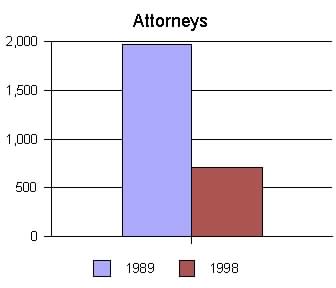
Inasmuch as the current assigned counsel rates do not even meet law practice overhead costs in many areas of the State, it is no surprise that attorneys are either removing their names from assigned counsel panels, remaining on the panels but refusing to take assignments or showing no interest in involving themselves in assigned counsel work at all. This problem is most acute in New York City, where overhead costs are generally the highest. Thus, in 1989, the assigned counsel panel for criminal cases in the First Department22 had 1030 attorneys who were actively taking assignments. Ten years later the panel had barely 400 attorneys actively taking assignments -- a decrease in attorneys of over 60%. The decline in the criminal case panel for the Second Department has been even worse. In 1989, that panel had 940 attorneys taking assignments; today, only about 300 attorneys were taking assignments -- a decline of nearly 70%.
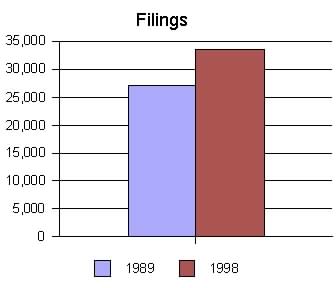
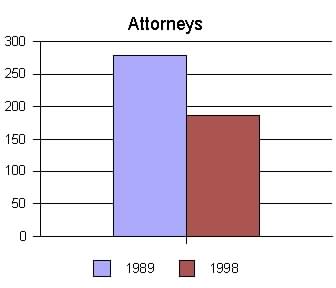
Counties outside of New York City have also experienced depletion in their assigned counsel panels, though not as severely as New York City. For example, in Erie County, 279 attorneys were taking criminal case assignments in 1989, but by 1999 the number had dropped to 187 -- a decline of 33%. In Monroe County, 206 attorneys are actively taking criminal assignments today, a decline of 8% from 1991 (the first year for which records are available for Monroe County.)
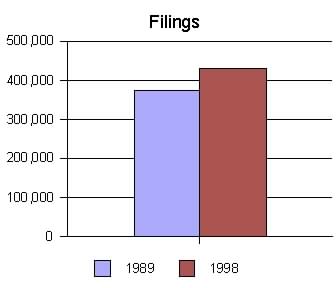
Unfortunately, the decline in attorneys willing to take criminal case assignments has taken place even as the demand for their work has increased. Total arrest case filings in New York City, for example, were 15.2% higher in 1998 than in 1989. In Erie County, criminal filings were 24.2% higher in 1998 over 1989. And in Monroe County, they were 16.6% higher in 1998 than in 1991.


Moreover, some jurisdictions now must rely on assigned counsel to handle an increasing share of criminal case assignments. For example, in New York City, the Legal Aid Society in past years represented the great majority of indigent criminal defendants, with assigned counsel handling only homicide cases and cases in which Legal Aid could not represent the defendant because of a conflict of interest. But this has changed over the last 15 years, with assigned counsel now representing a far more significant portion of indigent criminal defendants.
Similar problems have plagued the Family Court panels. In 1989, the panel for New York and Bronx counties had 109 attorneys actively taking assignments; today, the number has dropped to under 100. The Family Court panel for Kings, Queens and Richmond counties had 124 attorneys actively taking assignments in 1989, but today that number has also fallen to barely 100. In Erie County, the number of attorneys taking Family Court assignments declined from 162 in 1989 to 140 today. Yet the demand for these attorneys has surged over the past decade. In New York City, Family Court filings were 32.4% higher in 1998 than in 1989. In Erie County Family Court, filings were 33.6% higher in 1998 compared to 1989.


Although not all assigned counsel panels have suffered such large declines in the numbers of attorneys actively taking assignments, judges and program administrators confirm that all of the panels have lost many, if not most, of their experienced attorneys. Even those panels that have managed to replace departing attorneys have generally done so with far less experienced attorneys.
Major Disruptions in Court Proceedings
In short, because of the inadequate compensation for assigned counsel work, there is now a dramatically smaller number of attorneys -- who are often far less experienced -- to handle a significantly larger number of cases. This is causing major disruptions in the processing of cases, in both the Criminal Courts and Family Court. The following examples illustrate this problem:
This is an increasing problem in many of the most serious criminal prosecutions in which the defendant is represented by assigned counsel. As just one example among many, in a current Bronx Supreme Court murder case that has been pending for over 1,000 days, the trial has been delayed for months because the assigned defense attorney, who is simultaneously handling nearly 50 assigned counsel cases, has been tied up on trials of his other cases.
When criminal cases are delayed this long, prosecutors often have great difficulty securing their witnesses for trial, crime victims are denied the justice to which they are entitled and criminal defendants are denied a speedy resolution of the charges against them. If a larger supply of attorneys was available to handle these cases, extensive delays in bringing many cases to trial could be avoided.
Because of the legal mandate that an arraignment be provided within 24 hours of arrest,23 the justice system is under great pressure to perform all necessary pre- arraignment tasks in a timely fashion. The 24-hour rule has also necessitated the establishment of a greater number of arraignment parts, with nighttime and weekend shifts, with a concomitant greater need for assigned counsel to staff these parts. Yet the increasing difficulty in ensuring the presence of assigned counsel for the entirety of the arraignment parts' eight-hour shifts has severely strained efforts to comply with this legal mandate. Although the Legal Aid Society provides lawyers to represent defendants in the arraignment parts, assigned counsel must also be present to do so, because Legal Aid's limited resources and legal constraints (such as conflicts of interest) preclude it from representing all those who must be arraigned. If assigned counsel are not available, court staff frequently must search the courthouse to locate private attorneys willing to staff the arraignment part on a temporary basis until the assigned counsel arrives in the part, if at all.
The situation has become so critical that cases at times are not even called in these parts and instead are simply adjourned to a subsequent date. For example, nearly 50 cases recently on the calendar in an intake part in Queens Family Court were never called because assigned counsel were unavailable to staff the part. This occurred even though immediate court intervention may have been necessary in these cases, which included child abuse and neglect proceedings and matters in which juveniles were being held in custody.
A matter of paramount concern, this is a trend increasingly observed by former Presiding Justice Betty W. Ellerin of the Appellate Division, First Department, as well as judges and administrators in the Family Court in New York City. When counsel is not assigned to represent indigent petitioners in family offense cases, victims of domestic violence must make critical decisions on their own that may affect their future physical safety.
This is causing substantial disruption and delay in the processing and disposition of countless cases in the Criminal Courts and Family Court. And because assigned counsel have become so overloaded with cases, it is extremely difficult, if not close to impossible, to schedule hearings and trials in cases in which more than one assigned counsel is involved. The result is excessive adjournments, repeated re- schedulings and excessive delay until schedules can be coordinated and these proceedings can begin.
This development obviously has serious implications for the quality of lawyering provided to indigent litigants, who are increasingly being represented by attorneys lacking in experience and handling far greater numbers of cases than assigned counsel handled a decade ago. But it also frustrates the efficient processing of cases, because overburdened and less experienced attorneys are not as adept in negotiating with their adversaries and otherwise moving their cases toward an expeditious disposition.
IV. PROPOSED SOLUTION
Given the magnitude of the assigned counsel crisis, the Unified Court System concluded that it was imperative to convene representatives of all components of New York's legal community, as well as representatives of local governments throughout the State, to devise a solution. Under the direction of Hon. Juanita Bing Newton, Deputy Chief Administrative Judge for Justice Initiatives, the group met throughout the fall of 1999 in an effort to develop a comprehensive proposal that the legal community and the local governments could mutually support. Participating in this effort were officials and representatives of the following:
Appellate Division, First Department, Assigned Counsel Program
Appellate Division, Second Department, Law Guardian Program
Appellate Division, Third Department, Law Guardian Program
Erie County Assigned Counsel Program
New York State Attorney General's Office
New York State District Attorneys Association
New York State Association of Counties
Office of the New York City Criminal Justice Coordinator New York State Bar Association
Association of the Bar of the City of New York
New York State Defenders Association
New York County Lawyers Association
New York State Women's Bar Association
Even prior to convening, all of these groups, including the local governments, were united in their view that the current assigned counsel fees are inadequate and must be raised to meaningful levels if our justice system is to function fairly and efficiently. As a result of the meetings, however, the group achieved a consensus on the many other critical issues discussed below.
The existing two-tiered rate system for in-court and out-of court attorney work should be eliminated. Quality legal representation demands that attorneys commit sufficient time to out-of-court tasks. As the Court of Appeals has stated:
[The right to counsel] means more than just having a person with a law degree nominally represent [the client] upon a trial and ask questions. . . . [It] entitle[s] him to have counsel "conduct appropriate investigations, both factual and legal, to determine if matters of defense can be developed, and to allow himself time for reflection and preparation for trial.24
Compensating out-of-court work at a lower rate discourages such preparation, resulting in a lower quality of representation. Moreover, when attorneys come to court unprepared, the result is often delay in trials, hearings and other court proceedings. In many instances, the time an attorney spends on a case out-of-court is more valuable than the time spent in-court.
Our State's assigned counsel fee structure should encourage and promote attorney preparation. Accordingly, New York should follow the lead of many jurisdictions around the nation by establishing a single hourly rate for in-court and out-of-court work.
Separate rates for felony and non-felony work should be established. Although New York has always compensated felony and non-felony work at the same level, a strong argument can be made for separate rates. Felony prosecutions generally involve more complex issues, are more likely to proceed to hearing or trial, and expose the accused to more serious -- in many cases far more serious -- sanctions. Although a misdemeanor conviction can result in a jail sentence, and on occasion a significant collateral penalty such as civil forfeiture or even deportation, on the whole non-felony cases are simpler in nature and involve less serious consequences. It is for these reasons that assigned counsel panel attorneys who qualify for felony assignments must meet more rigorous qualification criteria than is true for attorneys who qualify for non-felony assignments. Therefore, it is appropriate to set different fees for performance of felony and non-felony work.
Most important, assigned counsel rates must be increased to levels sufficient to induce experienced and able criminal law and family law practitioners once again to take on these assignments. Reference to the rates paid for assigned counsel work in the federal courts is particularly instructive in determining appropriate compensation levels. The federal district courts for the Southern and Eastern Districts of New York compensate attorneys in criminal cases at a rate of $75 per hour. Based on our analysis of the overhead expenses incurred by New York practitioners, and given the comparable importance of these cases, this is both a fair and adequate rate compensation rate for attorneys assigned to handle felony and Family Court cases in the State courts.
Because, as discussed above, misdemeanor rates should be set at a somewhat lower level, the rate for misdemeanor cases should be increased to $60 per hour.
Article 18-B currently sets forth a series of caps on the total amounts that attorneys may receive in individual cases. Specifically, the statute provides that compensation for representing a defendant in a felony case may not exceed $1,200 and in a non-felony case $800; compensation for representing a litigant in Family Court case may not exceed $800; and compensation for an appeal in a felony case may not exceed $1,200 and for an appeal in a non-felony case or a Family Court case $800.25 The statute further provides that a trial or appellate court may provide for compensation in excess of the caps upon a showing of "extraordinary circumstances."
These caps bear no connection to modern economic reality, particularly in cases that advance beyond the preliminary stages of the proceedings. Accordingly, for years courts throughout the State have largely ignored the caps. Although some courts have been known to cut back on the number of hours submitted in attorney vouchers, courts routinely approve vouchers for amounts exceeding the caps so long as the vouchers are accompanied by an explanatory affidavit from the attorney.
Article 18-B should be revised to reflect this reality. Because the amount of work that an attorney expends on a case varies drastically from one case to another, the very concept of an arbitrary cap on compensation makes little sense. On the other hand, it makes sense to require judges to undertake additional scrutiny of an attorney fee voucher that seeks compensation beyond a threshold amount. Thus, Article 18-B should be amended to provide that when the compensation sought by an attorney exceeds $5,000 in a felony case or a Family Court case, or exceeds $2,500 in a non-felony case, the attorney must submit an affidavit with the voucher documenting the reasons for the additional hours expended. For appeals, the threshold should be $5,000, regardless of the nature of the case. These thresholds would eliminate the arbitrary nature of the caps while at the same time preserving an appropriate level of judicial scrutiny.
Moreover, the statute should provide for an administrative procedure allowing review of a judge's decision to reduce the number of hours set forth in a voucher. The statute should direct the Chief Administrative Judge to promulgate rules authorizing such review by the appropriate District Administrative Judge.
Fourteen years is an unconscionably long period of time to elapse between assigned counsel fee increases. This is particularly so given that the current rates were modest even when they were initially enacted in 1986. To help prevent this unacceptable situation from recurring, legislation increasing the rates should also establish a commission charged with reviewing the rates on a periodic basis and making non-binding recommendations to the Legislature for rate increases when necessary. The Commission should include members appointed by the Governor, the Legislature and the Chief Judge, as well as representatives designated by the New York State Association of Counties and the City of New York. Creation of a bi-partisan entity with local government representation to monitor the effectiveness and fairness of the rates will help to promote more timely compensation adjustments in the future.
Under the current structure, local governments in New York shoulder the entire fiscal burden of assigned counsel costs in the Criminal Courts as well as the assigned counsel costs for indigent adults in Family Court cases. These costs are considerable. For example, the total costs to local governments for assigned counsel compensation in New York in 1998 are estimated at $64,132,305.26 New York City's share of this amount was $44,620,259. And these amounts do not reflect the millions of dollars in additional expense that many local governments around the State incur in subsidizing public defender offices or legal aid societies.
It is reasonable for local governments to contribute to the costs of legal representation of the indigent. But given the many unfunded State mandates to which local governments have been subjected in recent years, local governments believe it is reasonable for State government to begin to share the tremendous burden of these costs. There is considerable merit to the local governments' position, particularly where there is a discrete source of State revenue that in itself can pay for the entire cost of the rate increases proposed herein. Under State law, every individual in New York who is convicted of an offense is required to pay a mandatory surcharge, ranging from as much as $150 for a felony offense to as little as $5 for a parking offense.27 Prior to 1996, all mandatory surcharge revenue was remitted to the State's "Criminal Justice Improvement Account" established pursuant to section 97-cc of the State Finance Law. Since then, however, most of this revenue has simply gone to the State General Fund.28 For example, in the current fiscal year, only an estimated $13,54,000 of mandatory surcharge revenue will be remitted to the Criminal Justice Improvement Account and applied to the criminal justice programs that the Account funds. The balance of the surcharge revenue -- an estimated $70,400,000 -- will simply go to the General Fund. If this $70,400,000 were dedicated to funding assigned counsel fees, it would pay for essentially the entire cost of increasing the fees to $75 per hour for felony and Family Court cases and $60 per hour for misdemeanor cases -- a projected annual cost of $71,800,000.29
Dedicating this money to pay for fee increases would achieve several major benefits. Although local governments would continue to pay assigned counsel costs up to the current rates, they would be spared the entire expense resulting from the proposed fee increases. Moreover, all of the mandatory surcharge revenue would be returned to the criminal justice system. And finally, if mandatory surcharge revenue were used to fund the fee increases, that would mean that the increases would be paid for by offenders themselves.
Although not discussed by the group that was convened to devise a solution to the assigned counsel fee crisis, an additional source of related revenue could help offset the cost of increased fees. Each year millions of dollars in court fines and mandatory surcharges go unpaid. Because experience has shown that governmental institutions are not equipped to function as collection agencies and thus have not been particularly successful at this task, the court system is about to begin a pilot program in which it will contract with private firms to collect outstanding fines and mandatory surcharges in six jurisdictions around the State. Although not all of these outstanding judgments are collectible, the hope is that much of them will be. If the program proves successful, the Legislature should consider authorizing Statewide expansion of the program, and dedicate the potentially millions of dollars collected to pay for assigned counsel fee increases.
In many areas of the State, and particularly in New York City, there are no formal screening procedures and no uniform standards for determining whether a litigant to whom counsel has been assigned is actually unable to afford counsel. The lack of formal procedures and standards undoubtedly leads to assignment of counsel in cases in which litigants are able to afford a portion, or even all, of the costs of their legal representation. It has also been suggested that in some cases the opposite is true -- that the absence of formal standards has served to deny counsel to individuals unable to afford this cost.
A recent report of the Association of the Bar of the City of New York documents this problem in New York City and discusses the need for a more formal screening mechanism.30 The court system should study this problem closely, and consider implementation of several measures. First, income guidelines should be established for assigned counsel eligibility. For example, an individual would be presumed eligible for assignment of counsel if his or her income is below a designated multiple of the federal income poverty guidelines. Because cost of living standards vary considerably around the State, the multiple should also vary from region to region. Second, some version of the successful recent eligibility screening pilot program in Brooklyn Supreme Court should be institutionalized. This would involve the use of Judicial Hearing Officers to make eligibility determinations, either as a matter of course in all cases, or at least in cases when some development, such as the posting of significant bail, indicates that the litigant may be able to afford some or all of the cost of counsel.
These measures offer the potential for significant cost savings for government. Thus, they could help to minimize the fiscal burden of assigned counsel fee increases.
V. CONCLUSION
If New York is to continue to meet its constitutional and statutory obligation to provide assigned counsel to indigent litigants in the Criminal Courts and Family Court, it is imperative that the hourly compensation for this work be increased. The failure to increase the current rates, which took effect some 14 years ago and no longer even cover average overhead expenses, has drastically reduced the number of attorneys willing to take these assignments. This has caused major disruption and delay in the adjudication of cases, both in the Criminal Courts and in Family Court. Absent immediate, meaningful fee increases, this crisis could become irreversible, with an entire generation of young lawyers having no interest in acquiring the critically important skills and experience needed to perform assigned counsel work.
The solution we propose, supported by all the key participants in this area, is to increase the rates to $75 per hour for felony and Family Court cases and to $60 per hour for non-felony criminal cases. Existing differential rates for in-court and out-of-court work should be eliminated. In addition, the existing caps on compensation should be eliminated and replaced by a requirement that attorneys seeking total compensation beyond specified threshold amounts submit an affidavit documenting the reasons for the additional work expended. Furthermore, to facilitate enactment of future rate increases, a bi-partisan commission should be established to review the rates on a periodic basis and make non- binding recommendations for rate increases when necessary.
Finally, State government should share the cost of assigned counsel compensation, which imposes considerable fiscal burdens on local governments. Mandatory surcharge revenue now remitted to the General Fund can support the entire amount of the proposed fee increases, which otherwise would have to be paid by local governments. This revenue should be returned to the criminal justice system, so that offenders themselves ultimately bear the cost of the fee increases.
1 See Code of Crim.
Proc. § 308 (originally enacted by L. 1881, c. 442). See also People ex rel.
Whedon v. Board of Supervisors, 192 App. Div. 705 (3d Dep't 1920).
2 See Memorandum of
Attorney General, 1965 N.Y. Legis. Ann., p. 34.
3 L. 1961, c. 365.
4 See Memorandum of Attorney
General, 1965 NY Legis. Ann., p. 34.
5 372 U.S. 335 (1963).
6 372 U.S. at 344.
7 People v. Witenski, 15 N.Y.2d 392 (1965). The
Supreme Court later extended the Gideon ruling to all criminal cases.
See Argersinger v. Hamlin, 407 U.S. 25 (1972).
8 Under the statute, "crime" is defined
broadly as follows:
[A] felony, misdemeanor, or the breach of any law of this
state or of any law, local law or ordinance of a political
subdivision of this state, other than one that defines a
"traffic infraction," for which a sentence to a term of
imprisonment is authorized upon conviction thereof.
County Law § 722-a.
9 County Law § 722.
10 See Fam. Ct. Act § 262(c).
11 Fam. Ct. Act § 249.
12 Fam. Ct. Act § 243.
13 County Law § 722-b.
14 See also Fam. Ct. Act §
245(c)(providing that law guardian assignments be compensated pursuant to the
rates established in section 35(3) of the Judiciary Law -- i.e., $40/hour for
in-court work and $25/hour for out-of-court work).
In 1987, the
Legislature eliminated the in-court/out-of-court differential for assigned
counsel appellate work. L. 1987, c. 317. Thus, attorneys handling appeals in
criminal cases and Family Court cases are compensated at a flat rate of
$40/hour.
15 See
"Rates of Compensation Paid to Court Appointed Counsel in Non-Capital Felony
Cases at Trial: A State-by-State Overview," Spangenberg Group (November 1999).
Two states pay hourly rates that are roughly comparable to New York: Maryland,
which pays a higher out- of-court rate of $30 but a lower in-court rate of $35;
and Massachusetts, which pays $54 for homicide cases, $39 for felony and
youthful offender cases, and $30 for all other criminal cases, with no
distinction between in-court and out-of-court work.
16 Alabama pays $50/hour for in-court
work and $30/hour for out-of-court work; Arkansas pays an average of $80 to $85
per hour; Georgia pays $60 for in-court work and $45 for out-of-court work; and
Louisiana pays an average of $42 per hour.
17 See Daniel Wise, "City Will Increase Hourly Rates
for Future Bond Counsel," New York Law Journal, October 15, 1999, p. 1, col. 3.
18 See County Law §
722-c(authorizing counsel to retain investigative, expert or other services upon
a judicial finding that such services are "necessary").
19 Administrative Order #73 of the Chief
Administrator of the Courts, February 6, 1992.
20 "Desktop Reference on the Economics
of Law Practice in New York," New York State Bar Association, p. 12 (1997).
21 This is a reasonable
adjustment, particularly in light of the very substantial increases in
commercial rent in the downstate region during the past several years.
22 In New York City, the
assigned counsel panels are organized by judicial department. Accordingly, the
First Department panel provides attorneys for cases in New York and Bronx
counties, and the Second Department panel provides attorneys for cases in Kings,
Queens and Richmond counties.
23 See CPL § 140.20(1)(requiring that arrested person
be brought to court for arraignment "without unnecessary delay"); People ex
rel. Maxian v. Brown, 77 N.Y.2d 422 (1990)(upholding lower courts'
determination that a delay in arraignment in New York City of more than 24 hours
is presumptively unnecessary under the statute).
24 People v. Bennett, 29 N.Y.2d
462, 466 (1972)(citations omitted).
25 County Law § 722-b.
26 This amount reflects the actual assigned counsel costs for
New York City and the counties of Nassau, Suffolk, Westchester, Erie, Monroe and
Onondaga, with the costs for the remaining counties estimated at 15% of the
total of these larger jurisdictions.
27 The surcharge is $85 for a misdemeanor offense and $40 for
a violation offense, Penal Law § 60.35(1), $25 for a traffic infraction, VTL §
1809(1)(c), and $15 for a vehicle equipment, VTL § 1809(1)(a).
28 See L. 1996, c. 309.
29 The projected annual
cost of increasing law guardian fees -- which has always been a State cost -- to
$75 per hour is $24,837,500.
30 See "Determining a Defendant's Eligibility for
Assigned Counsel Services," Association of the Bar of the City of New York (June
1999).