Overview
BFF is a collaborative approach to working with all child welfare cases, including those with substance use disorder (SUD), regardless of risk or need. BFF offers statewide change throughout child welfare, family court, as well as SUD and mental health treatment practices by integrating effective family treatment court (FTC) principles into the broader legal/judicial child welfare system. This process includes early identification, quality assessment, and trauma-informed responses to families.
BFF's 6 Principles (based on FTC research)
Why the BFF Approach?
“National research tells us that there are 8.7 million children living with parents who need treatment for substance use disorder.”
Lipari RN, & Van Horn SL (2017). Children living with parents who have a substance use disorder.
“Ninety percent of those who need treatment services do not receive them.”
McCance-Katz, E.F. (2018). The National Survey on Drug Use and Health: 2018.
What We Noticed
38% of neglect/abuse cases in NYS involving children under 3 alleged substance use in the petition.
29% of neglect/abuse cases involving children 3 & over alleged substance use in the petition.
Source: NYS Unified Court System, Universal Case Management System, CWCIP Data Metrics, 2013–2021
Theory of Change
The BFF approach to serving families (i.e., data collection and sharing; multisystem cross training) seeks to reduce recurrence of maltreatment and increase the number of children remaining safely in their homes, timely permanency, support recovery, and increase judicial capacity. Steps include:
- Early identification
- Enhanced judicial practices
- Timely access to treatment
- Increased family and case team communication and information sharing
- Increased use of evidence-base
Problem-Solving Courts
Problem-solving courts focus on a specific family need, such as SUD, mental health, or very young children. These judge-led, multidisciplinary teams receive specialized training to: 1) effectively identify and respond to the family’s strengths and needs, and 2) connect to appropriate therapeutic strategies. While admission offers go out to all parents meeting eligibility for the problem-solving court, participation is typically voluntary. Each jurisdiction determines eligibility, and local resources dictate capacity.
BFF is not a specialized problem-solving court, but rather a collaborative approach to working with all child welfare cases, including those with SUD, regardless of risk or need. Given its universal applicability and broad capacity, BFF suits a wide range of jurisdictions, especially those with limited community resources.
Family Treatment Court
FTCs serve children, parents, and families involved in the child welfare system when parental substance use and/or co-occurring mental health disorders contribute to child abuse or maltreatment. Judges, court personnel, attorneys, child protective services, treatment professionals, and other community partners collaborate on and coordinate services. All strive to promote: 1) safe, nurturing, and permanent homes within mandatory timeframes for all children; 2) stability and recovery for all parents; and 3) access to needed services and supports for all family members. FTCs provide intensive judicial monitoring along with family-focused interventions, services, and supports drawing upon the families’ strengths and meeting their comprehensive needs.
Strong Starts Court Initiative
Strong Starts brings expertise in early child development to all stages of a child welfare proceeding to strengthen families and interrupt intergenerational cycles of system involvement. The program focuses on families (with children 0-3) involved in the family court due to allegations of abuse and neglect. Infants and parents benefit from enhanced judicial practices, clinical assessments, customized service plans, increased collaboration and problem solving, and access to a network of community and evidence-based services. Services include those in the domain of child development, adult development, and those supporting infant mental health, parent-child attachment, and family stability.
Shifts in Business
State Governance Structure: An executive committee and core planning team consisting of key stakeholders across the courts, child welfare, health, mental health, and SUD treatment meet regularly to remove systems barriers and facilitate change related to the BFF approach.
Data Sharing and Evaluation: State-level partners across systems work together to better track data related to the courts, child welfare, public health, mental health, and SUD treatment.
BFF Blueprint: A comprehensive guide now helps court, child welfare, health, mental health, and SUD treatment professionals navigate the implementation process.
Multisystems Collaborative Trainings: Trainings previously reserved for FTCs and partners are now available statewide to all child welfare professionals and partners.
Onsite Substance Abuse Assessments: SUD providers rotate a daily schedule so staff can assess individuals at the courthouse and refer to the treatment provider of choice.
Universal Screening: Pilots use a multifaceted approach, including use of a validated screening instrument, checking with collateral contacts, drug screens, and signs and symptoms of substance use. Local social services departments administer the UNCOPE+ in counties as part of a universal screening approach to identify families affected by SUD earlier.
Universal Assessment: A universal assessment form allows individuals recommended for treatment to choose any provider for treatment without needing a new assessment.
Peer Recovery Support: Pilots sought to implement peer recovery supports to encourage family engagement and access to treatment. Peer supports work with SUD providers as well as local departments of social services.
Motivational Interviewing (MI): All six pilot sites’ DSS caseworkers received MI training. MI is an evidence-based, goal-directed, client-centered counseling style for eliciting behavioral change by helping clients explore and resolve ambivalence. MI may help with a wide range of problem behaviors related to alcohol and substance use, health promotion, medical treatment adherence, and mental health issues.
Governance Structure
BFF is a collaborative approach to helping parents, children, and families achieve well-being and family preservation; the program identifies needs early and effectively to either keep children at home or return them safely.
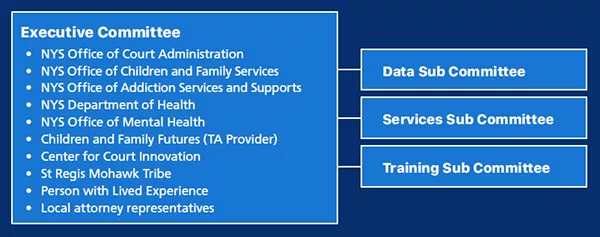
Each regional leadership team includes members selected from local collaboratives within the judicial districts. Leadership team members: 1) inform the executive committee, 2) may join one or more statewide sub committees, and 3) act as representatives of, and conduits of information to, the communities in their respective districts. Representation includes:

The New York State Unified Court System received a grant from the Office of Juvenile Justice and Delinquency Prevention (OJJDP) to work with other state agencies in 2020. Goals include prioritizing early identification of families in need of SUD treatment while supporting enhanced access to quality treatment. The grant allows the Child Welfare Court Improvement Program (CWCIP) to build on its BFF project pilots—originally funded through a prior OJJDP grant—and continue to expand training and technical assistance that promotes FTC best practices in counties without FTCs. The grant also supports the enhancement and expansion of FTCs in collaboration with the Division of Policy and Planning. The project provides resources and technical assistance to promote continuous quality improvement through sharing data, cross-training, supporting the use of universal screening, access to quality assessments, more frequent court reviews, and integration of trauma-informed care practices.
Leadership Partners
For more information or any questions: [email protected].