

Handsome v Continental Mills, Inc.
2026 NY Slip Op 50955(U)
June 12, 2026
Supreme Court, Kings County
Aaron D. Maslow, J.
Published by New York State Law Reporting Bureau pursuant to Judiciary Law § 431.
This opinion is uncorrected and will not be published in the printed Official Reports.
Crystal Handsome, individually and on behalf of all others similarly situated, Plaintiff,
v
Continental Mills, Inc., Defendant.
Supreme Court, Kings County
Decided on June 12, 2026
Index No. 535263/2025
Sheehan & Associates, P.C., Great Neck (Theodore Hillebrand of counsel), for Plaintiff.
Davis Wright Tremaine LLP, New York City (Gaurav Talwar of counsel), for Defendant.
Aaron D. Maslow, J.
[*1]The following numbered papers were read on this motion:
Submitted by Defendant
NYSCEF Doc No. 6: Notice of Motion
NYSCEF Doc No. 7 Affirmation in Support
NYSCEF Doc No. 8: Memorandum of Law
NYSCEF Doc No. 9: RJI
NYSCEF Doc No. 26: Memorandum of Reply
NYSCEF Doc No. 27: AI Intelligence Certification
NYSCEF Doc No. 28: Affidavit of Service
NYSCEF Doc No. 29: Correspondence to Judge
NYSCEF Doc No. 30: Emails to the Court
[*2]Submitted by Plaintiff
NYSCEF Doc No. 2: Complaint
NYSCEF Doc No. 11: Memorandum of Opposition
I. Questions Presented
The issue presented before the Court is whether Defendant Continental Mills, Inc.'s labeling of its Krusteaz brand Cinnamon Swirl Quick Bread Mix with "No Artificial . . . Preservatives" is materially misleading to a reasonable consumer under New York General Business Law (GBL) §§ 349-350, where Plaintiff contends the use of processed silicon dioxide implies the use of preservatives.
II. Background
Defendant produces, markets, and sells Krusteaz brand Cinnamon Swirl Quick Bread Mix ("the Product") to consumers in New York. Plaintiff Crystal Handsome purchased the Product, believing that no preservatives would be used based on the label's prominent statement "No Artificial Flavors • Colors • Preservatives." However, the ingredient list shows silicon dioxide ("silica"), as reflected below:
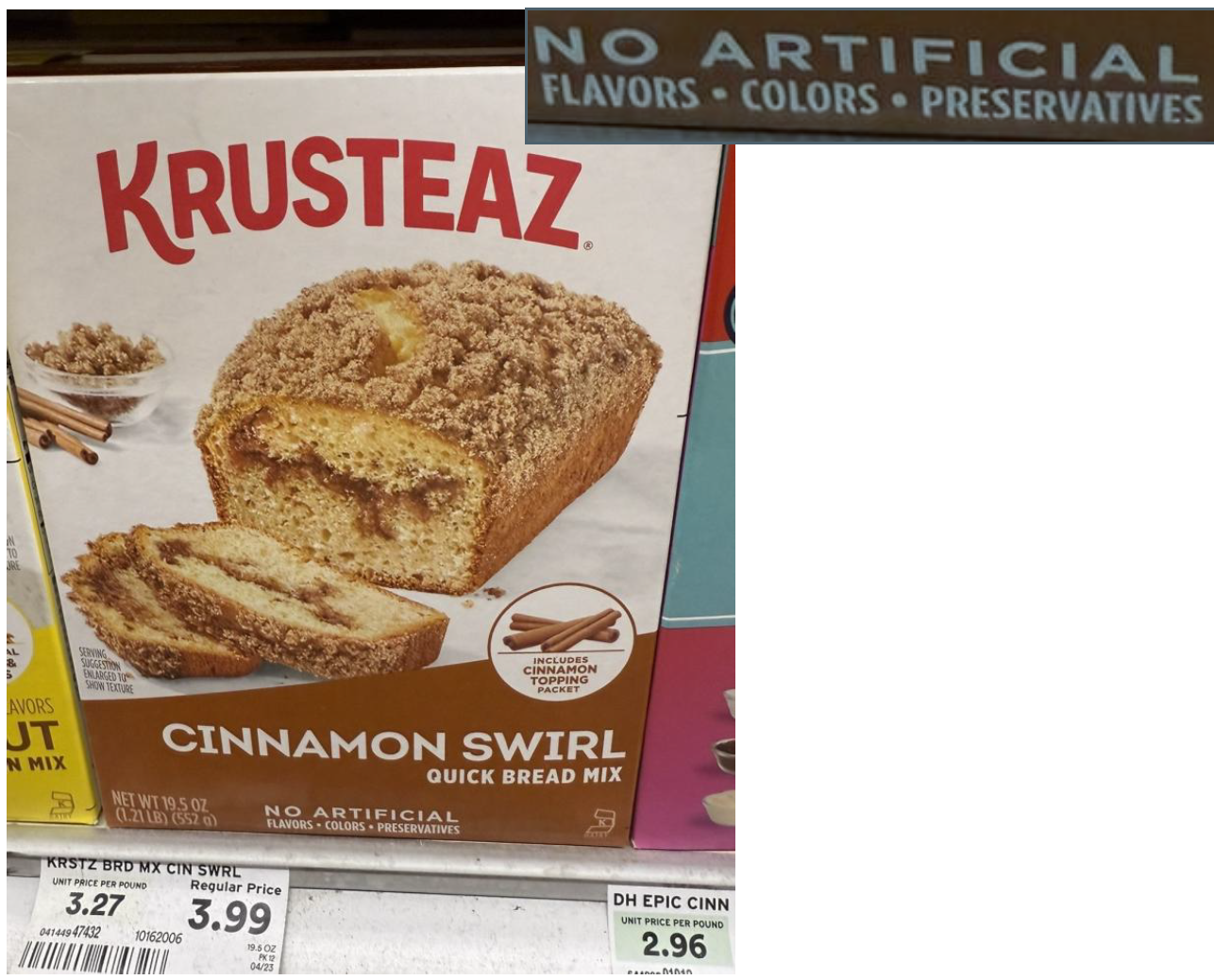
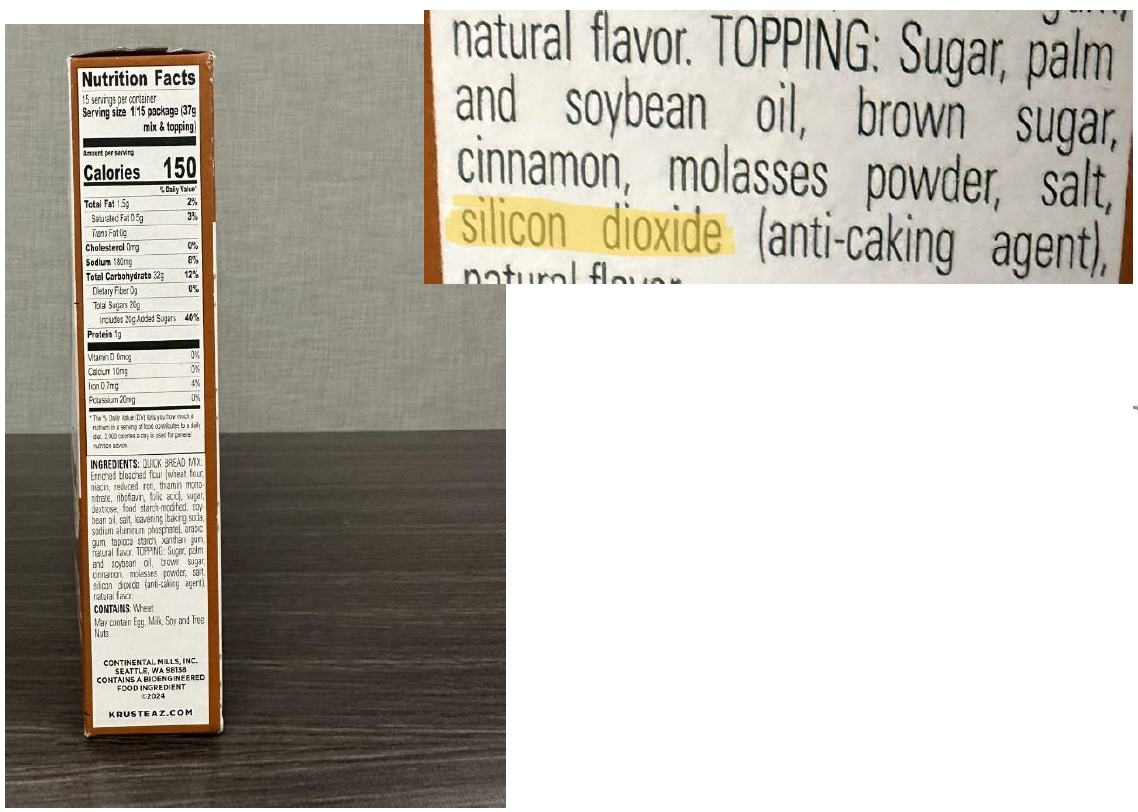
(NYSCEF Doc No. 2, Complaint)
Although Plaintiff admits that silica is based on two natural elements: rocks and sand, her dissatisfaction arises from the Product's use of synthetic rather than naturally occurring silica. This assertion derives from Plaintiff's belief that the silica used in store-bought food is generally synthetic, produced in large factories through chemical reactions involving halides and other carrier gasses. While Plaintiff agrees that silica can prevent caking of powders, its use also results in slower decomposition and prevention of spoilage. In essence, it has the ability to act as a preservative. Thereby, Plaintiff contends she paid more than she otherwise would have for the allegedly misleading bread mix, sold at $3.99. (See id.)
Defendant now seeks dismissal of the complaint in its entirety with prejudice under CPLR 3211 (a) (7) on the grounds that Plaintiff failed to state a cause of action that the Product's label could deceive reasonable consumers.
III. Contentions
A. Defendant Continental Mills, Inc.'s Argument
Defendant posits that no reasonable consumer would construe the silica in the Product to be either artificial or a preservative. It is uncontested that silica, a naturally occurring compound, is used in the Product as an anti-caking agent to prevent the cinnamon topping from clumping. As reasonable consumers are deemed to consider the entire food label (see NYSCEF Doc No. 8, Defendant's memorandum of law citing Pasik v Sabra Dipping Co., 2022 NY Slip Op 34852[U], [*3]*9 [Sup Ct, Nassau County 2022] ["(T)he entire label must be considered in determining whether the label is misleading in examining the claim under the General Business Law - not select portions."], disclosing silica's intended use on the Product avoids consumer confusion about the meaning of "No Artificial . . . Preservatives." Given this clear disclosure, Defendant asserts that the inclusion of silica in the Product is not misleading to a reasonable consumer.
Moreover, Defendant argues that Plaintiff's opposition re-writes the complaint such that it asserts facts not originally pled. Notably, the opposition papers suggest that the silica included in the Product is synthetic because it is created by an artificial process, an assumption that cannot be made without additional facts (see NYSCEF Doc No. 26, Defendant's reply memorandum of law citing WW-35th LLC v Morgan Ct. Condominium, 60 Misc 3d 1215[A], 2018 NY Slip Op 51137[U] [Sup Ct, NY County 2018] [court declined to hear argument raised for first time in opposition]). Plaintiff also fails to plead in the complaint that (1) halides are artificial (see id., citing Karabas v TC Heartland LLC, 770 F Supp 3d 454, 467 [ED NY 2025] [("Plaintiff's 'generalized' discussion about the manufacturing process is not sufficient to show that defendant's product is synthetic."]); (2) the silica in the Product is produced through chemical reactions; or (3) that there is any chemical difference between the form found in nature and the form produced synthetically (see id., citing Valencia v Snapple Beverage Corp., 2024 WL 1158476 [SD NY 2024], *6 [dismissing GBL claims where plaintiff "describe[d] no respect in which the citric acid derived from Aspergillus niger differs chemically from the citric acid derived from citrus fruits"]).
B. Plaintiff Crystal Handsome's Opposition
Plaintiff claims that the motion must be denied because the Court is required to accept as true each and every allegation (see NYSCEF Doc No. 11, Plaintiff's memorandum of law in opposition citing Davis v Boeheim, 24 NY3d 262, 268 [2014] [reversing dismissal under CPLR 3211 [a] [7] because what matters is if "any reading of the complaint supports" plaintiff's claim]). Under this standard, the Court must accept as true the argument that silica is "a non-natural synthetic ingredient" (NYSCEF Doc No. 2, complaint). However, even if the Court required more proof as to its synthetic nature, the complaint provided a detailed explanation of the general process for producing synthetic silica as well as research on why consumers typically avoid preservatives. Whether or not silica's ability to be used as a preservative would transform the anti-caking agent into a preservative in the minds of reasonable consumers, Plaintiff avers, is an issue of fact to be litigated (see NYSCEF Doc No. 11, Plaintiff's memorandum of law in opposition citing Vectron International Inc. v Corning Oak Holding, Inc., 106 AD3d 1164, 1167 [3d Dept 2013] [denying dismissal where contract was subject to multiple interpretations]; Thompson v Schwan's Consumer Brands Inc., 2024 WL 3862104, *4 [SD NY 2024] [denying dismissal of GBL §§ 349 and 350 based on the uncontested allegation in the pleading that the products' use of Phosphate Salts "tende[ed] to prevent or slow [the Product's] deterioration," which is a proper definition of 'preservative'; "Reasonable consumers . . . understand 'preservative' to mean 'a chemical used to stop food from decaying' "]).
Plaintiff further states that a cause of action is made out under GBL §§ 349 and 350, which bar deceptive and misleading practices. The use of silica as an anti-caking agent was [*4]located on the back of the Product, which is insufficiently prominent considering the "No Artificial . . . Preservatives" representation on the front (NYSCEF Doc No. 11, Plaintiff's memorandum of law in opposition citing People v Orbital Publishing Group, 169 AD3d 564, 566 [1st Dept 2019] [disclaimer on reverse of solicitations for newspaper and magazine subscriptions, not referenced on the front and consisting of two paragraphs of block text, deemed misleading due to being insufficiently prominent and unlikely to be read by consumers]). The misleading nature of the Product inducing Plaintiff's purchase thereby led to the injury of having "paid more for the Product than she would have, had she known" the truth.
IV. Discussion
A. General Considerations
When a party moves pursuant to CPLR 3211 (a) (7) to dismiss an action, the standard is whether the pleading states a cause of action, not whether the proponent of the pleading has a cause of action (see Sokol v Leader, 74 AD3d 1180, 1180-1181 [2010]). In deciding the motion, the court must accept the facts as alleged by the plaintiff as true, accord plaintiffs the benefit of every possible favorable inference, and determine only whether the facts as alleged fit within any cognizable legal theory (see Integrate NYC, Inc. v State of NY, 45 NY3d 176, 184 [2025]; Leon v Martinez, 84 NY2d 83, 87-88 [1994]).
B. GBL §§ 349 and 350
"New York's Consumer Protection Act—General Business Law article 22-A—was enacted to provide consumers with a means of redress for injuries caused by unlawfully deceptive acts and practices (see General Business Law §§ 349, 350; see also, Oswego Laborers' Local 214 Pension Fund v Marine Midland Bank, 85 NY2d 20 [1995]). This legislation, much like its federal counterpart, the Federal Trade Commission Act (15 USC § 45), is intentionally broad, applying 'to virtually all economic activity' (Karlin v IVF Am., 93 NY2d 282, 290 [1999]). The statute seeks to secure an 'honest market place' where 'trust,' and not deception, prevails (Oswego, 85 NY2d at 25, quoting Mem of Governor Rockefeller, 1970 NY Legis. Ann, at 472)." (Goshen v Mut. Life Ins. Co. of NY, 98 NY2d 314, 323-324 [2002].).
"The goals of GBL §§ 349-350 were major assaults upon fraud against consumers, particularly the disadvantaged[ ] (Givens, Practice Commentaries, McKinney's Cons Laws of NY, Book 19, General Business Law § 349, at 574-575)" (Teller v Bill Hayes, Ltd., 213 AD2d 141, 148 [2d Dept 1995]). Thereby, "[b]oth General Business Law §§ 350 and 349 qualify as remedial statutes: they 'giv[e] a mode of remedy for a wrong where an injured person had none or an ineffective remedy under the prior system of law.' (McKinney's Cons Laws of NY, Book 1, Statutes § 35; see also, McKinney's Cons Laws of NY, Book 1, Statutes § 321, 342.) Remedial statutes such as these require liberal construction and application, 'to spread their beneficial results as widely as possible'. (McKinney's Cons Laws of NY, Book 1, Statutes § 54 [a].) In addition, the court must 'consider the mischief sought to be remedied and should favor the construction which would suppress the evil and advance the remedy'. (Metropolitan Life Ins. Co. v State Tax Commn, 80 AD2d 675, 677 [3d Dept], affd 55 NY2d 758 [1981); McKinney's Cons [*5]Laws of NY, Book 1, Statutes, §§ 54, 95.)" (New York Pub. Interest Research Group v Insurance Info. Inst., 140 Misc 2d 920, 925 [Sup Ct, NY County 1988], affd 161 AD2d 204 [1st Dept 1990].)
1. GBL § 349
General Business Law § 349 (a) provides, "Unfair, deceptive acts or practices in the conduct of any business, trade or commerce or in the furnishing of any service in this state are hereby declared 'unlawful." "Under General Business Law § 349 (h) '[a] prima facie case requires . . . a showing that defendant is engaging in an act or practice that is deceptive or misleading in a material way and that plaintiff has been injured by reason thereof' (Oswego, 85 NY2d at 25). Additionally, the allegedly deceptive acts, representations or omissions must be misleading to 'a reasonable consumer' (Oswego, 85 NY2d at 26; see also, Karlin, 93 NY2d 282; Gaidon, 94 NY2d 330)." (Goshen, 98 NY2d at 323-24.) "The phrase 'deceptive acts or practices' under the statute is not the mere invention of a scheme or marketing strategy, but the actual misrepresentation or omission to a consumer (see Gaidon, 94 NY2d 330; Oswego, 85 NY2d 20)" (Goshen, 98 NY2d at 325).
"A plaintiff under section 349 must prove three elements: first, that the challenged act or practice was consumer-oriented; second, that it was misleading in a material way; and third, that the plaintiff suffered injury as a result of the deceptive act (see, Oswego Laborers' Local 214 Pension Fund v Marine Midland Bank, 85 NY2d 20, 25; see also, Gaidon v Guardian Life Ins. Co., 94 NY2d 330, 344; Small v Lorillard Tobacco Co., 94 NY2d 43, 55-56). Whether a representation or an omission, the deceptive practice must be 'likely to mislead a reasonable consumer acting reasonably under the circumstances' (Oswego Laborers' Local 214 Pension Fund v Marine Midland Bank, supra, at 26). A deceptive practice, however, need not reach the level of common-law fraud to be actionable under section 349 (see, Gaidon v Guardian Life Ins. Co., supra, at 343). In addition, a plaintiff must prove 'actual' injury to recover under the statute, though not necessarily pecuniary harm (see, Oswego Laborers' Local 214 Pension Fund v Marine Midland Bank, supra, at 26; see also, Givens, Practice Commentaries, McKinney's Cons Laws of NY, Book 19, General Business Law § 349, at 565)." (Stutman v Chemical Bank, 95 NY2d 24, 29 [2000].)
Here, Plaintiff clearly meets the first and third elements. Labeling of consumable goods is a consumer-oriented practice. Plaintiff is also a consumer who allegedly failed to receive the benefit of her bargain after purchasing the Product that could have cost less based on its use of an alleged preservative. However, whether the Product was marketed in a materially misleading way warrants further analysis.
As to silica's potential use as a preservative, this Court looks to federal case law, given the absence of controlling authority from New York State courts. To survive dismissal under this guidance, a plaintiff must, first, sufficiently plead that the challenged ingredient functions as a preservative (Kelly v Beliv LLC, 640 F Supp 3d 286, 298 [SD NY 2022]; Hu v Herr Foods, Inc., 251 F Supp 3d 813, 816 [ED Pa 2017]). As defined by Merriam-Webster, a "preservative" is "an [*6]additive used to protect against decay, discoloration, or spoilage"FN1 (Kelly, 640 F Supp at 298). Applying this definition, Plaintiff sufficiently alleges silica's dual functionality as set forth below:
49. Trade journals and industry publications agree that anticaking agents like silicon dioxide are crucial for food preservation, extending shelf life, and maintaining nutritional value.
50. Leading Chinese supplier JK Silica, described how food grade silicon dioxide can improve a powder's quality and shelf life, as a moisture absorbent and anti-caking agent.
51. Using such additives allows powdered foods to stay fresh for so long, despite humidity, damp storage conditions, or extended periods on store shelves.
52. The above-identified functions indicate how silicon dioxide (i) prevents and/or limits oxidation, (ii) absorbs free moisture, (iii) inhibits clumping, (iv) helps to maintain texture, color, and consistency, and/or (v) reduce susceptibility to spoilage from yeasts, molds, and/or bacteria, through its effects on moisture and lipids.
53. This is because silicone dioxide is a "chemical[] that, when added to [the Product, and/or its components], tends to prevent or retard deterioration." 1 N.Y.C.R.R. 259.1(a).
(NYSCEF Doc No. 2, complaint.)
Defendant's labeling of silica as an anti-caking agent is not dispositive of how the Court should evaluate its function. As Judge Koeltl noted in Mason v Reed's Inc., "whether the citric acid in the products is a preservative is an objective fact independent of the subjective intentions of the products' manufacturer" (Mason v Reed's Inc., 515 F Supp 3d 135, 145 [SD NY 2021]). Therefore, we must look beyond Defendant's subjective classification in recognition of silica's capacity to function as both a preservative and anti-caking agent.
Second, the plaintiff must adequately allege that a reasonable consumer would be materially misled by the phrase "No Preservatives" (Kelly, 640 F Supp 3d 286; Hu, 251 F Supp 3d 813). "[A] plaintiff 'must do more than plausibly allege that a label might conceivably be misunderstood by some few consumers.' Sarr v. BEF Foods, Inc., No. 18-CV-6409 at *3 (E.D.NY Feb. 13, 2020) (cleaned up). Rather, a plaintiff must 'plausibly allege that a significant portion of the general consuming public or of targeted customers, acting reasonably in the circumstances, could be misled.' Id. (cleaned up)." (Dwyer v Allbirds, Inc., 598 F Supp 3d 137, 149 [SD NY 2022]; see also Axon v Citrus World, Inc., 354 F Supp 3d 170, 182 [ED NY 2018], affd sub nom. Axon v Florida's Nat. Growers, Inc., 813 Fed Appx 701 [2d Cir 2020]).
However, a clear division exists among the federal courts regarding the application of this rule. In the case of Hu v Herr Foods, Inc., the court determined that the plaintiff failed to adequately plead "that a reasonable consumer would define an ingredient as a preservative regardless of its functionality" and that accepting such as true would "credit legal conclusions as factual allegations" (Hu, 251 F Supp 3d at 821). Conversely, the Kelly v Beliu LLC court felt that because the ingredient could function as a preservative, "it cannot be said that it would be 'impossible for the plaintiff to prove that a reasonable consumer was likely to be deceived' by [*7]Defendant's labeling of the Product as 'No Preservatives' " (Kelly, 640 F Supp at 298).
Although federal case law raises questions about what constitutes adequate pleading under the reasonable consumer standard, the Court need not resolve that issue here. Plaintiff clearly alleges that the Product's packaging represents that it contains "No . . . Preservatives," yet includes silica, a compound designated as an anti-caking agent that also functions to extend shelf life, thus meeting the definition of a preservative. Notably absent is any allegation addressing how a reasonable consumer would be misled:
8. They employed industrial chemists, who developed novel Frankenstein-like compounds, with names like borax, salicylic acid, and formaldehyde.
9. Their purpose was to disguise unsanitary practices, prevent foodborne illness from spoiled raw materials, conceal inferior quality, and/or extend minimal quality.
10. To protect New Yorkers from these frauds, which concealed dangerous chemicals, the Department of Agriculture and Markets ("Ag&Mkts") set requirements for truthful and honest disclosures. AGM § 3.
11. Even after a century, these substances remains prevalent.
12. And likewise for the public's opposition to these industrial chemicals.
13. This is confirmed by research from Nielsen and Mintel, indicating that almost ninety percent of Americans will pay more for healthier foods, understood as those without these potentially harmful compounds.
14. In fact, consumers consider them a greater threat than foodborne illness.
15. The International Food Information Council ("IFIC") found that almost thirty percent of the public consider these a greater concern than foodborne illness.
(NYSCEF Doc No. 2, Complaint).
Plaintiff fails to plausibly allege that a significant portion of reasonable consumers within New York were misled by the label and, instead, focuses on the general populace's dislike of chemical preservatives. Inasmuch as Plaintiff's opposition papers seek to remedy this deficiency, such belated contentions cannot cure the Complaint or be considered on a motion to dismiss under CPLR 3211 (a) (7). Therefore, without asserting facts demonstrating that a reasonable consumer would be materially misled, Plaintiff has not adequately alleged the second element nor made out a cause of action under GBL § 349.
2. GBL § 350
GBL § 350 declares "false advertising in the conduct of any business, trade, or commerce or in the furnishing of any service in this state" unlawful. "A plaintiff must demonstrate that the advertisement (1) had an impact on consumers at large, (2) was deceptive or misleading in a material way, and (3) resulted in injury (see Scott v Bell Atl. Corp., 282 AD2d 180, 183-184 [2001], mod on other grounds 98 NY2d 314 [2002]). The test is whether the advertisement is 'likely to mislead a reasonable consumer acting reasonably under the circumstances' (Oswego Laborers' Local 214 Pension Fund v Marine Midland Bank, NA, 85 NY2d 20, 26 [1995]; Scott v Bell Atl. Corp., 282 AD2d 180, 184 [2001]). While there is no requirement that the plaintiff allege reliance on defendants' deceptive practices in a GBL § 349 claim (see Stutman, 95 NY2d [*8]at 29; Small v Lorillard Tobacco Co., 252 AD2d 1, 7 [1998], affd 94 NY2d 43 [1999]), to state a claim under GBL § 350, plaintiff must allege reliance on the false advertisement (see Andre Strishak & Assoc., P.C., 300 AD2d at 610)." (Lazaroff v Paraco Gas Corp., 39 Misc 3d 1217[A], 2011 NY Slip Op 52541[U], *7 [Sup Ct, Kings County 2011]).
Despite Plaintiff's assertion that she relied on the allegedly misleading label statement when purchasing the Product, her claim under GBL § 350 fails for the same reasons as does her claim under GBL § 349.
V. Conclusion
Therefore, even construing all facts pleaded as true and according Plaintiff every possible favorable inference under CPLR 3211, Plaintiff fails to state a claim under GBL §§ 349 and 350. Despite properly pleading silica's function as a preservative, she does not plausibly allege that the inclusion of silica in the Krusteaz brand Cinnamon Swirl Quick Bread Mix renders the "No Artificial . . . Preservatives" statement materially misleading to a reasonable consumer.
Accordingly, IT IS HEREBY ORDERED that Defendant's motion to dismiss the complaint is GRANTED without prejudice.
Footnotes
Preservative, Merriam-Webster, https://www.merriam-webster.com/dictionary/preservative [last accessed June 14, 2026].