
Collecting the Judgment
In General
Enforcement Officers
Locating the Judgment Debtor’s Assets
Collecting the Judgment
The person who is awarded a judgment is called the judgment creditor, and the person who owes the amount awarded is called the judgment debtor.
To begin collecting a judgment, you should contact the judgment
debtor either directly or through the debtor’s attorney
if the debtor was represented by an attorney, and request
payment of the judgment amount. If the judgment debtor does
not pay, you are entitled to begin collection efforts. These
may include one or any combination of the following:
a) garnishment of
wages and or bank accounts,
b) lien, seizure
and or sale of real property and or personal property, including
automobiles,
c) suspension of motor vehicle registration, and or driver’s
license, if the underlying claim is based on the judgment
debtor’s ownership or operation of a motor vehicle,
d) revocation, suspension, or denial of renewal of any applicable
business license or permit,
e) investigation and prosecution by the State Attorney General
for fraudulent or illegal business practices, and
f) a penalty equal to three times the amount of the unsatisfied
judgment plus attorney’s fees, if there are unpaid claims.
You may read information on these collection methods in the
Collecting the Judgment section
below.
You may need the services of an enforcement officer. An enforcement officer can use the power allowed to him or her by the law to collect the amount due to you. To learn more about enforcement officers, continue reading below.

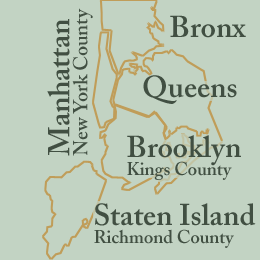
There are two kinds of enforcement officers: A Sheriff, who is a City of New York employee, and a City Marshal, who is not employed by the city but rather works independently. There is a deputy sheriff in each county, and there are many marshals. You can get a list of marshals from the clerk. You should contact an enforcement officer in the county where the judgment debtor has property. If you do not know where the judgment debtor has property, then contact an enforcement officer in the county where the judgment debtor resides.
When you contact an enforcement officer, ask him or her to request an ‘execution’ from the court. The execution allows the officer to seize a judgment debtor’s property or money. Before the officer can ask the court for an execution he or she must know what assets the judgment debtor has and where they can be found. It is your responsibility to provide this information. The enforcement officer will not look for the judgment debtor’s assets without your assistance.
You will have to pay certain fees for the enforcement officer’s services. For example, you must pay the enforcement officer’s milage fee in advance for a property execution, or up to $50.00 in advance for an income execution.
Sometimes these fees can be added to the amount of the judgment and will be paid by the judgment debtor. Also, if you reach a settlement with the judgment debtor after you hire an enforcement officer, you will not recover the fees already paid, and will be responsible to the enforcement officer for 5% of the settlement amount. This is true even if you negotiate the settlement without any assistance from the enforcement officer.
Locating the Judgment Debtor’s Assets
You can use an information subpoena to find a judgment debtor’s assets. An information subpoena is a legal document that requires a person, a corporation, some other business, or the judgment debtor him or herself to answer certain questions about where the judgment debtor’s assets can be found. There are two parts to an information subpoena: The court’s direction to the witness to provide answers to the questions submitted, and questions about the assets. An information subpoena can be served on the judgment debtor or on any person, corporation or business that you believe has information about the judgment debtor’s assets. Examples of these are an employer, a bank, a landlord, or the telephone or other utility company.
The Clerk will provide an information subpoena and set questions for a $3.00 fee. You can also purchase the necessary forms from a legal stationery store or copy the necessary forms from a legal forms book. These can be found in any law library. The information subpoena must be signed by the court clerk, so you must come to the court in any case. To learn where to go in your county, refer to Information Subpoenas. After the form is signed, you must serve the information subpoena, two copies of the written questions, and a stamped self-addressed envelope with the correct amount of postage to the person(s) or companies from whom you seek information by registered or certified mail, return receipt requested. For further instructions on how to properly serve the subpoena and to obtain an affidavit of service, refer to Instructions on Service of Information Subpoena and Affidavit of Service.
A simple way to improve the chances of collecting your judgment is to learn the name and address of the bank where the judgment debtor keeps a savings or checking account. One way of doing this is to look at the back of a cancelled check that you or a friend may have given to the him or her. With this information, the enforcement officer can seize the judgment debtor’s account and use the funds to satisfy the judgment.
After you have provided the enforcement officer with information on the judgment debtor’s assets, he or she can serve a restraining notice on the bank, or on some other person or business that owes money to the judgment debtor, and eventually take the money. If the judgment debtor is employed, the enforcement officer can garnish (take) a portion of his or her salary to satisfy the judgment.
You may also check with the Department of Motor vehicles to find out if the judgment debtor owns a car. If the judgment debtor owns a car, the enforcement officer can take the car and sell it to pay your judgment. You must give the enforcement officer the model, year, license plate and location of the car. If the judgment debtor borrowed money to buy the car, that loan must be paid out of the proceeds of the sale before you can get any money. Also, you will have to pay towing and storage fees in advance to the enforcement officer. These fees can typically be $150.00 or more.
You may also be entitled to suspend a judgment debtor’s driver’s license. If your small claims case was based on the judgment debtor’s ownership or operation of car, the Department of Motor Vehicles may suspend the judgment debtor’s driver’s license and registration privileges until the judgment is paid. The amount of the judgment must be more than $1000.00 and must be unpaid for more than 15 days. The clerk can give you more information on this method.
If your small claim relates to the judgment debtor’s business, and the business is licensed or certified by a state or local authority, you can notify that authority if your judgment is not paid within 35 days after the judgment debtor received notice of the judgment. Failure to pay a judgment may be considered by the licensing agency as grounds for revoking, suspending, or refusing to grant or renew a license to operate a business.
If the judgment debtor is a business that the court finds to be engaged in fraudulent or illegal conduct, you have the right to notify the attorney General, and, if the business is licensed, the appropriate licensing authority as well.
If the judgment debtor fails to pay three or more recorded judgments despite having sufficient resources to pay them, you may be able to sue the judgment debtor for triple damages. Check with the small claims clerk to find out if the judgment debtor is listed in the index of unsatisfied judgments maintained by the court. To find out where to go in your county, go to Locations.